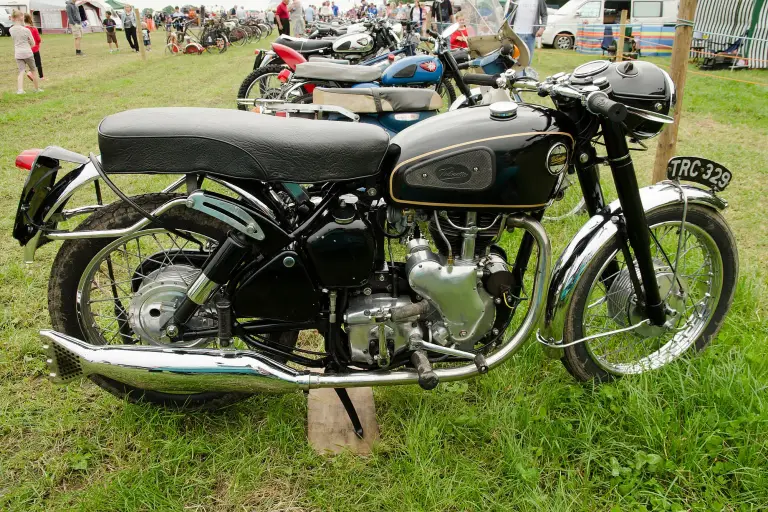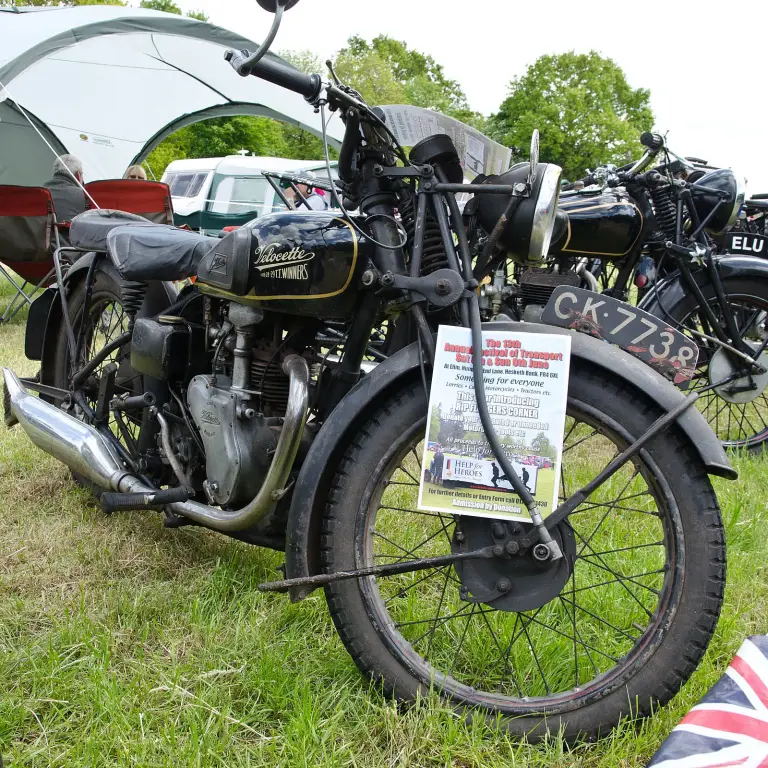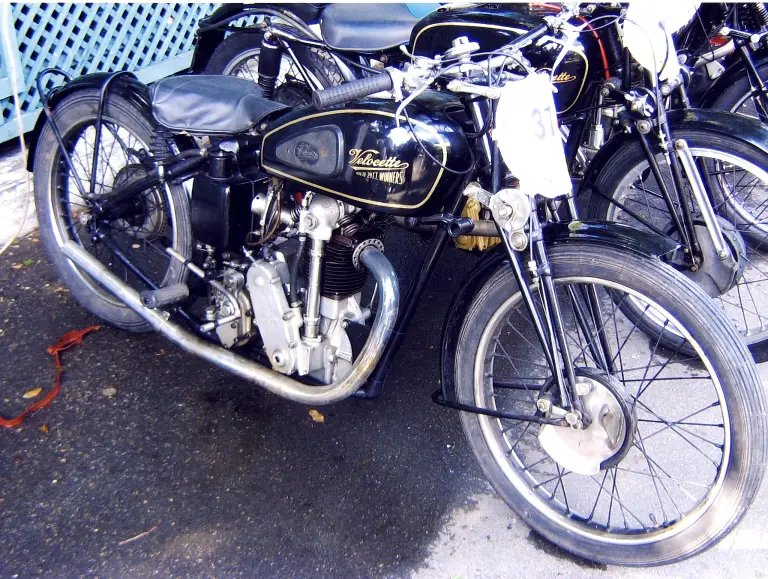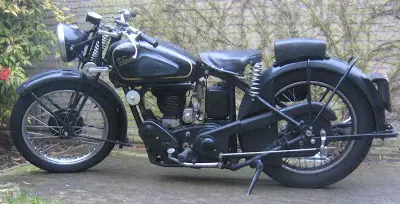
The Velocette MSS was a 500 cc overhead-valve single introduced in 1935 as a super-sports machine to rival the overhead-camshaft KSS. It continued in production until 1968 and, after the arrival of the Venom in 1955, became better known as a touring motorcycle and sidecar hauler.
Velocette MSS at a glance
| Maker | Veloce Ltd, Birmingham |
|---|---|
| Production | 1935–1968 |
| Class | 500 cc sports single |
| Engine | pushrod overhead-valve, high camshaft |
| Developed from | Velocette MOV 250 design |
| Frame to 1954 | rigid triangulated full loop, shared with the KSS |
| Forks | Webb girder; Dowty Oleomatic in 1948; Velocette telescopic in 1951 |
| 1954 update | swinging arm, square bore and stroke, alloy cylinder head |
| Scrambler | 1954, built mainly for the American market |
| Front wheel | 19-inch, against 21-inch on the KSS |
| Production ended | 1968 |
Based on one source: the English Wikipedia article on the MSS. No free photographs of the model were found, so the previous record image is kept.
History of the Velocette MSS
A cheaper way to 500 cc
The MSS was introduced in 1935 as a sports machine in the 500 cc class. Its engine was an enlarged version of the high-camshaft pushrod design developed by Veloce with help from the Australian designer Phil Irving, first used as the 250 cc MOV for 1934. The success of the MOV led to the 350 cc MAC and then to the MSS. The pushrod M series was a less expensive alternative to the overhead-camshaft K series, whose assembly demanded skilled labour; the MSS was meant to rival the sporting KSS, with similar performance and a near-identical chassis, although the KSS used a 21-inch front wheel and the MSS a 19-inch one.
Rigid frame and girder forks
From 1935 to 1954 the MSS used a simple triangulated full-loop rigid frame shared with the 350 cc overhead-camshaft KSS, with Webb girder forks. Production continued after the Second World War, with Dowty Oleomatic telescopic forks added in 1948 and Velocette’s own telescopic forks in 1951. For 1954 the model moved to a swinging-arm chassis and its engine was redesigned with a square bore and stroke and an aluminium alloy cylinder head.
The Scrambler
A Scrambler version of the MSS appeared in 1954, intended mainly for the American market to support off-road competition. It is identified by engine numbers ending in S and used the same swinging-arm frame as the standard MSS, but with double-damped telescopic forks, aluminium alloy mudguards and a smaller fuel tank. Its cylinder head had larger valves and a new camshaft, and it breathed through an Amal TT carburettor; that engine configuration was later used in the Venom, with near-100 mph performance.
Burt Munro and the end
Burt Munro of New Zealand, the subject of the film The World’s Fastest Indian, raced a heavily modified 1936 MSS. He made special pistons, altered the frame and increased the capacity to 650 cc, reaching 138 mph (222 km/h) and a quarter-mile time of 12.31 seconds. After the sporting Venom arrived in 1955 the moderately tuned MSS was better known for touring and sidecar work. Demand fell in the 1960s as buyers turned to super-sports machines, and production ended in 1968, three years before all Velocette production stopped in 1971.
Design and features
- Pushrod alternative: the M series was simpler and cheaper to build than the overhead-camshaft K series.
- KSS chassis: the rigid full-loop frame and girder forks were shared with the 350 cc KSS.
- Modernised in 1954: swinging arm, square engine dimensions and an aluminium cylinder head.
- Scrambler pedigree: its tuned engine layout went on to power the Venom.
- Long life: built from 1935 to 1968 with only gradual changes.
Velocette MSS versions
- MSS (1935–1954): rigid frame, Webb girder forks, 19-inch front wheel.
- Post-war MSS: Dowty Oleomatic forks in 1948, Velocette telescopic forks in 1951.
- 1954 MSS: swinging-arm frame, square bore and stroke, alloy head.
- MSS Scrambler (1954): off-road model for America with Amal TT carburettor.
- Later MSS: touring and sidecar machine after the Venom took over the sporting role.
The MSS was the parent of the Venom and Viper, and shared its frame with the K-series racers. More machines are in the Velocette collection.
Sources
- Velocette MSS, English Wikipedia: development, Scrambler, racing history