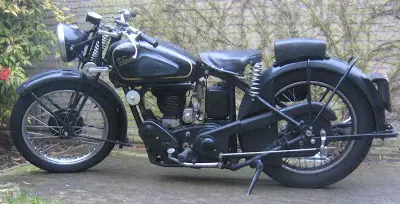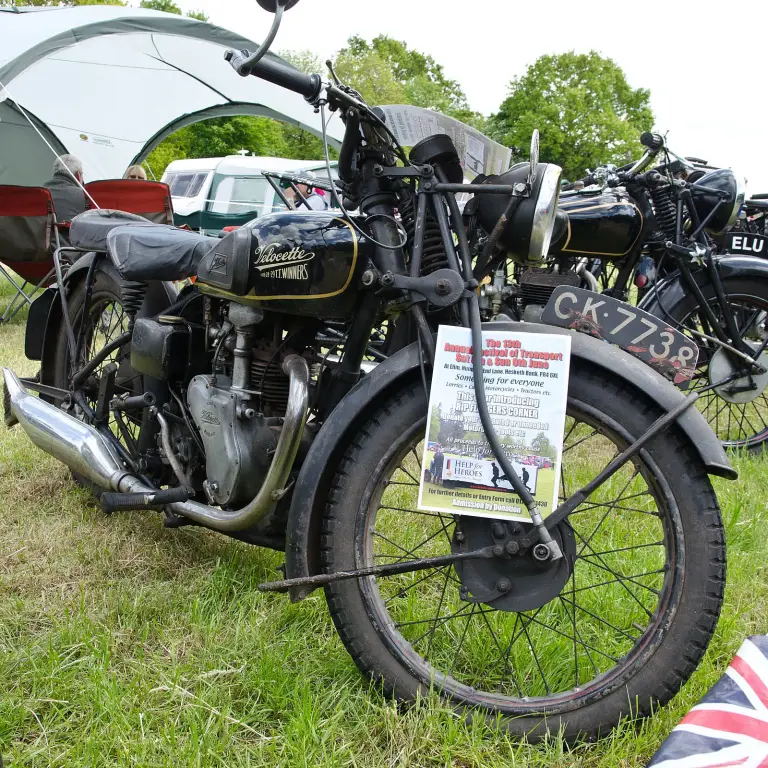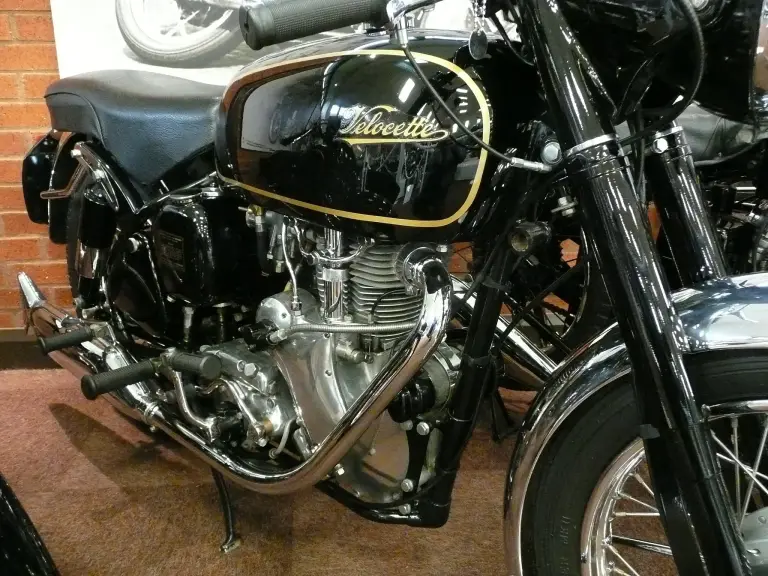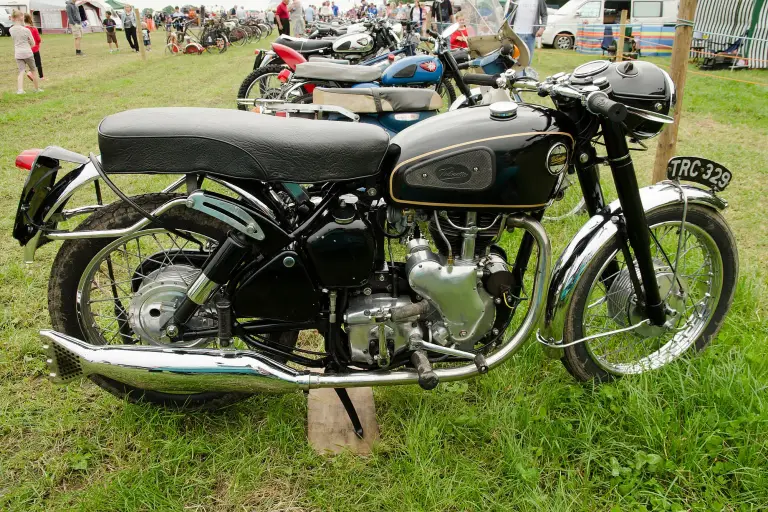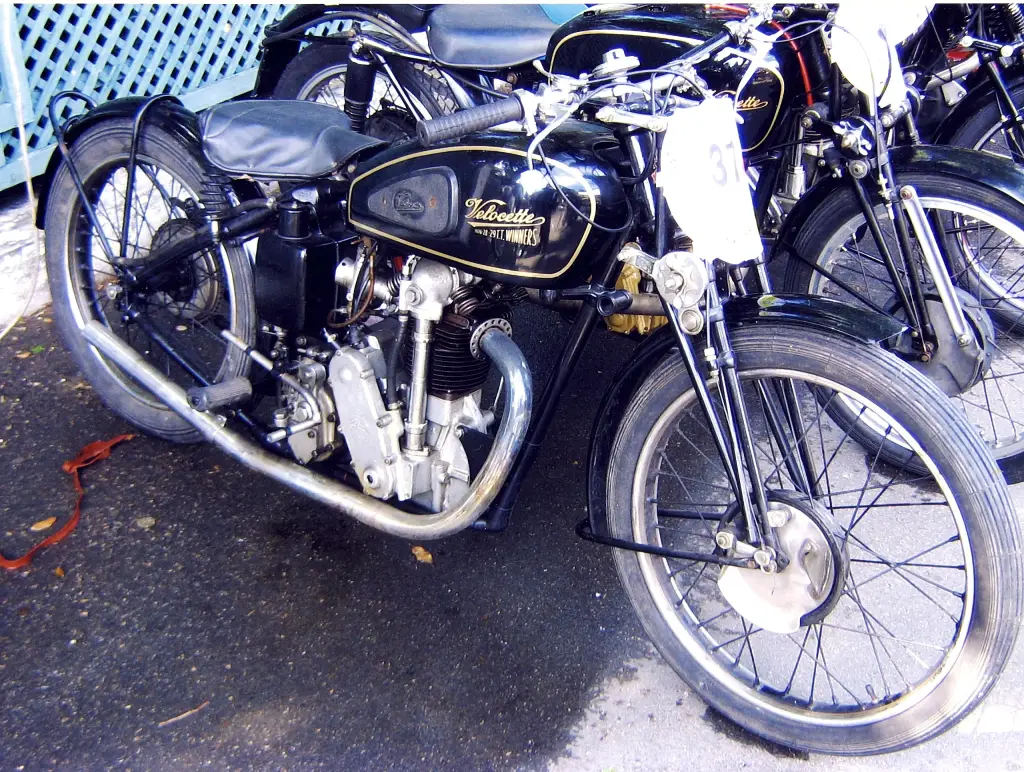
The Velocette KTT was the racing variant of the Model K, an overhead-camshaft 350 cc single made by Veloce Ltd in Birmingham. Developed by Percy and Eugene Goodman, sons of the founder, it gave Velocette its first Isle of Man TT win in 1926 and went on to become one of the most successful production racers of its time.
Velocette KTT at a glance
| Maker | Veloce Ltd, Birmingham |
|---|---|
| Production | 1929–1950 |
| Type | production racer, 350 cc |
| Engine | single-cylinder, overhead camshaft |
| Based on | Velocette KSS |
| First TT win | 1926, Alec Bennett |
| Foot gear change | 1928, the first positive-stop system |
| Full-cradle frame | Mark V, late 1935 |
| Swinging arm | Mark VIII, 1938 |
| Mark VIII production | to 1949, about 238 built |
| Total built | about 1,000 |
Based on one source: the English Wikipedia article on the KTT.
History of the Velocette KTT
A racer built for the Isle of Man
The KTT grew out of the Model K series. A racing version was built by Percy and Eugene Goodman in 1925, and after twelve months of development Velocette took its first TT victory in 1926, when Alec Bennett won with Gus Kuhn and Fred Povey also finishing in the first nine to give the factory the team prize. The TT designation marked the machine as intended for racing, although KTTs could also be ordered as road-legal motorcycles — an early example of a production racer.
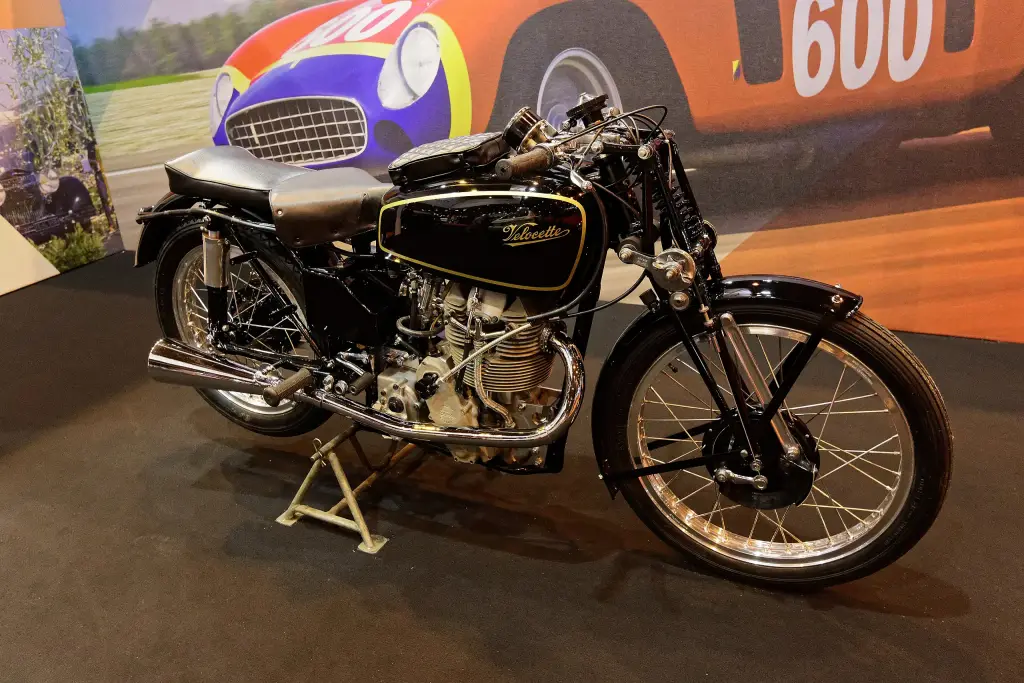
The Mark series
Work on the racer produced the first positive-stop foot gear change on a motorcycle in 1928: a mechanism that could change up or down with a single movement and return the lever to its position. Other makers had adapted hand levers for the foot, but none had designed a system like this, and it quickly replaced the hand change and became the standard arrangement on almost every motorcycle since. From 1929 the model was developed year by year in a Mark series, with the first year later designated Mark I.
New frames and engines
The first major change came in late 1935 with the Mark V, which used a new full-cradle frame in place of the open-bottom frame that had used the engine as a stressed member since 1929. Only an estimated six Mark VI machines were built in 1936, for selected riders; they were the first KTTs with an aluminium cylinder head. Stanley Woods joined the Veloce team, and his feedback shaped the 1937 Mark VII, whose engine was moved forward by about 1.5 inches for better handling and which received a larger aluminium head and barrel. Only 37 Mark VIIs were built.
The swinging-arm Mark VIII
After the factory team used swinging-arm rear suspension in 1937, Veloce introduced the Mark VIII in 1938. It was the first production motorcycle with a swinging-arm rear fork and enclosed suspension units, although these were oleo-pneumatic and used air as the springing medium. The system came from designer Harold Willis, who flew a light aircraft with Oleo suspension legs and obtained a special pair of air shocks from the Oleo company. Mark VIII production ended in 1949 after about 238 machines, and roughly 1,000 KTTs were built between 1929 and 1950.
Design and features
- Positive-stop foot change: the 1928 mechanism became the pattern for almost every motorcycle since.
- Early swinging arm: the 1938 Mark VIII was the first production motorcycle with enclosed swinging-arm suspension.
- Overhead-camshaft single: the 350 cc engine was derived from the Model K and its KSS road model.
- Production racer: customers could buy a works-derived machine, optionally in road-legal form.
- Full-cradle frame: introduced on the Mark V of 1935 and carried through the later Marks.
Velocette KTT versions
- Mark I–Mark V (1929–1935): the open-bottom frame with the engine as a stressed member.
- Mark VI (1936): about six built, the first with an aluminium cylinder head.
- Mark VII (1937): engine moved forward, larger head and barrel, 37 built.
- Mark VIII (1938–1949): swinging-arm rear suspension, about 238 built.
- Road-legal KTT: racing specification supplied with the equipment needed for the road.
The KTT was the racing member of the Model K family, alongside the road-going MSS and MAC. More machines are in the Velocette collection.
Sources
- Velocette KTT, English Wikipedia: development, Mark series, production