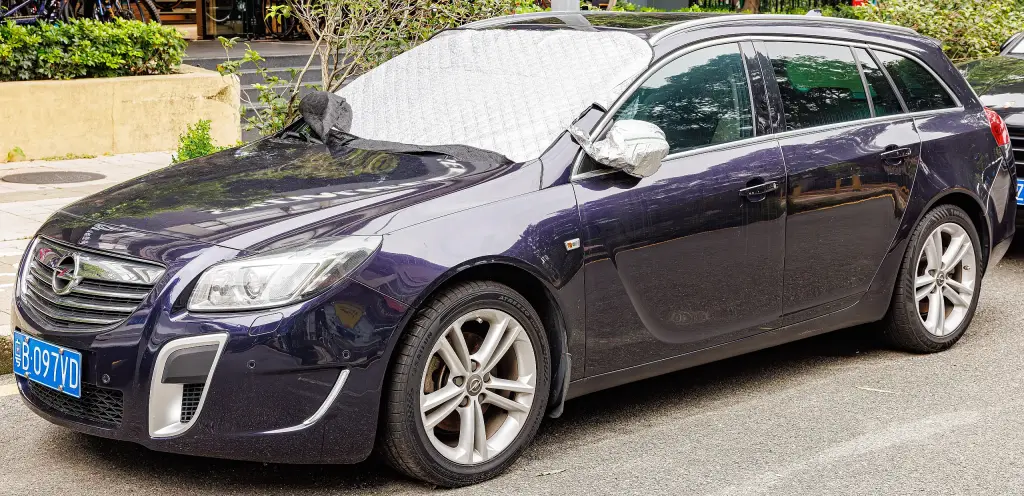
The Vauxhall Insignia was Vauxhall’s large family car from 2008 to 2022, replacing both the Vectra and the Signum under a single name. It was the first production car on General Motors’ Epsilon II platform, and the first Vauxhall to drop the traditional V grille.
Vauxhall Insignia at a glance
| Maker | Vauxhall (Opel Insignia on the continent) |
|---|---|
| Production | 2008–2022 |
| Debut | British International Motor Show, 23 July 2008 |
| On sale | October 2008, for the 2009 model year |
| Bodies | five-door liftback and Sports Tourer estate |
| Platform | GM Epsilon II, also used by the Saab 9-5 and Chevrolet Malibu |
| Length | 4.83 m saloon and liftback, 4.91 m estate |
| Wheelbase | 2.73 m |
| Hot model | Insignia OPC, 2.8 V6 turbo, 325 PS |
| Discontinued | 2022, without a successor |
Written from the English and German Wikipedia articles on the Opel Insignia; the Vauxhall car is the same model with a different badge.
History of the Vauxhall Insignia
In December 2006 Vauxhall announced that the Vectra name would be retired. General Motors Europe president Carl-Peter Forster said the new car would be “a radical departure” from the Vectra, and in late 2007 Vauxhall confirmed the name Insignia. With it Opel hoped to win back some of the market share the Omega had once held. The Insignia debuted as the Vauxhall Insignia at the British International Motor Show in London on 23 July 2008 and went on sale in October 2008 as the 2009 model, as a five-door liftback and a five-door estate called the Sports Tourer — a departure for Opel, which had traditionally called estates Caravan.
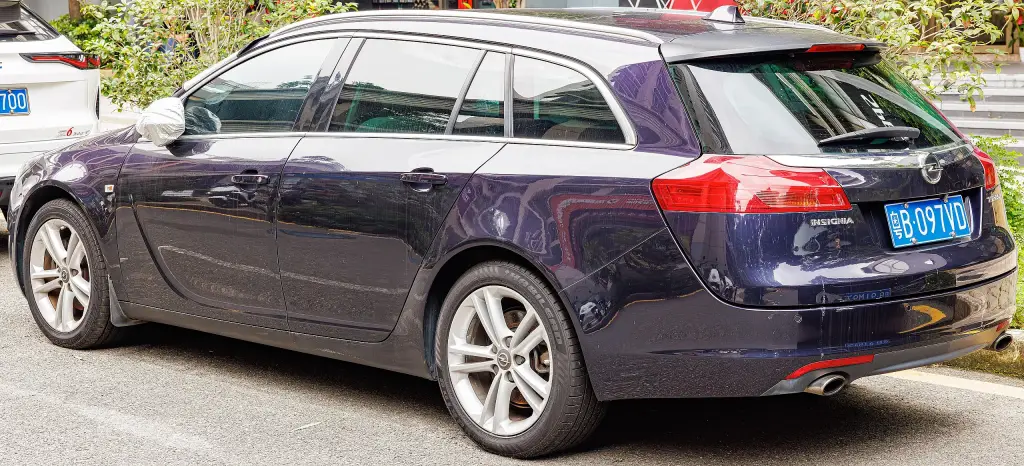
It was the first production car based on the Epsilon II platform, later used by the Saab 9-5 and Chevrolet Malibu, and it offered 30 mm more knee room than the Vectra. Saloon and liftback shared a length of 4.83 m, the estate was slightly longer at 4.91 m, and all three shared a 2.73 m wheelbase. The Insignia also introduced redesigned badges for Opel and Vauxhall; for Vauxhall it was the first car to dispense with the “V” grille that had marked its models since 1994 and helped distinguish them from otherwise identical Opels.
Safety technology was a selling point. Adaptive Forward Lighting used bi-xenon gas discharge lamps with variable beam distribution in width, direction and range, plus static cornering lights and LED daytime running lights, with sensors monitoring surroundings, traffic and weather. Opel Eye used a camera at the top of the windscreen to watch the road ahead, giving lane departure warning above 60 km/h and a traffic sign memory; the Insignia was the first production car with a dual-function frontal camera that could also recognise traffic signs.
In early 2009 Opel revealed the Insignia OPC, powered by a 2.8-litre single-turbo V6 of 325 PS and 435 Nm, 400 Nm of it from 2,000 rpm, with a six-speed manual or automatic and Saab’s Haldex active all-wheel drive. It had a modified MacPherson strut front suspension called HiPerStrut to reduce torque steer, an electronic limited-slip differential at the rear and FlexRide adaptive suspension with OPC, Sport and Normal settings; an OPC version of the Sports Tourer was also offered, and in April 2011 an OPC Unlimited without a speed limiter. A small number of Insignias, 17 of them, were modified by Erich Bitter and sold as the Bitter Insignia with the 2.8 Turbo engine and an all-leather interior. In February 2022 Opel confirmed that the Insignia would end production at the close of the year without a successor.
Design and features
- Two cars in one: the Insignia replaced both the Vectra and the Signum.
- New face: the first Vauxhall without the V grille since 1994.
- Opel Eye: lane departure warning and traffic sign recognition from one camera.
- OPC: the 325 PS V6 turbo with all-wheel drive and FlexRide.
- Sports Tourer: the estate that broke with Opel’s Caravan naming.
Vauxhall Insignia versions
- Insignia liftback (2008): the five-door main body style.
- Insignia Sports Tourer: the five-door estate.
- Insignia OPC (2009): 2.8 V6 turbo with all-wheel drive.
- Insignia OPC Unlimited (2011): the unlimitered version.
- Bitter Insignia: 17 luxury derivatives by Erich Bitter.
The Insignia replaced the Vectra and the Signum, and it sat above the Astra. More cars are in the Vauxhall collection.
Sources
- Opel Insignia, English Wikipedia: history, platform, safety, OPC, end of production
- Opel Insignia, German Wikipedia: model background