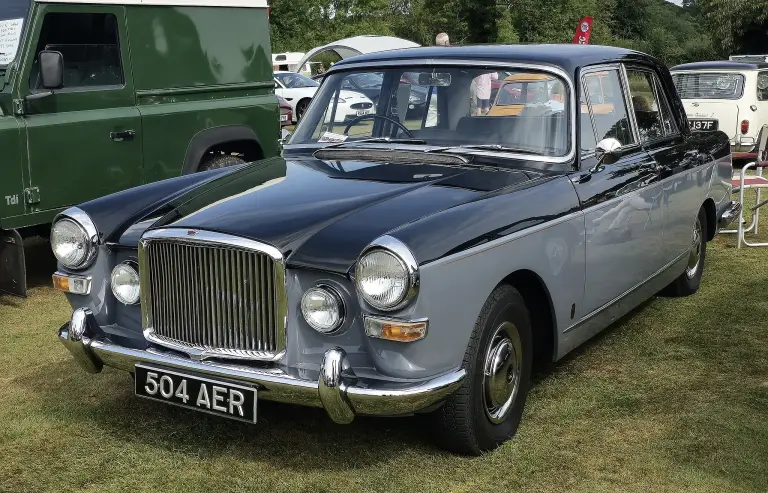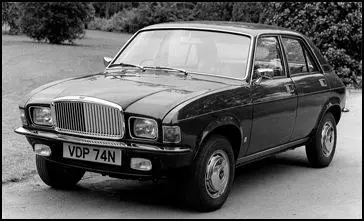
The Vanden Plas 1500 was the luxury version of the Austin Allegro, introduced by British Leyland in September 1974. It carried none of the Allegro badges: instead buyers got a prominent grille, a leather-and-walnut interior and a price of £1,951 against £1,159 for the basic car.
Vanden Plas 1500 at a glance
| Maker | British Leyland, Austin-Morris division |
|---|---|
| Introduced | September 1974 |
| Based on | Austin Allegro (ADO67) |
| Body | two- or four-door saloon |
| Engine | E-Series 1500 cc, later 1750 cc |
| Layout | front-wheel drive, Hydragas suspension |
| Price at launch | £1,951 against £1,159 for the Austin Allegro |
| Interior | leather seats, walnut fascia, walnut rear picnic tables |
| Steering wheel | conventional, never the Allegro’s quartic wheel |
| Boot | fully trimmed |
| Allegro production | 642,350 cars, 1973–1982 |
The Vanden Plas 1500 has no article of its own on English Wikipedia; it is described in the Austin Allegro article, which is the source for the details of the car.
History of the Vanden Plas 1500
The Austin Allegro arrived in 1973 as British Leyland’s replacement for the Austin 1100 and 1300. It was a two-box saloon with front-wheel drive, the familiar A-Series engine in the cheaper models and the overhead-camshaft E-Series unit of 1500 and 1750 cc in the more expensive ones, all riding on the new Hydragas suspension. Its rounded shape, the work of Harris Mann, had been altered before production to fit the taller E-Series engine and the heating system from the Morris Marina.
British Leyland had avoided the full badge engineering of the old ADO16 range, but in September 1974 it added an upmarket Allegro under the Vanden Plas name. This was the Vanden Plas 1500, also offered with automatic transmission, and the Allegro name was not used on it at all.
The car was aimed at buyers with traditional tastes. It had a prominent grille of its own at the front, while the interior was reworked with seats upholstered in real leather and reclining backrests, deep-pile carpets, extra sound insulation, a new instrument panel in walnut and walnut folding tables for rear passengers. There was a nylon headlining and a fully trimmed boot.
The Allegro started at £1,159 in 1974; the Vanden Plas 1500 was listed at £1,951, roughly two thirds more. The upmarket version also escaped one of the Allegro’s best-known features: although the owner’s manual showed it, the VP 1500 was never sold with the quartic steering wheel, which was dropped from the rest of the range in 1974. A 1750 version joined the range later, and the Vanden Plas treatment remained part of the Allegro line until production ended in 1982 after 642,350 cars.
Design and features
- Own grille: a prominent front end that marked the car out from an ordinary Allegro.
- Leather and walnut: real leather seats, a walnut fascia and walnut folding tables in the back.
- Quiet and trimmed: extra sound insulation, deep-pile carpets, nylon headlining and a fully trimmed boot.
- Conventional wheel: the Vanden Plas 1500 never used the Allegro’s quartic steering wheel.
- Choice of engines: 1500 cc at launch, with a 1750 cc version added later.
Vanden Plas 1500 versions
- Vanden Plas 1500 (1974): the original model with the 1500 cc E-Series engine.
- Vanden Plas 1500 automatic: offered from launch alongside the manual.
- Vanden Plas 1750: the larger engine added to the range later.
The same walnut-and-leather idea was applied to bigger BMC cars in the Vanden Plas Princess. More cars are in the Vanden Plas collection.
Sources
- Austin Allegro, English Wikipedia: Vanden Plas version, equipment, prices
- Austin Allegro, German Wikipedia: place of the Vanden Plas 1500/1750 in the range