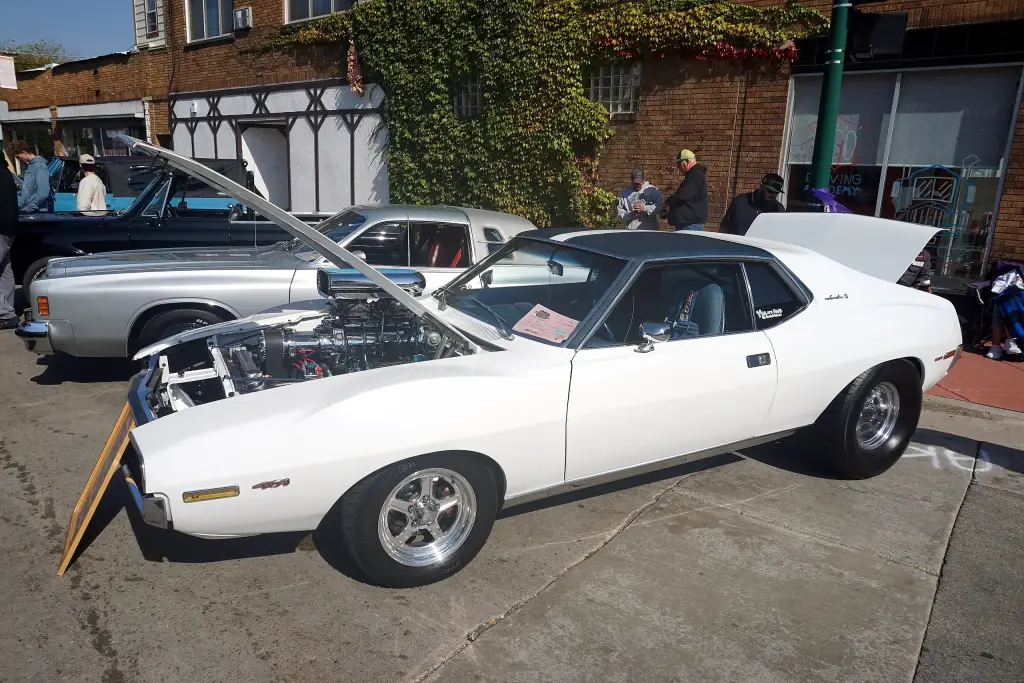
The VAM Javelin is the Mexican version of the AMC Javelin, the two-door hardtop with which American Motors entered the pony car market in 1968. Javelins were assembled under licence in Mexico by Vehículos Automotores Mexicanos (VAM) alongside the cars built in Kenosha, Wisconsin.
VAM Javelin at a glance
| Maker | American Motors Corporation (US); VAM, Mexico |
|---|---|
| Production | 1968–1970 and 1971–1974 |
| Class | pony car |
| Body | two-door hardtop |
| Layout | front engine, rear-wheel drive |
| Engines | 232 cu in (3.8 L) I6; 290 cu in (4.8 L) V8; 343 cu in (5.6 L) V8 |
| Price 1968 | from US$2,743 |
| Trans-Am titles | 1971, 1972, 1976 |
| Trims | base and SST |
| Assembly | Kenosha, Wisconsin; under licence in Mexico and other countries |
Based on one source: the English Wikipedia article on the AMC Javelin. It records assembly in Mexico but does not describe the VAM version in detail.
History of the VAM Javelin
American Motors entered the pony car market with the Javelin, a segment created by the Ford Mustang. The design evolved from two AMX prototypes shown on the company’s Project IV auto-show circuit in 1966. Because sales of convertibles were falling and AMC lacked the resources for separate fastback and notchback bodies, Dick Teague’s team penned a single semi-fastback two-door hardtop on the compact Rambler American platform.
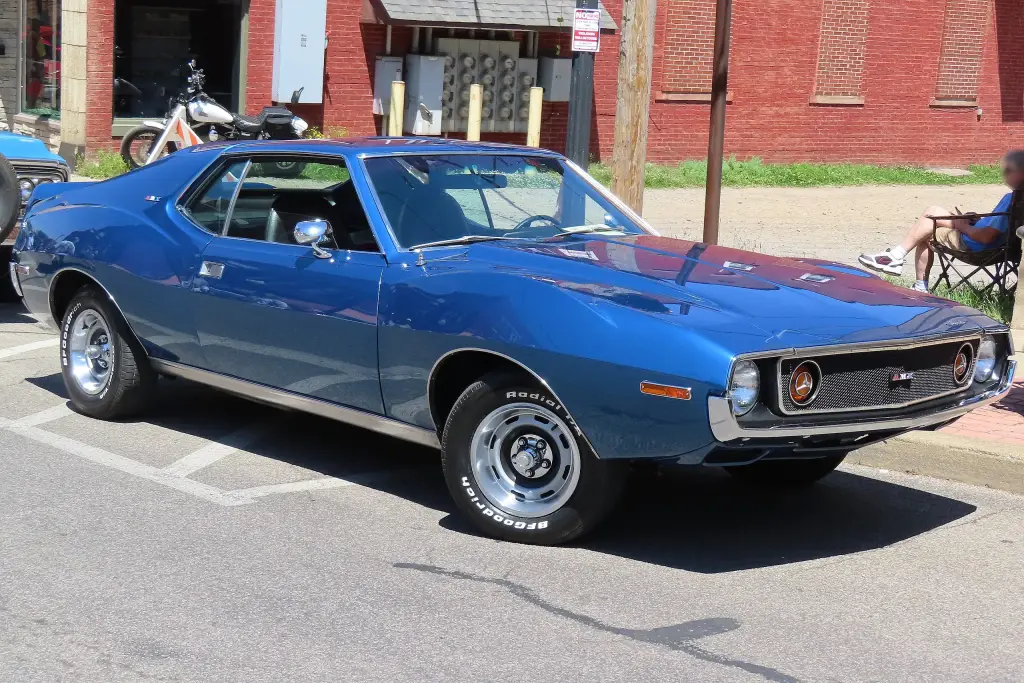
The Javelin debuted on 22 August 1967 for the 1968 model year and went on sale on 26 September 1967, with prices starting at US$2,743. It carried several safety innovations, including what AMC called the first industry use of fibreglass safety padding on the interior windshield posts, flush-mounted paddle-style door handles, exterior side marker lights, three-point seat belts and front headrests. The interior was deliberately free of bright trim to reduce glare.
Buyers chose between the base Javelin and the more luxurious SST, which added reclining front seatbacks, upgraded upholstery, simulated wood-grain door trim, a sports steering wheel and bright exterior trim. The standard engine was a 232 cu in (3.8 L) straight-six; a 290 cu in (4.8 L) V8 and a 343 cu in (5.6 L) V8 were optional. The “Go Package” combined the four-barrel 343 with power front disc brakes, heavy-duty suspension, dual exhausts, body-side stripes and Magnum 500 wheels, and could reach 60 mph in eight seconds.
The Javelin won the Trans-Am race series in 1971, 1972 and 1976, and the second-generation AMX version was the first pony car used as a standard highway police car by an American law-enforcement agency. The model was built in two generations, 1968–1970 and 1971–1974, and was also assembled under licence in Germany, Mexico, the Philippines, Venezuela and Australia. In Mexico the local cars were sold by VAM as the VAM Javelin.
Design and features
- Twin-venturi grille: a recessed honeycomb grille with outboard headlamps and turn signals set into the bumper.
- Raked windshield: the glass was set at 59 degrees for a sporty profile.
- Safety equipment: padded windshield posts, side marker lights, three-point belts and headrests.
- Comfortable cabin: thin-shell bucket seats, a fully carpeted interior and a 10.2 cu ft boot.
- Go Package: a 343 V8 with disc brakes, uprated suspension, dual exhausts and stripes.
VAM Javelin versions
- Base (1968–1970): the standard Javelin with a 232 six.
- SST (1968–1970): the more luxurious trim with reclining seats and extra brightwork.
- Go Package: the performance option with the 343 V8 and chassis upgrades.
- Second generation (1971–1974): the redesigned Javelin.
- AMX (second generation): the high-performance variant of the Javelin.
- VAM Javelin: Mexican assembly by Vehículos Automotores Mexicanos.
The Javelin shared its compact platform with the VAM American and sat above the VAM Gremlin. More cars are in the VAM collection.
Video: VAM 1972 Javelin
Video on YouTube.
Sources
- AMC Javelin, English Wikipedia: development, launch, engines, safety equipment, racing, licensed assembly