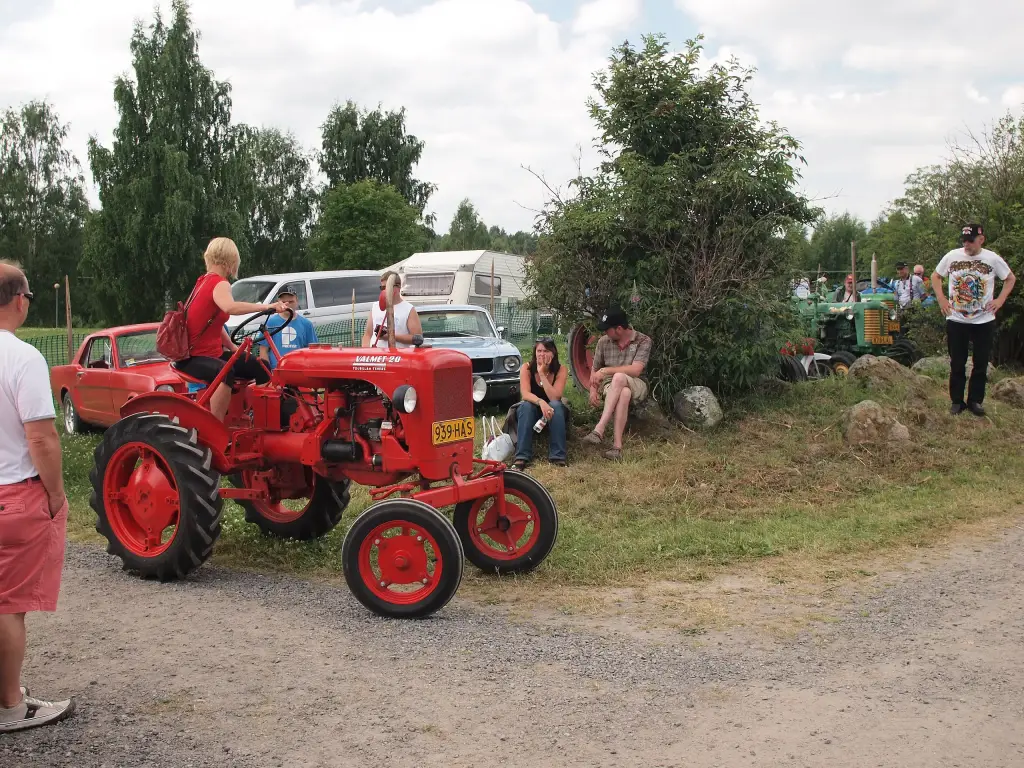
The Valmet 20 was the second tractor model built by Valmet, introduced in 1955 as a more powerful development of the Valmet 15. It was designed for the small Finnish farms of the 1950s, and its modest power earned it the nickname “piikkilangankiristäjä” — barbed-wire tightener.
Valmet 20 at a glance
| Maker | Valmet, Tourula plant, Jyväskylä |
|---|---|
| Production | 1955–1963 |
| Predecessor | Valmet 15 |
| Engine | four-cylinder petrol, 1,414 cm³ |
| Power | 22 hp |
| Fuel tank | 26 litres (20 MT: 30 litres) |
| Weight | just over 100 kg more than the Valmet 15 |
| Colour | bright red (Miranol 0273) |
| Industrial version | Valmet 20 MT, 20 built |
| Built | 9,800 Valmet 15 and 20 together |
Based on the Finnish Wikipedia article on the Valmet 20; company history from the English Valtra article.
History of the Valmet 20
In the early 1950s Finland still had about 250,000 farms, most of them no larger than 25 hectares, and the tractor had to be light enough for soft fields and able to pull a 14–16 inch single-furrow plough. The Valmet 20 was developed from the Valmet 15, whose basis was a prototype known as Pikku-jehu. In 1953 Valmet arranged sales of the tractor model with Hankkija, Labor and OTK. By 1954 a total of 2,000 Valmet 15 and Valmet 20 tractors had been built; during 1955 alone 2,082 Valmet 20s were made, 55 of them exported to Turkey. Production of the two models ended in 1963, although the tractors dated 1963 had already been built in 1962.
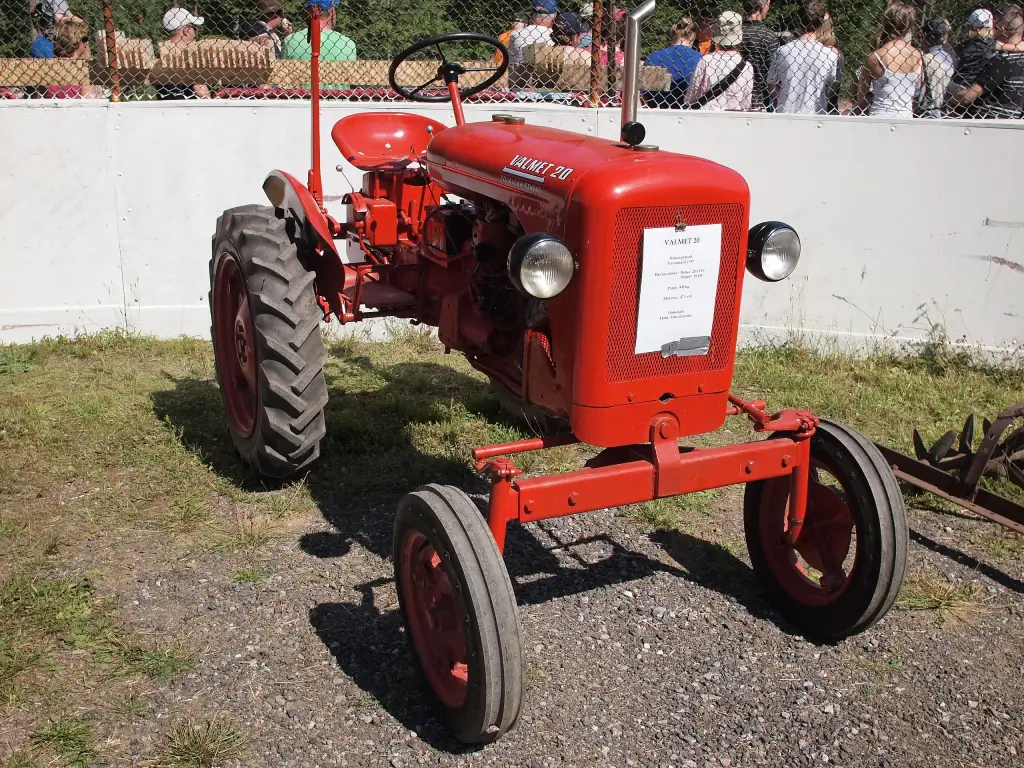
The tractor was built by the State Rifle Factory (Valtion Kivääritehdas), later the Valmet Tourula plant. In the first years the State Agricultural Machinery Research Institute criticised the Valmet against North American tractors: engine power was not up to the level of its competitors, but the machine was famous for its lightness and agility.
The Valmet 15 and Valmet 20 looked almost identical. They can be told apart by the track rod, which on the 15 runs in front of the front axle and on the 20 behind it; the 20 also received a beam-type front axle and three engine mounting bolts per side instead of two. The Valmet 20 is a little over 100 kg heavier than its predecessor, and both were painted bright red.
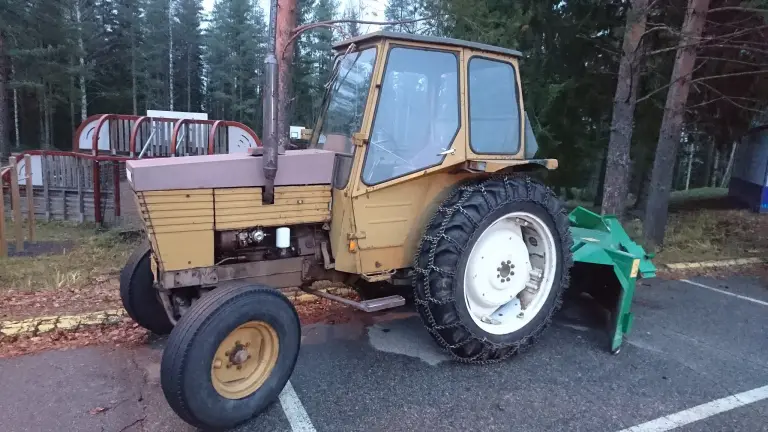
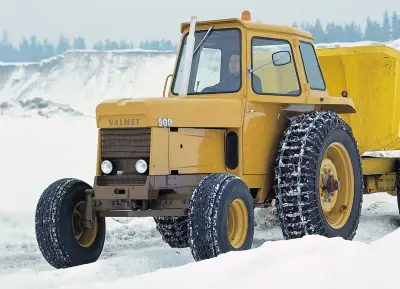
A small industrial series was also built: the Valmet 20 MT, 20 tractors made between 1955 and 1963. It was distinguished by the letters MT, a yellowish colour instead of the usual red, and a much lower build than the agricultural model. At least four genuine MT tractors are believed to survive, one of them displayed at Valmet’s Linnavuori plant.
Design and features
- Built for small farms: light and agile, sized for fields of up to about 25 hectares.
- Petrol engine: a four-cylinder 1,414 cm³ unit of 22 hp.
- Simple equipment: a mechanical lift was part of the standard specification.
- Easy to identify: beam front axle and the track rod behind the axle distinguish it from the Valmet 15.
Valmet 20 versions
- Valmet 20 (1955–1963): the standard agricultural tractor.
- Valmet 20 MT (1955–1963): low-built industrial version, 20 examples, painted yellow.
- Export batch: 55 of the 1955 tractors went to Turkey.
The Valmet 20 was followed in the range by the diesel-engined Valmet 359 D, and its small-farm role passed to the Valmet 565. More tractors are in the Valmet collection.
Video: [fi] – Valmet 20 (talvi)
Video on YouTube.
Sources
- Valmet 20, Finnish Wikipedia: development, production figures, differences, MT version
- Valtra, English Wikipedia: company history and the place of the Valmet 20 in the range
- Valmet (traktori), Finnish Wikipedia: model list and production years