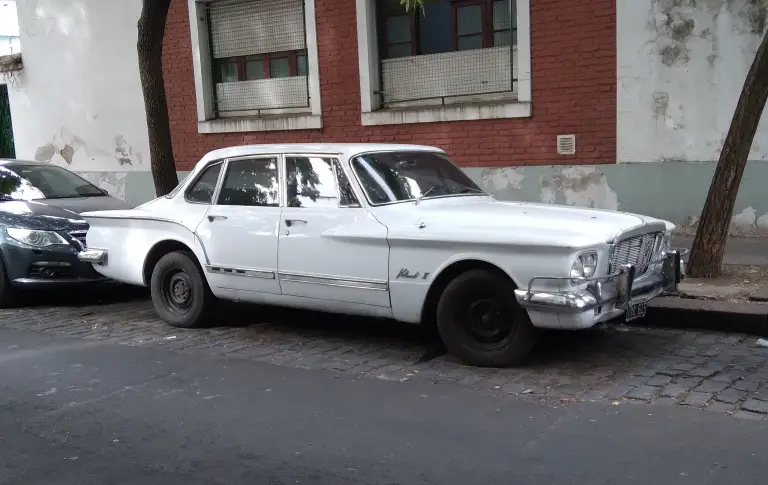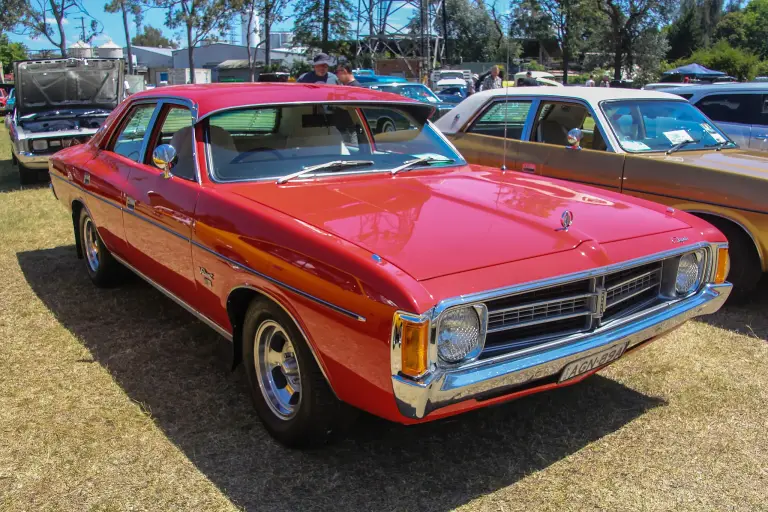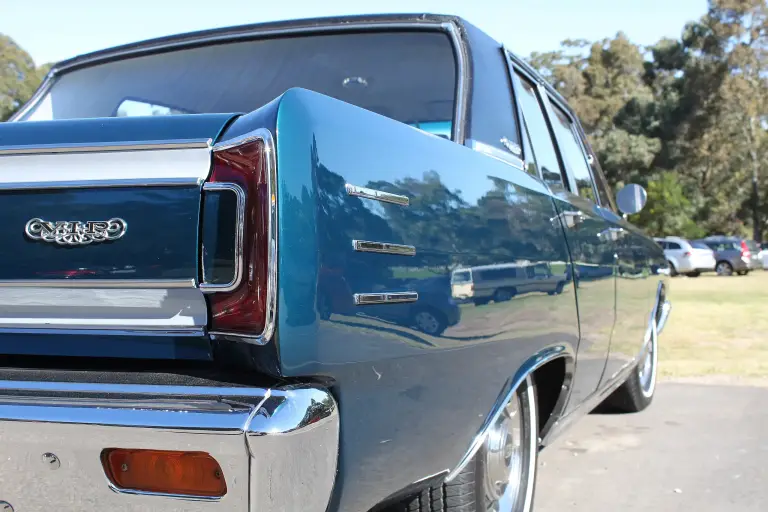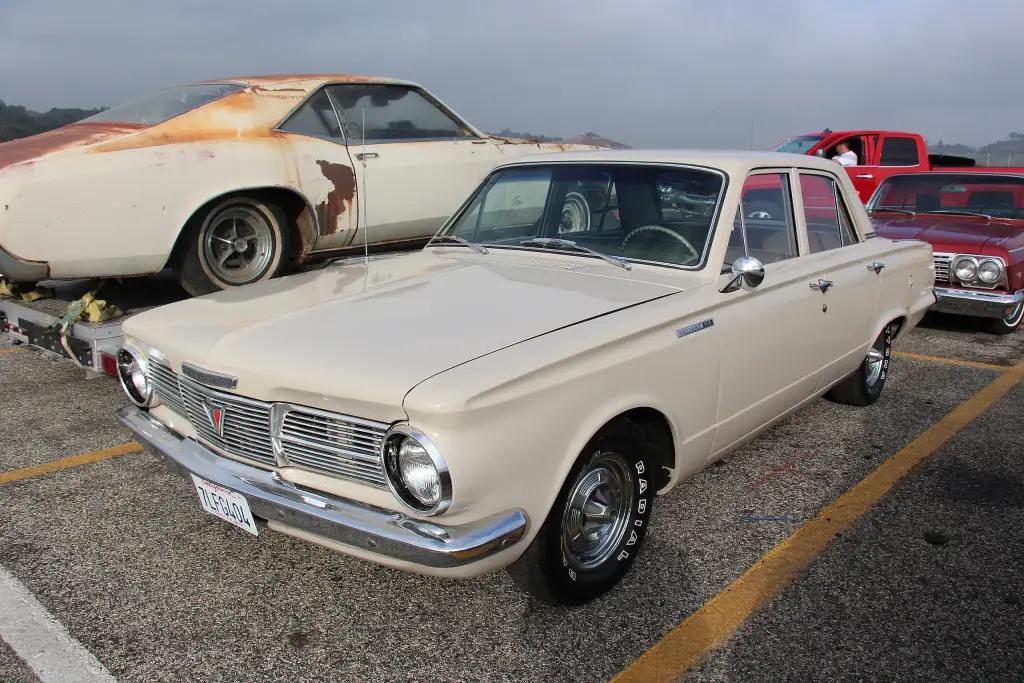
The Plymouth Valiant was the compact car with which Chrysler answered the Volkswagen Beetle, the Rambler and the coming compacts from Ford and General Motors. For 1963 it was completely reskinned, and in the V-100, V-200 and Signet trim levels it carried the Valiant through to the end of the 1966 model year.
Plymouth Valiant V-100 and V-200 at a glance
| Maker | Plymouth division, Chrysler Corporation |
|---|---|
| Production | 1963–1966 (second generation) |
| Body styles | two- and four-door saloon, two-door hardtop, convertible, four-door estate |
| Trim levels | Valiant V-100 (basic), V-200, Signet (premium) |
| Engines | 170 cu in six, 225 cu in slant-six, 273 cu in V8 from mid-1964 |
| Power, V8 | 180 bhp; 235 bhp Commando 273 from 1965 |
| Wheelbase | 106 in (2,700 mm) |
| Gearbox | three-speed manual; A833 four-speed manual with Hurst shifter |
| Differential | Sure-Grip limited-slip offered as an option |
| Sales, 1963 | 225,056 |
| Rallying | SCCA Manufacturers Rally Championships, 1965 and 1966 |
This page is based on one source, the English Wikipedia article on the Plymouth Valiant, whose second-generation section covers the V-100, V-200 and Signet.
History of the Plymouth Valiant V-100 and V-200
A new body for 1963
The Valiant had appeared in 1960 as a brand of its own, following a design by Virgil Exner and a debut at the British International Motor Show in London on 26 October 1959; from 1961 it was classified as a Plymouth and from 1964 it was sold in the United States only as a Plymouth Valiant. For 1963 the car was totally reskinned with a wheelbase 0.5 in (13 mm) shorter, a wide flat bonnet and a flat, square rear deck. The upper feature line ran from the rear body in a gentle sweep to the front wing tip, where it was veed back and down. The roof was flatter and sharper in profile, and the grille was a variation of the inverted trapezoid used on contemporary Chryslers, with a fine mesh insert. The range covered two-door hardtop and convertible, two- and four-door saloons and a four-door estate; the hardtop and convertible came only in the high V-200 and premium Signet trim levels. The optional 225 cu in slant-six was at first offered with the die-cast aluminium block introduced in late 1961, but early in the 1963 model year the aluminium block was dropped and both the 170 and the 225 were sold with iron blocks only. In December 1962 Plymouth offered its first vinyl-covered roof, an option on the Signet.
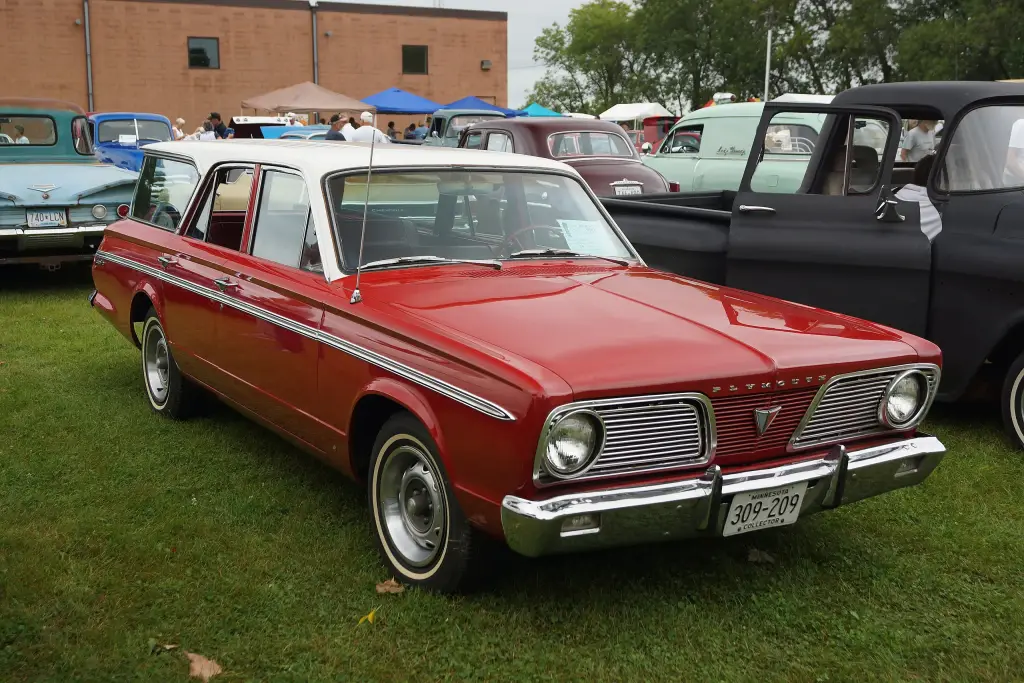
The new body was much better received than the original: sales for 1963 rose to 225,056. The Valiant was sold in Mexico as a Chrysler Valiant from that year, and in the United States it was now paired with the Dodge Dart, which replaced the Lancer.
The 273 V8 and the sporting Valiants
In mid-1964 Chrysler released an all-new 273 cu in (4.5 L) V8 as an option on all Valiants. With solid tappets, it was the first engine of Chrysler’s LA range and was engineered to fit the compact A-body engine bay; cars so equipped carried V-shaped emblems on the sides of the cowl. With 180 bhp the Valiant became the lowest-priced V8 automobile in the world. For 1965 a hotter 235 bhp version called the Commando 273 was offered, with 10.5:1 compression, a four-barrel carburettor, a performance camshaft and a low-restriction exhaust. The new Chrysler A833 four-speed manual gearbox came with a Hurst shifter, and the Sure-Grip limited-slip differential was added to the option list. Plymouth also supported a team of Valiant two-door saloons that won the SCCA Manufacturers Rally Championships in 1965 and 1966.
1964 to 1966 changes
The 1964 Valiant had a restyled front with a new horizontal-bar grille and a Valiant medallion in a flat bulge at its centre; vertical tail lamps replaced the horizontal items and the ring-shaped rear deck decoration gave way to a Valiant script in the right-hand corner. There were few styling changes for 1965, but the 1966 cars were altered more visibly, with a split grille and a fine-patterned insert, new front wings, new rear wings on the saloons, a bevelled-edge boot lid, a heavier rear bumper and a new roof line with a large rear window.
Design and features
- Slant-six: the 225 cu in six was canted 30 degrees to the right, which allowed a lower bonnet line.
- Cheap V8: the 273 of 1964 made the Valiant the lowest-priced V8 car in the world.
- Four-speed option: the A833 gearbox with a Hurst shifter arrived with the V8 era.
- Rally success: works Valiant two-door saloons took the SCCA Manufacturers Rally Championships in 1965 and 1966.
Plymouth Valiant V-100 and V-200 versions
- V-100: the basic trim, offered in the simpler body styles.
- V-200: the higher trim, available with the hardtop and convertible bodies.
- Signet: the premium trim, with the hardtop and convertible and the first Plymouth vinyl roof.
- Commando 273 (1965): the 235 bhp version of the V8.
- 1966 cars: split grille, new wings and a new roof line with a large rear window.
The Argentine branch of the same car is described in Valiant (Argentina), and the Australian Valiants in Chrysler Valiant VIP and Chrysler Valiant VK Regal. More cars are in the Valiant collection.
Video: 1966 Plymouth Valiant V-100 with the 225 slant-six
Video by Ulf Karlsson on YouTube.
Sources
- Plymouth Valiant, English Wikipedia: second generation, engines, trim levels, changes