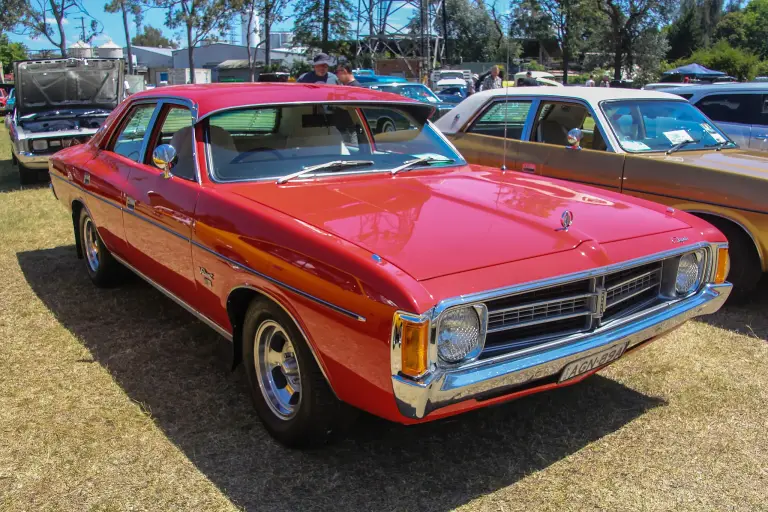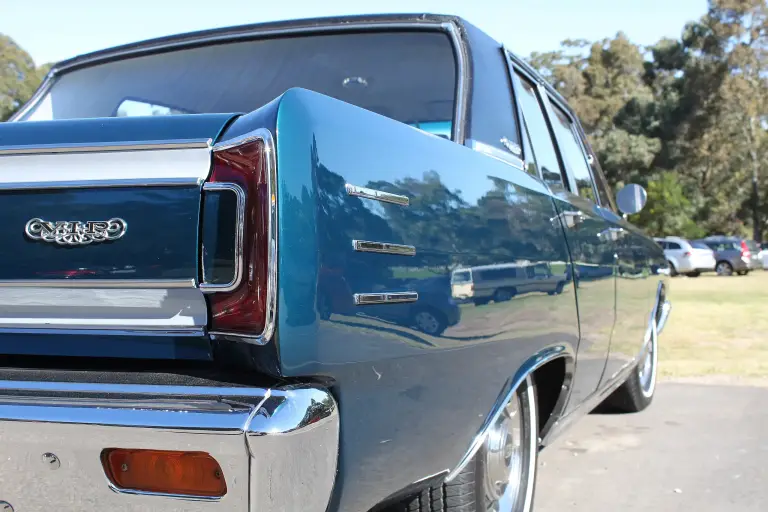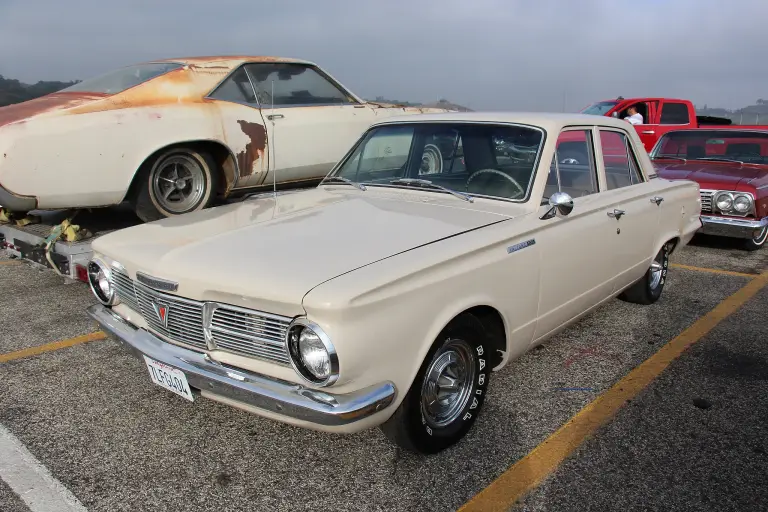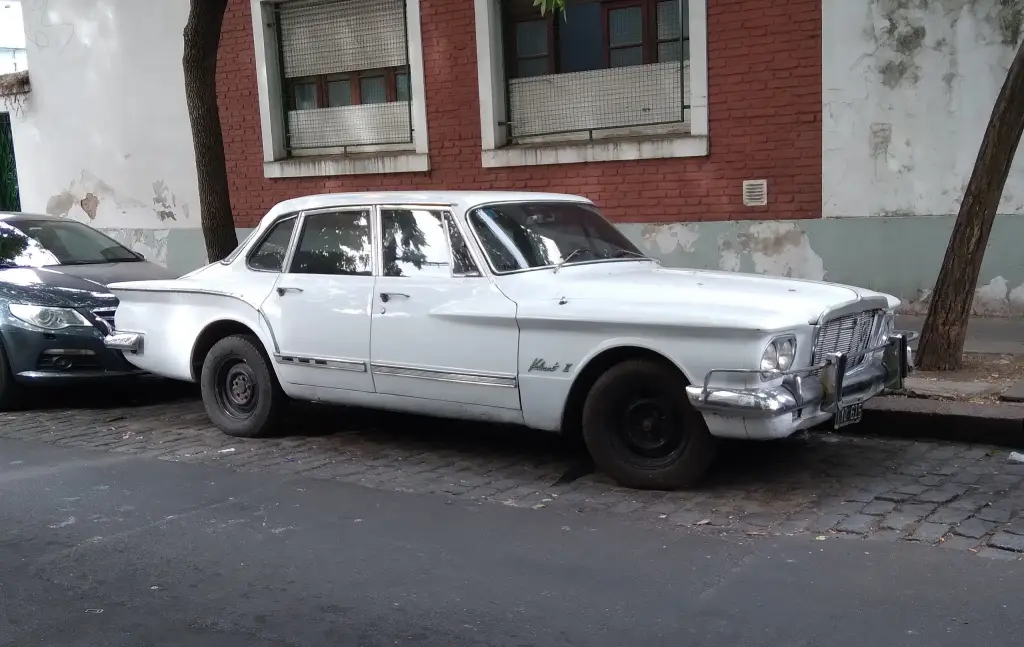
The Valiant was a line of four compact saloons built and sold in Argentina by Chrysler-Fevre Argentina S.A., the national subsidiary of the Chrysler Corporation, between 1962 and 1968. The first two generations were based on the American Plymouth Valiant, the third and fourth on the second-generation Dodge Dart. In Argentina the name was used as a marque in its own right, not as a Plymouth model.
Valiant (Argentina) at a glance
| Maker | Chrysler-Fevre Argentina S.A. |
|---|---|
| Production | 1962–1968 |
| Models | Valiant I (V-200), Valiant II, Valiant III, Valiant IV |
| Based on | Plymouth Valiant (I and II); Dodge Dart (III and IV) |
| Assembly | CKD at first; fully Argentine production from 1963 |
| Engine, Valiant I | 2,790 cc slant-six, 100 hp at 4,400 rpm |
| Engine, Valiant II | 3,687 cc slant-six, 139 hp at 4,500 rpm |
| Top speed | 155 km/h (Valiant I); 160 km/h (Valiant II) |
| Gearbox | three-speed manual |
| Wheelbase, Valiant III | 2,819 mm |
| Sport version | Valiant III GT, 180 hp at 4,800 rpm |
| Replaced by | the Dodge line, 1968 |
The Argentine Valiant has no English Wikipedia article; the history and technical data here come from the Spanish article on the line, with the English article on the Plymouth Valiant for the origin of the model. The Spanish article is the only source for the Argentine production details.
History of the Valiant (Argentina)
From imported cars to local assembly
Chrysler had agreed in 1959 with the firm of Julio Fevre and Diego Basset, and Chrysler Argentina S.A. was set up the same year. Local production began in 1960 with D-100 pick-ups and D-400 trucks sold under the Dodge, Fargo and De Soto names. The compact car project took shape in 1961, when the Ford Falcon and the Rambler line from Industrias Kaiser Argentina showed that a small car was needed. Chrysler chose the first-generation Plymouth Valiant, already being sold in Australia as the Chrysler Valiant SV1, and decided to market it in Argentina simply as a «Valiant», turning the name into a marque of its own. Of the two American versions, the basic V-100 and the better equipped V-200, the V-200 was chosen for production.
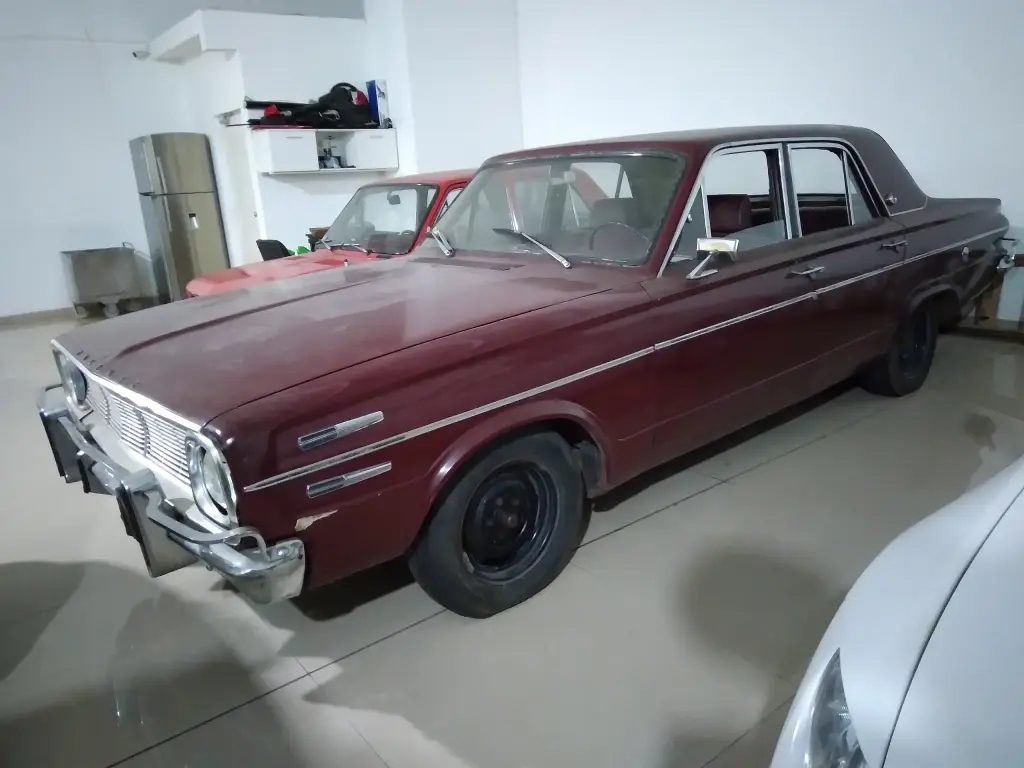
The Valiant V-200, known colloquially as the Valiant I, was presented on 3 October 1962. It was a four-door saloon with two rows of bench seats for six people, and its fins, low height and sloping rear window made a strong impression on the Argentine market. The engine was a 2,790 cc Chrysler Slant-6 inclined 30 degrees to the right of the centre line, which allowed a low bonnet; it drove through a three-speed gearbox with a column lever and gave 100 hp at 4,400 rpm and a claimed 155 km/h. The car was assembled from CKD kits, because the engine and gearbox were still imported from the United States. Production ended in 1963.
Valiant II and full national production
In 1963 Chrysler-Fevre decided to nationalise production completely. The V-200 gave way to the Valiant II, built entirely in Argentina. Its main novelty was a larger 3,687 cc Slant-6, again inclined 30 degrees, with 139 hp at 4,500 rpm and a top speed of 160 km/h, coupled to a three-speed gearbox with synchromesh on second and third that was now made locally. The Valiant II was also the first Argentine production car with a 12-volt alternator. Otherwise it kept the body and most of the specification of the V-200, and its short production run, which ended in 1964, made it a transitional model.
Valiant III, IV and the end
The Valiant III arrived in 1964 with the mechanics of the Valiant II but a new body derived from the American Dodge Dart and a wheelbase of 2,819 mm, longer than that of the second-generation American Valiant. In June 1965 the range grew with two versions: the Valiant III Coronado, a luxury model with a vinyl-covered rear roof section, a metallic grey front roof and servo brakes as standard, and the Valiant III GT, a sporting model with higher compression, two Holley RX 7000 A carburettors on a special manifold, 180 hp (134 kW) at 4,800 rpm, a floor-mounted gearbox and a shorter 3.31:1 differential. The GT was the most powerful six-cylinder car Chrysler built in Argentina; another Chrysler six came close to its output only about ten years later, with the Dodge Polara RT.
The Valiant IV was presented in May 1966 and closely resembled the Dodge Dart sold in the United States from that year. Two years later the whole Valiant line was replaced by the new Dodge range. The name was briefly reused in 1968 for the Dodge Valiant, a transitional model between the old Valiant line and the new Dodge Polara. The Valiant also raced in Turismo Carretera: it appeared in 1962 alongside the Ford Falcon and the Chevrolet 400, Rubén Luis di Palma was among its first drivers, Carlos Löeffel was the only driver to win with a Valiant II, and late in the decade modified prototypes used Valiant III chassis.
Design and features
- Slant-6 at 30 degrees: the inclined six allowed a low bonnet and was kept by Chrysler Argentina until 1979.
- First with an alternator: the Valiant II of 1963 was the first Argentine production car with a 12-volt alternator.
- Local production: from 1963 the cars were made entirely in Argentina instead of being assembled from imported kits.
- Coronado and GT: from 1965 the range offered a luxury version and a 180 hp sporting one.
Valiant (Argentina) versions
- Valiant I / V-200 (1962–1963): the first model, with the imported 2,790 cc engine.
- Valiant II (1963–1964): fully national production and the 3,687 cc engine.
- Valiant III (1964–1966): Dodge Dart-based body and a longer wheelbase.
- Valiant III Coronado (1965): luxury version with vinyl roof and servo brakes.
- Valiant III GT (1965): 180 hp sporting version with two carburettors.
- Valiant IV (1966–1968): the last of the line, close to the 1966 Dodge Dart.
The American car the first two generations were based on is described in Plymouth Valiant V-100 and V-200; the Australian branches of the name are in Chrysler Valiant VIP and Chrysler Valiant VK Regal. More cars are in the Valiant collection.
Video: Valiant III 1964
Video by Pablo Mastrolorenzo on YouTube.
Sources
- Valiant (automóvil), Spanish Wikipedia: history, models, engines, racing
- Plymouth Valiant, English Wikipedia: origin of the model and the slant-six