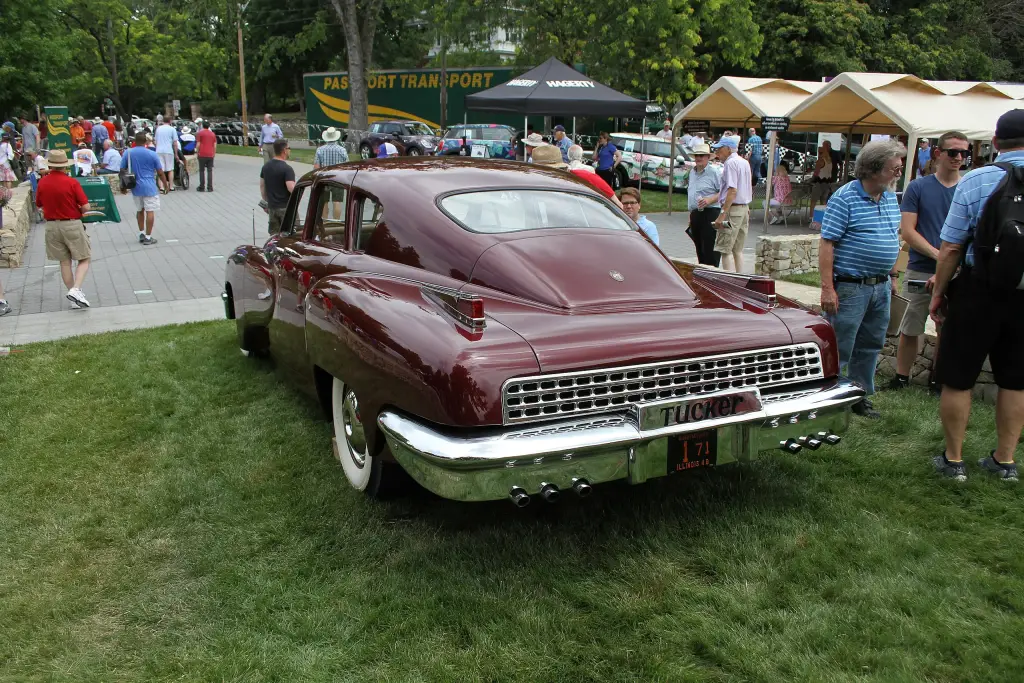
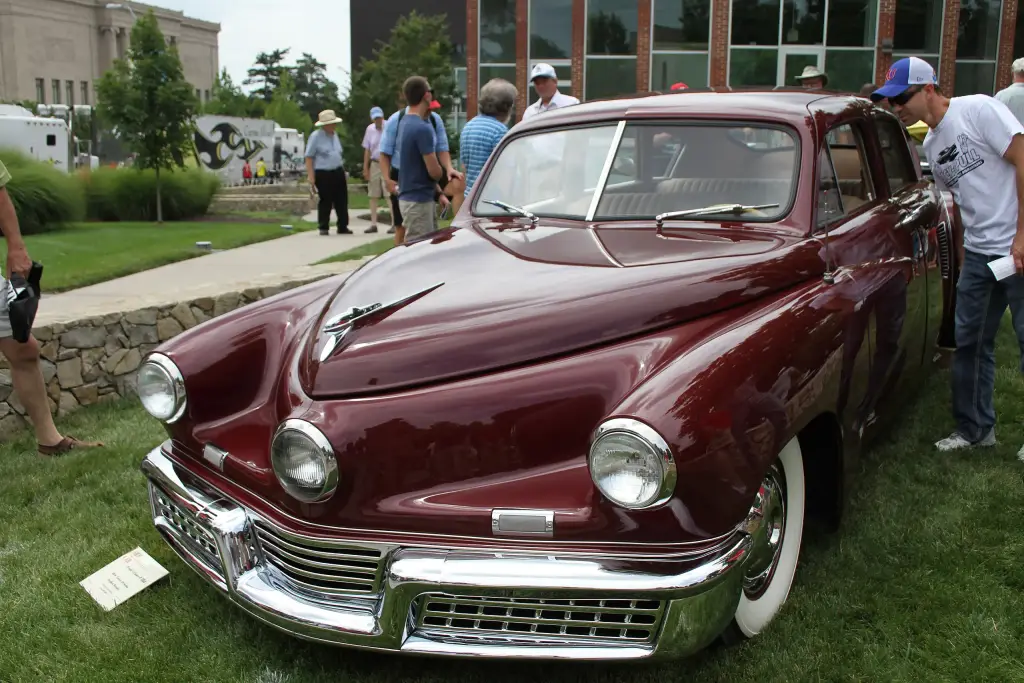
The Tucker 48 was the only model of the Tucker Corporation, conceived by Preston Tucker and built in Chicago in 1948. It combined a rear-mounted flat-six, disc brakes, independent suspension and a central third headlamp that turned with the steering. Only 51 cars were made before the company ceased operations on 3 March 1949.
Tucker 48 at a glance
| Maker | Tucker Corporation, Chicago, Illinois |
|---|---|
| Production | 1948–1949 |
| Built | 51, including the prototype |
| Engine | 5.5-litre water-cooled flat-six, rear-mounted |
| Power | about 123 kW |
| Brakes | disc brakes front and rear |
| Wheelbase | 3,302 mm |
| Length, width, height | 5,563 / 2,007 / 1,524 mm |
| Kerb weight | 1,921 kg |
| Drag coefficient | 0.27 |
| Price | announced at $1,000, sold at about $4,000 |
| Surviving cars | 47 of the 51 |
History of the Tucker 48
Origins and development
After the Second World War the Big Three in Detroit had not developed new models since 1941, because their resources had gone into war production. Preston Tucker began planning his own car before the war ended and hired designer George S. Lawson in the summer of 1944. Lawson left the company in December 1946 after a disagreement, and the Chicago stylist Alex Tremulis, of the firm Tammen & Denison, continued the work. Tremulis worked to a three-month contract that expired in March 1947, and in the same period Tucker brought in a team of five designers from the New York firm of J. Gordon Lippincott. The two groups built full-size clay models side by side, and the passenger side of the Lippincott model, which kept the side profile Tremulis had developed, was chosen for production.
The Torpedo name and the Tin Goose
The car was first named the Torpedo, and the name was changed to Tucker ’48 around the time of Lawson’s departure, reportedly because Tucker did not want to remind the public of the war. The Torpedo was really a prototype, and no car left the works under that name, although the production model is still widely called the Tucker Torpedo. The first prototype was nicknamed the Tin Goose, a name that was meant unkindly at the time and is used affectionately today.
The end of the company
Promotional material for the car, with claims such as “15 years of testing produced the car of the year” even though no running prototype existed, played a part in the Securities and Exchange Commission charges against Tucker. The allegations were proved baseless and Tucker was acquitted in January 1950, but the negative publicity and the trial had already forced the company to stop all operations on 3 March 1949. Between January 1947 and July 1948 one prototype and fifty production cars were completed; 47 of the 51 are still in existence. A 52nd car put together from original parts in the late 1980s is not counted among the originals.
Design and features
- Third headlamp: a central lamp in the nose came on at steering angles of more than ten degrees to light the road around corners. Seventeen states limited cars to two headlamps, so Tucker made a cover for the centre light.
- Safety equipment: seat belts, a padded dashboard, a steering-wheel and dashboard impact pad, and a windscreen designed to detach outwards in a crash.
- Rear engine: a water-cooled aluminium flat-six of 5.5 litres drove the rear wheels through a rear-wheel-drive layout.
- Brakes and suspension: disc brakes at all four wheels and independent suspension, both unusual for an American car of the time.
- Aerodynamics: a drag coefficient of 0.27, an excellent figure for 1948.
Tucker 48 versions
- Tin Goose: the hand-built prototype of 1947, nicknamed by Alex Tremulis.
- Tucker 48 (1948–1949): the 50 production cars, with the Lippincott styling and the rear flat-six.
- 1980s car: a 52nd example assembled from original parts in the late 1980s and not counted among the originals.
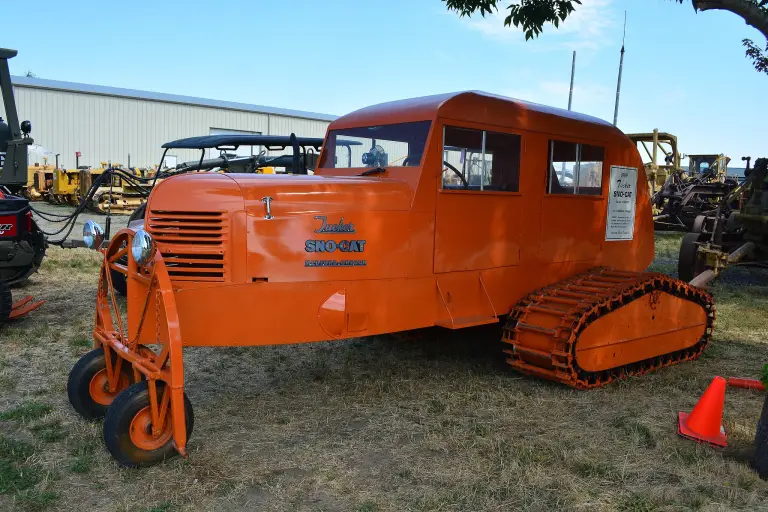
The Tucker 48 was the company’s only car; a very different kind of tracked Tucker is the Tucker Sno-Cat. More cars are in the Tucker collection.
Video: BAD Co. Car 01 Tucker Torpedo
Video on YouTube.
Sources
- Tucker 48, English Wikipedia: history, design, features
- Tucker 48, German Wikipedia: dimensions, production numbers, survivors