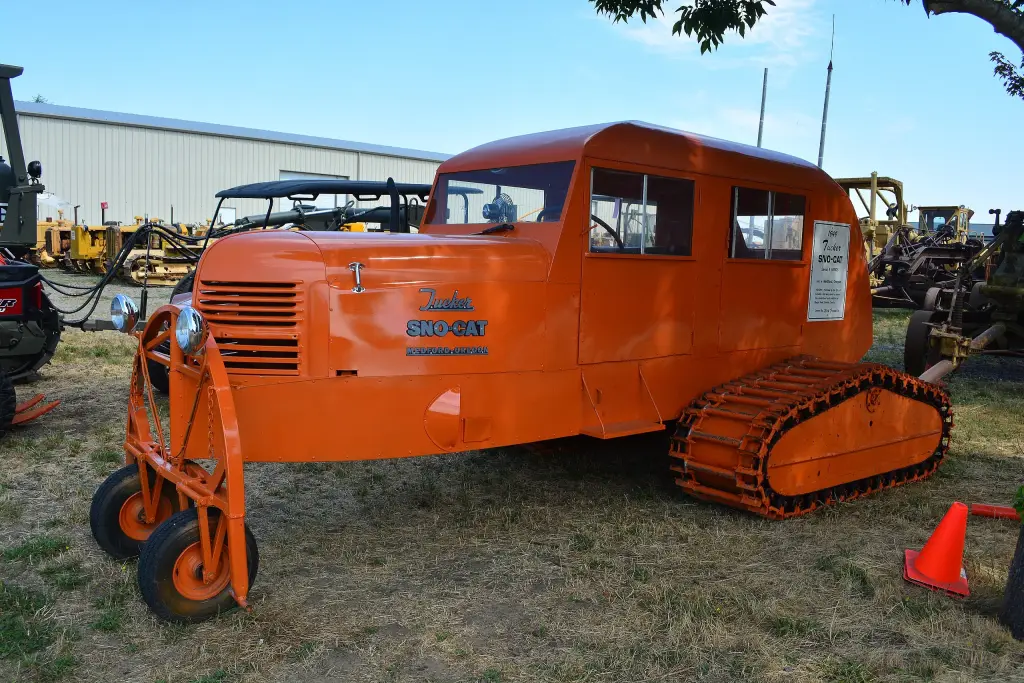
The Tucker Sno-Cat is a family of tracked vehicles for snow, manufactured in Medford, Oregon, by the company of the same name. What sets it apart from other truck-sized snow vehicles is the use of four independently mounted sets of tracks. Different models have served expeditions in the Arctic and Antarctic since the second half of the twentieth century.
Tucker Sno-Cat at a glance
| Maker | Tucker Sno-Cat Corporation, Medford, Oregon |
|---|---|
| Type | tracked vehicle for snow and ice |
| Layout | four independently mounted sets of tracks |
| Two-track models | 222 Tucker Kitten, 322 and 323 |
| Kitten engine | 10 hp |
| Body styles | sedan, enclosed cargo and open bed |
| Numbering | series 200 to 900, higher numbers larger |
| Early track | steel track running around steel pontoons |
| Later track | fiberglass pontoons, then rubber belts with metal grousers |
| Current track | all-rubber Terra Track belt |
| Uses | polar transport, trail grooming, fire suppression, drilling and cranes |
| Antarctic fame | four cars on the 1957–58 Trans-Antarctic Expedition |
Based on one source, the English Wikipedia article on the Tucker Sno-Cat.
History of the Tucker Sno-Cat
Early models
The first Tucker Sno-Cats used two front-mounted steering skis and two sets of tracks at the rear. A few experimental cars and early production models kept to two tracks: the small 222 Tucker Kitten, powered by a 10 hp engine, and the 322 and 323 were two-track machines with a conventional front engine. The Kitten was built in at least two variants, some with square corner doors and some with rounded ones, and at least one prototype used two tracks with a mid-mounted engine.
The four-track Sno-Cat
The majority of Sno-Cats used four sets of tracks, and these are considered the classic Sno-Cats of American history. The body could be configured in many ways, with sedan, enclosed cargo and open bed styles all available. Model numbers described the configuration: a Model 342 was a ‘300’ series, four-track, two-door machine, while a Model 443 was a ‘400’ series, four-track, three-door unit. Early models ran through series 200 to 900, the larger numbers being the larger machines, and the 500 series had extra wide tracks for carrying heavy loads in deep soft snow.
Steel pontoon to Terra Track
The early Sno-Cats ran on a steel track that revolved around a steel pontoon, driven by a toothed sprocket at the top centre of the pontoon. Rust caused maintenance problems with the steel pontoons, and fiberglass pontoons replaced some steel parts while the mechanism stayed essentially the same. Steel tracks were then replaced by two rubber belts with metal cleats, or grousers, on the outside, driven by two sprockets on a hub and supported inside by a series of wheels and guides. The most modern version is the all-rubber Terra Track, a wide single belt of multi-ply construction similar to a car tyre, with moulded rubber treads instead of steel grousers.
Antarctica and beyond
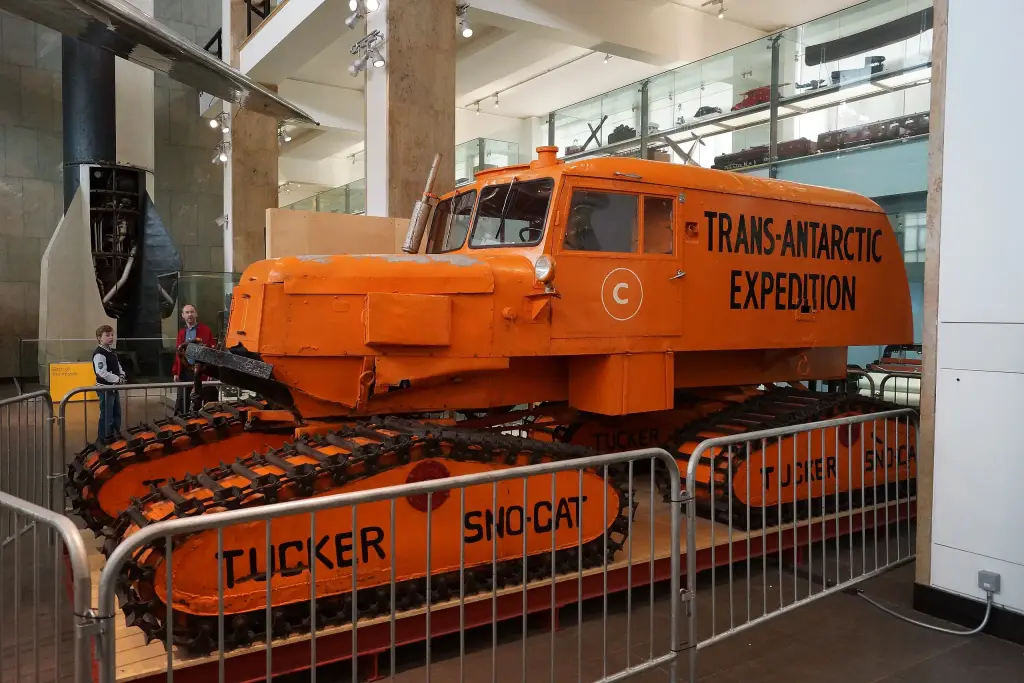
The English explorer Sir Vivian Fuchs championed the first Trans-Antarctic expedition and used four specially prepared Tucker Sno-Cats. Sno-Cats are still regarded as a premier extreme-condition vehicle and remain in use in both polar regions. Of the three Sno-Cats that travelled to the South Pole, door-code ‘A’ is displayed in the Antarctic section of the Canterbury Museum in Christchurch, New Zealand, and door-code ‘B’ is at the Antique Gas and Steam Engine Museum in Vista, California. Door-code ‘C’ went back to the United Kingdom and is at the Science Museum at Wroughton, viewable by appointment; the fate of door-code ‘D’ is unknown. An image of door-code ‘B’ spanning a crevasse is image 108 on the Voyager Golden Record.
Design and features
- Four independent tracks: each set is mounted separately, which is what separates the Sno-Cat from ordinary snowcats.
- Configurable bodies: sedan, enclosed cargo and open bed versions were all built on the same chassis family.
- Model numbering: the number records the series, the number of tracks and the number of doors.
- Track development: steel pontoon first, then rubber belts with grousers, and finally the all-rubber Terra Track.
- Modern work: ski resort grooming, polar passenger transport, fire suppression, drilling and crane operations.
Tucker Sno-Cat versions
- 222 Tucker Kitten: a small two-track Sno-Cat with a 10 hp engine.
- 322 and 323: two-track models with a conventional front engine.
- 300 series: four-track machines, such as the two-door Model 342.
- 400 series: four-track machines, such as the three-door Model 443.
- 500 series: extra wide tracks for heavy loads in deep soft snow.
- Terra Track: the modern all-rubber belt version of the track.
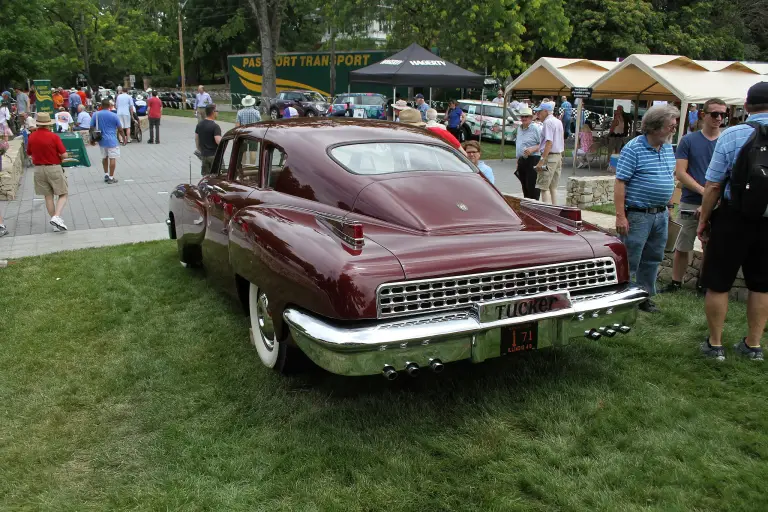
The Sno-Cat is made by the same Tucker family name as the rear-engined Tucker 48 car of 1948. More machines are in the Tucker collection.
Video: Tucker Sno-Cat
Video on YouTube.
Sources
- Tucker Sno-Cat, English Wikipedia: history, models, track design, Antarctic use