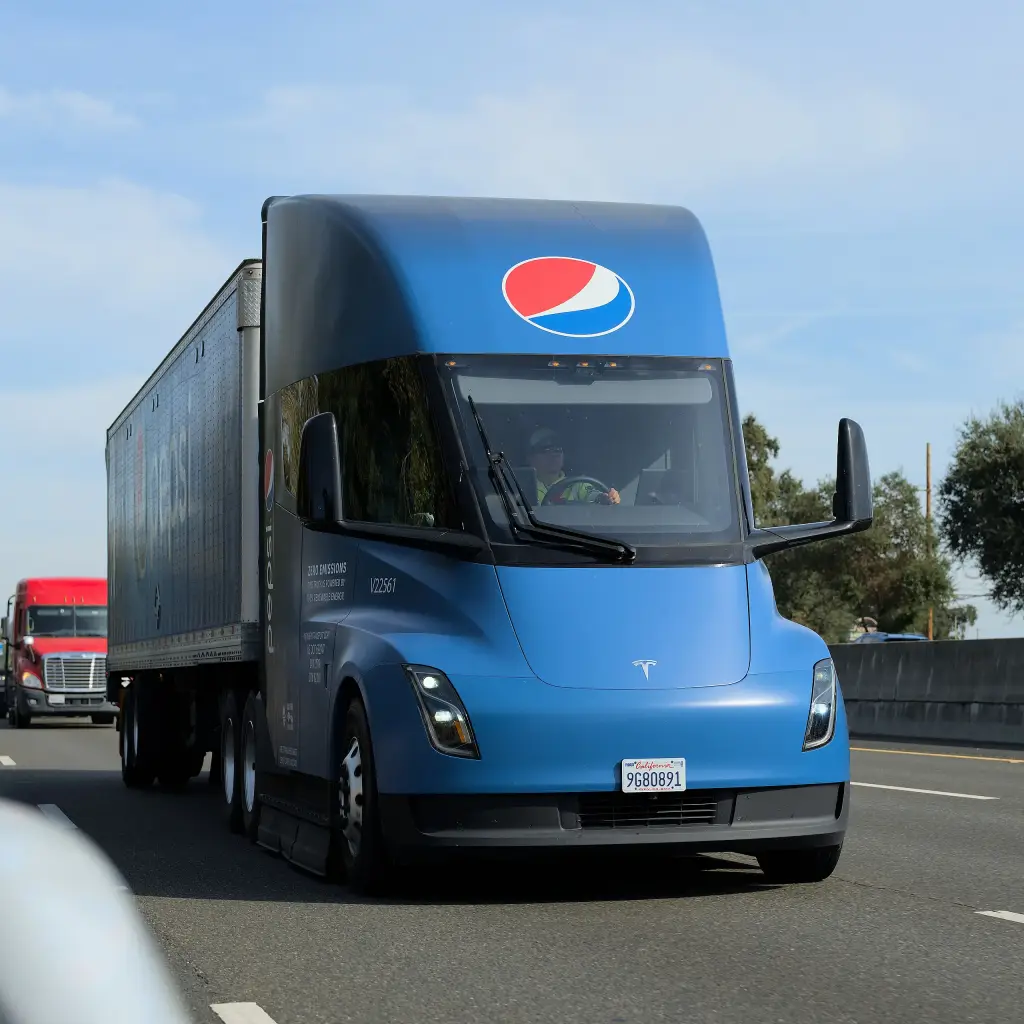
The Tesla Semi is a battery-electric semi-trailer truck that Tesla has built since 2022. It has three motors and roughly three times the power of a typical diesel tractor. Two concepts were shown in November 2017 with production promised for 2019, but volume production began only on 29 April 2026.
Tesla Semi at a glance
| Maker | Tesla, Inc. |
|---|---|
| Type | battery-electric semi-trailer truck |
| Unveiled | 16 November 2017 |
| Production start | October 2022; volume from 29 April 2026 |
| First deliveries | 1 December 2022, PepsiCo |
| Motors | three |
| Range | 325 miles (520 km) or 500 miles (800 km) |
| Payload | up to 45,000 lb (about 20 long tons) |
| Energy use | under 2 kWh per mile (1.2 kWh/km) |
| Plant | next to Giga Nevada, planned 50,000 a year |
History of the Tesla Semi
Promise and delay
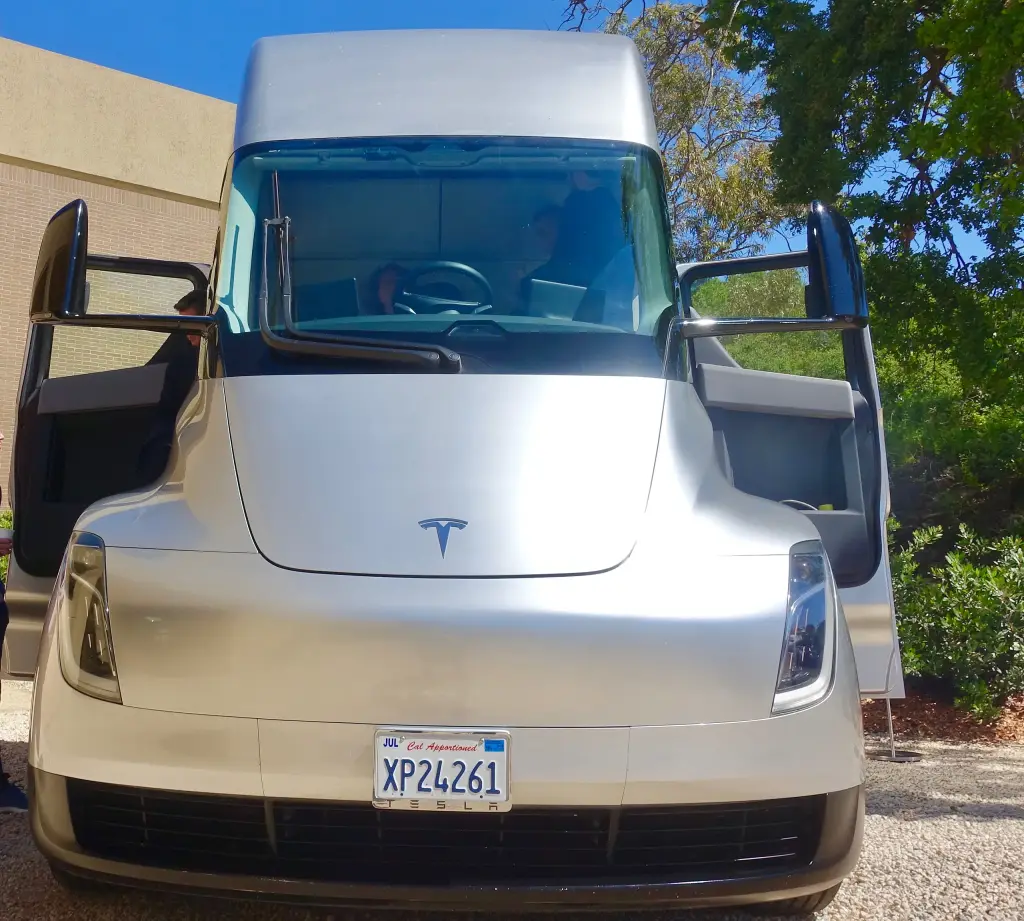
The Semi was first mentioned in the Tesla 2016 Master Plan. A concept was unveiled at a press conference on 16 November 2017, when Tesla projected prices of US$150,000 and US$180,000 for the 300- and 500-mile versions and promised production in 2019. Tesla later said a lack of battery capacity was one limit, and it chose to use its cells for passenger cars first. In January 2021 the start slipped to late 2021 and in October 2021 to 2023.
First trucks
In October 2022 Musk announced that production of the 500-mile version had begun. In November 2022 a Semi drove 500 miles at 81,000 lb (37,000 kg), and on 1 December 2022 Tesla delivered the first trucks to PepsiCo at its Nevada plant. PepsiCo said the trucks could haul Frito-Lay food about 425 miles (684 km), or about 100 miles (160 km) with heavy loads of soft drinks. Walmart, Costco, Sysco, Martin Brower and US Foods were also testing it in 2024.
Volume production
In August 2024 a Semi caught fire after leaving a road in Placer County, California, closing I-80 for hours; the driver was uninjured. In May 2025 Tesla planned a public Megacharger network of 46 stations. A new Semi with a sleeker front and almost 1,000 lb (450 kg) less weight was shown on 23 March 2026, and volume production started on 29 April 2026.
Design and features
- Three motors: about three times the power of a typical diesel semi.
- Battery under the cab: the packs sit under the floor between the front and drive wheels.
- Efficiency tests: NFI measured 1.64 kWh/mi in August 2024; DHL measured 1.72 kWh/mi over 388 miles at 75,000 lb in October 2024.
- Safety: Tesla said independent motors and wheels would detect and prevent jackknifing.
- Warranty: Tesla intended to warrant the drivetrain for 1 million miles.
Tesla Semi versions
- 325-mile Semi: the standard-range version, expected at about US$260,000 by 2026.
- 500-mile Semi: the long-range version, expected at about US$300,000 by 2026.
- Founder’s Series: a US$200,000 launch edition announced in 2017.
- 2026 redesign: a lighter model with a sleeker front.
The Semi was shown at the same 2017 event as the second-generation Roadster. For the truck’s smaller relative see the Tesla Cybertruck, and for everything else the Tesla collection.
Sources
- Tesla Semi, English Wikipedia: history, deliveries, tests, 2026 production
- Tesla Semi, German Wikipedia: background