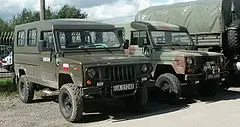
The Honker, first known as the Tarpan Honker, is a Polish multi-purpose off-road vehicle. Its prototype appeared in 1984 and production ran, under several owners, until 2016. It is best known for its service with the Polish Army both at home and in Iraq.
Tarpan Honker at a glance
| Maker | FSR Poznań, later Daewoo Motor Polska, Andoria-Mot, Intrall Polska, DZT Tymińscy |
|---|---|
| Prototype | 1984 |
| Series production | from 1988 |
| Body | three-door, on a rigid frame with leaf springs |
| Variants | 4012 hardtop, 4022 pickup, 4032 prototype |
| Petrol engines | M20 up to 1992; later FSO Polonez units |
| Diesel engines | 2.5-litre Iveco; Andoria 4CT90 and 4CTi90 turbodiesel from 1997 |
| Production 1992 | 450 vehicles |
| Production 1994 | 314 vehicles |
| Production 1995 | 288 vehicles |
| Peak year | 495 vehicles in 2004 |
| End of production | 2016 |
The article is based on one source, the English Wikipedia page on the Tarpan Honker.
History of the Tarpan Honker
The prototype of the Honker was created in 1984 at the Fabryka Samochodów Rolniczych in Poznań. Based on the earlier Tarpan, it was meant to replace it as the basic Polish light commercial off-roader in public services, a role shared until then with the imported Soviet UAZ-469. Serial production began only in 1988, in two versions: the Honker 4012 hardtop for up to ten passengers and the Honker 4022 pickup for two.
Soon after production started, FSR built a slightly shorter and narrower version, 2,210 mm wide, designated Honker 4032. The prototype never entered series production, but it was the first car known simply as a Honker, without a reference to the Tarpan.
Production stayed small: 450 vehicles in Poznań in 1992, 314 in 1994 and 288 in 1995, and FSR production stopped in early 1996. In late 1996 the design was bought by Daewoo Motor Polska, which moved assembly to Lublin, revised the interior and sold the car as the Daewoo Honker 2324. Plans for a modernised Honker II with 4×2 or 4×4 drive were dropped, and the factory modified the exterior instead, continuing with the Daewoo Honker 2000.
After the bankruptcy of Daewoo the licence passed to two companies. Andoria-Mot built the vehicle in small numbers in 2002–2003 and created two modernised hardtop pickups; Intrall Polska made it from January 2004 to spring 2007 and added the heavier Honker MAX in 2004. That year also brought the Honker Skorpion 3, an armoured, mine-protected version for the Polish contingent in Iraq.
In 2009 the rights were sold to DZT Tymińscy, which restarted production. Annual output under Daewoo and its successors had ranged from about 30–50 cars in 2001 to 495 in 2004, 245 in 2006 and only 35 in 2007; in 2008 a Ukrainian company planned to build a modernised version but never did. DZT Tymińscy filed for bankruptcy in 2016, ending production of the Honker.
Design and features
- Military and utility work: used by the Polish Land Forces and police, and the largest civilian operator is KGHM, which takes miners underground.
- Simple chassis: a three-door body on a rigid frame with leaf-sprung axles.
- Mixed engines: M20 petrol shared with the Żuk and Nysa until 1992, then FSO Polonez petrol units, 2.5-litre Iveco diesels and finally Andoria turbodiesels.
- Armoured derivative: the Skorpion 3 was built specifically for service in Iraq.
Tarpan Honker versions
- Honker 4012: hardtop for up to ten passengers.
- Honker 4022: two-seat pickup.
- Honker 4032: shorter, narrower prototype, the first car called simply Honker.
- Daewoo Honker 2324 and 2000: Lublin-built versions with a revised interior and exterior.
- Honker MAX: heavier off-road version from Intrall, 2004.
- Honker Skorpion 3: armoured, mine-protected version for the Polish Army in Iraq.
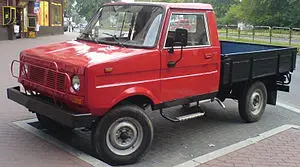
The Honker was developed from the earlier Tarpan 233 pickup. More Polish vehicles are in the Tarpan collection.
Sources
- Tarpan Honker, English Wikipedia: history, variants, engines, production figures, operators