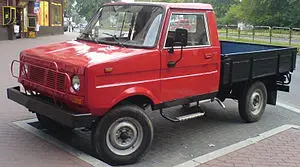
The Tarpan 233 was the first series version of the FSR Tarpan, a pickup truck produced by Fabryka Samochodów Rolniczych „Polmo” in Poznań. Built for Polish agriculture, it carried a sliding wall between the cab and the cargo bed, and was named after the wild horse of the Polish steppe.
Tarpan 233 at a glance
| Maker | Fabryka Samochodów Rolniczych „Polmo”, Poznań |
|---|---|
| Production | from December 1972; series production from early 1973 |
| Class | light agricultural pickup |
| Engine | M20 petrol, later S-21 of 51.5 kW |
| Layout | front engine, rear-wheel drive |
| Body | pickup with a movable wall behind the cab |
| Payload | 2 people and 600 kg, or 6 people and 300 kg |
| Curb weight | 1,320 kg after the first modernisation |
| Built by April 1973 | 250 |
| Output 1973 | 250 |
| Output 1974 | 1,582 |
| Output 1975 | 2,760 |
| Output 1976 | 3,941 |
| Export | Greece and Iran |
There is no English Wikipedia page for the Tarpan 233 itself; the article is based on one source, the English Wikipedia page on the FSR Tarpan family.
History of the Tarpan 233
At the turn of the 1960s and 1970s the Polish authorities decided to build a vehicle for agriculture, and Greater Poland, then a leading farming region, was chosen for the factory. Prototypes were built in two Poznań centres: the Warta at Techniczna Obsługa Samochodów and the Tarpan at the Instytut Obróbki Plastycznej, working with the Poznań University of Technology. Both were shown to Edward Gierek and industry officials before the 6th Congress of the Party in December 1971.
A joint design team led by Roman Skwarek then started again from scratch. Front-wheel drive and the S31 engine of the FSO Syrena were dropped in favour of the M20 engine used in the FSC Żuk and FSO Warszawa. Two Warta-2 vehicles were built, one with canvas doors and a canvas bed cover, the other with a movable wall behind the cab; the second layout was taken into production. Both were presented in September 1972 at the agricultural exhibition in Myślęcinek near Bydgoszcz.
In December 1972 the factory in Poznań-Antoninek delivered the first „information series” of 25 cars under the name Tarpan. The name came from a competition run by Express Poznański: 1,146 readers sent 416 suggestions and Bronisław Hasiński proposed Tarpan, a symbol of the durable Polish horse. By the end of April 1973, 250 Tarpan 233 vehicles had been built.
Field tests brought a first modernisation: a front bumper, indicator lamps from the Polski Fiat 125p, a narrower grille that no longer covered the headlights, two-stage headlight adjustment for load, push-button door handles from the Polski Fiat 126p, reshaped front seats, a revised instrument cluster, a modified steering column and a telescopic rear shock absorber. Curb weight rose to 1,320 kg. Production grew quickly, from 250 cars in 1973 to 1,582 in 1974 and 3,941 in 1976.
On 1 July 1975 the manufacturer became independent as Fabryka Samochodów Rolniczych „Polmo” and took over plants in Gniezno, Swarzędz and Złotów. The design office then fitted a two-person reclining bench, a new dashboard, electrical parts shared with the Polski Fiat family, optional four-speed gearboxes from FSO and, on request, a mechanical differential lock. From 1976 the body panels were pressed rather than hammered, the body was made in Poznań and the frame in a branch plant.
Design and features
- Movable cab wall: the partition behind the seats could be shifted to carry either two people and 600 kg or six people and 300 kg.
- Proven mechanicals: the M20 engine and much of the running gear came from the Żuk and Warszawa, which made servicing easy in the countryside.
- Built for farm work: a simple ladder frame, leaf springs and a steel pickup bed rather than car-like comfort.
- Steady development: bumpers, new lamps, Fiat-sourced handles and a telescopic rear damper arrived after the first field tests.
Tarpan 233 versions
- Warta-2 (1972): the two prototypes, one with canvas doors and bed cover, one with the sliding wall.
- Tarpan 233 (1972–1973): the first series pickup with the movable partition.
- S-21 engine cars: later cars could be had with the 51.5 kW S-21 engine alongside the M20.
- Export cars: the Tarpan was sold to Greece and Iran.
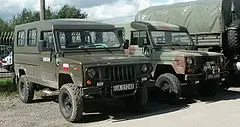
The Tarpan was replaced in Polish service by the off-road Tarpan Honker. More Polish vehicles are in the Tarpan collection.
Sources
- FSR Tarpan, English Wikipedia: development, naming, production figures, modernisation