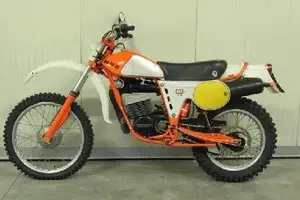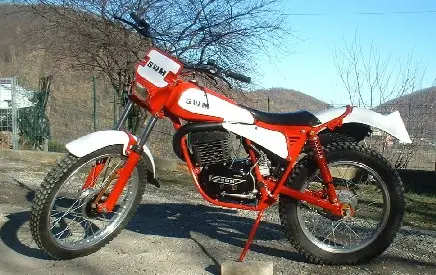
SWM entered trials in 1977 with a pair of Rotax-engined machines, the TL125 and TL320, and within four years the Italian firm had a world champion: Gilles Burgat won the 1981 Trials World Championship on an SWM. Production of the trials line ended in 1984.
SWM trial at a glance
| Maker | SWM (Speedy Working Motors), Milan, Italy |
|---|---|
| Founded | 1971 by Piero Sironi and Fausto Vergani |
| First trials bikes | TL125 and TL320, 1977 |
| Engine | Rotax rotary valve single, trials version |
| Engine development | input from Sammy Miller and Charles Coutard |
| Bodywork | Acerbis plastic mouldings |
| Suspension | Marzocchi |
| First colours | red and white |
| 1979 | yellow and black models |
| 1980 | Girling Gas shocks and Betor forks |
| World title | Gilles Burgat, 1981 |
| Last models | TL350 Jumbo 1983; 125 and 320 in the new frame 1984 |
This page is based on a single source, the English Wikipedia article on SWM Motorcycles; it covers the trials models in one section, so the article is shorter than usual.
History of the SWM trial
Entering trials, 1977
SWM was founded in Milan in 1971 by Piero Sironi and Fausto Vergani and began with small-capacity enduro bikes using Sachs engines. Trials came in 1977 with the TL125 and TL320, both powered by a Rotax rotary valve engine built in a special trials version; Rotax developed it with input from Sammy Miller and Charles Coutard. Acerbis supplied the plastic mouldings and Marzocchi the suspension, and the first trials machines were finished in red and white. At the time the main rivals in the class were Fantic Motor, Bultaco and Montesa.
Development through the years
The bikes were updated almost every season. Yellow and black models appeared in 1979. In 1980 they were fitted with Girling Gas shocks and Betor forks. A 240 model with a blue frame followed in 1982, a colour that acknowledged Pernod’s sponsorship of trials. In 1983 every bike received an alloy swing arm and SWM introduced the TL350 Jumbo, which used a new reed valve engine in a new frame in the same yellow and blue colours. The final change came in 1984, when the 125 and 320 were put into that new frame, after which production ceased.
Racing and after
The high point of the racing programme was Gilles Burgat’s 1981 Trials World Championship on an SWM. The company went into liquidation in 1984. The bikes remain in use in classic and twinshock trials in Britain, Rotax engine spares are still readily available, and components that went out of production, such as the Acerbis plastics, are made and distributed by specialists including MotoSWM in the UK and MidWest SWM in the United States.
Design and features
- Rotax rotary valve engine: a trials-specific version of the Rotax single, developed with Sammy Miller and Charles Coutard.
- Italian cycle parts: Marzocchi suspension and Acerbis plastic bodywork.
- Season-by-season updates: colours, Girling Gas shocks and Betor forks, a blue-framed 240 and alloy swing arms.
- World champion: Gilles Burgat took the 1981 Trials World Championship on an SWM.
- Continuing support: Rotax spares and re-made Acerbis plastics keep the bikes running today.
SWM trial versions
- TL125 (1977): the small-capacity trials model, red and white at first, moved into the new frame in 1984.
- TL320 (1977): the larger trials bike of the original pair, also updated in 1984.
- 1979 yellow and black models: the second colour scheme.
- 240 (1982): blue frame, a nod to Pernod’s trials sponsorship.
- TL350 Jumbo (1983): new reed valve engine and frame, yellow and blue.
- 1983-84 specification: alloy swing arms across the range.
The small-capacity enduro and modern machines are covered in the article on the SWM 125. More models of the marque are in the SWM collection.
Video: ENTRENO SWM TRIAL CLASSIC
Video on YouTube.
Sources
- SWM Motorcycles, English Wikipedia: trials history, models, colours, world championship