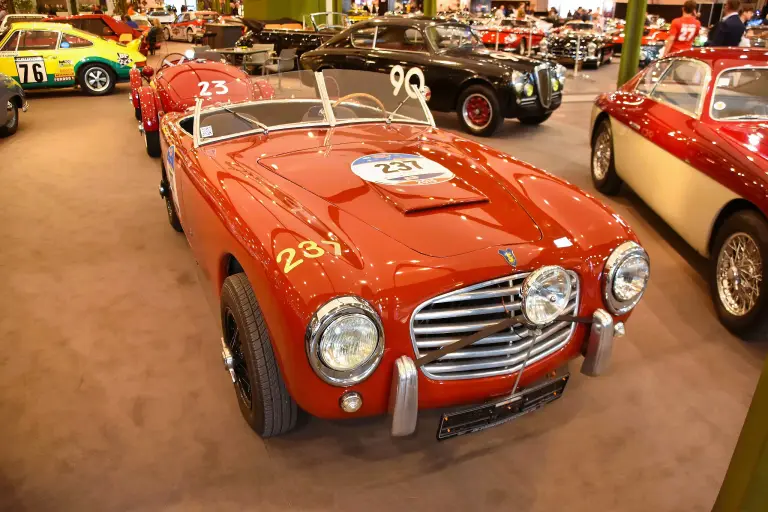
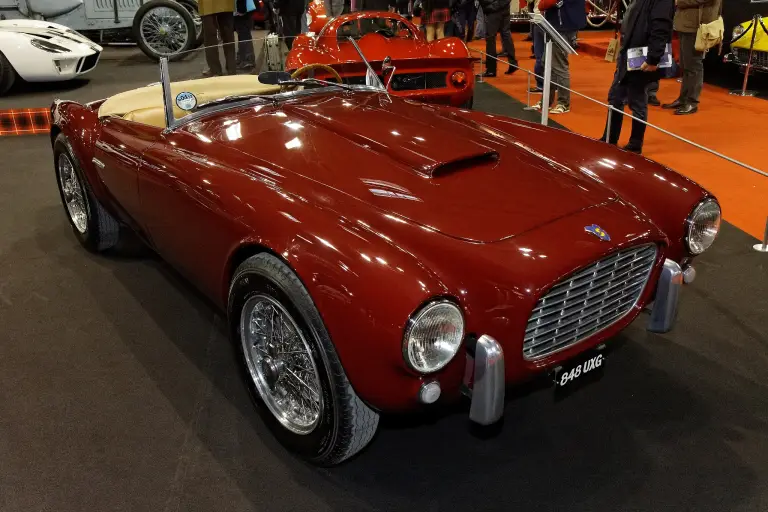
The Siata Spring, also known as the SIATA 850 Spring, is a two-seat spider that Siata produced from 1967 to 1970. It used a reinforced Fiat 850 chassis and an 843 cc engine, and its body was styled after English sports cars and 1930s models. After Siata failed, production continued in Sardinia as the ORSA Spring until 1975.
Siata Spring at a glance
| Maker | SIATA, Turin; later ORSA, Cagliari |
|---|---|
| Production | 1967–1970 (SIATA), then to 1975 (ORSA) |
| Body | two-seat spider |
| Chassis | Fiat 850, reinforced with a boxed crossmember |
| Engine | 843 cc Fiat 850 Super (ORSA: 903 cc, 47 hp) |
| Top speed | over 125 km/h |
| Brakes | ORSA version: front discs from the SEAT 850 Especial |
| Wheels | wire wheels optional at 50,000 lire |
| Built | about 3,500 |
| Markets | Italy, France, Germany and the United States |
The Spring is described on the Italian Wikipedia; the English article covers the Fiat 850 base car, and the page above uses it only for background.
History of the Siata Spring
The Spring is sometimes described as one of the first cars created after a careful study of the market. Siata interviewed a number of young people to find out what they expected from a car, and after the survey it prepared the prototype of a small spider with an English flavour in 1965. Two years later the car entered production as the SIATA 850 Spring.
The chassis was that of the Fiat 850, reinforced with a boxed crossmember. The spider body, inspired by English sports cars and by the cars of the 1930s, was built entirely at the Siata works in Strada di Lanzo. The engine was the 843 cc unit of the Fiat 850 Super, which allowed the small spider to exceed 125 km/h, and wire wheels were offered as an option for 50,000 lire to complete its fashionable, retro look.
In 1970 Siata ceased activity after going bankrupt, but the Spring’s assembly line was taken over by a group of young Sardinian industrialists. With finance from the Cassa per il Mezzogiorno they formed ORSA, the Officina Realizzazione Sarde Automobili, and continued to build the Spring at their own plant in Cagliari. The ORSA version used mechanicals from the Spanish SEAT, with the front disc brakes of the 850 Especial and a 903 cc engine derived from that of the SEAT 850 Sport Coupé, producing 47 hp.
In 1972 the engineer Rivolta bought 75 per cent of the shares, but the effects of the oil crisis forced the company to stop making cars in 1975 and to switch to fire-fighting vehicles. The ORSA Spring therefore has the distinction of being the only Italian car produced in Sardinia. About 3,500 Springs were built in all, and they were sold in Italy, France, Germany and the United States, where the SIATA name is still associated with sporting small cars.
Design and features
- Fiat 850 underpinnings: a standard Fiat 850 chassis reinforced with a boxed crossmember.
- Retro spider body: styling inspired by English sports cars and 1930s models, built at Siata’s Strada di Lanzo works.
- Small but brisk: the 843 cc Fiat 850 Super engine took the car past 125 km/h.
- Sardinian production: after Siata’s bankruptcy the line moved to Cagliari under the ORSA name.
Siata Spring versions
- SIATA 850 Spring (1967–1970): the original version with Fiat 850 chassis and 843 cc engine, built in Turin.
- ORSA Spring (1970–1975): Sardinian-built version with SEAT-derived 903 cc engine and front disc brakes.
- Wire-wheel option: optional wire wheels at 50,000 lire on the original car.
Siata’s earlier models were the 208S and the Daina, and more are in the Siata collection.
Video: Siata Spring
Video on YouTube.
Sources
- Fiat 850 SIATA Spring, Italian Wikipedia: history, chassis, engine, ORSA, production
- Fiat 850, English Wikipedia: base car, engine family