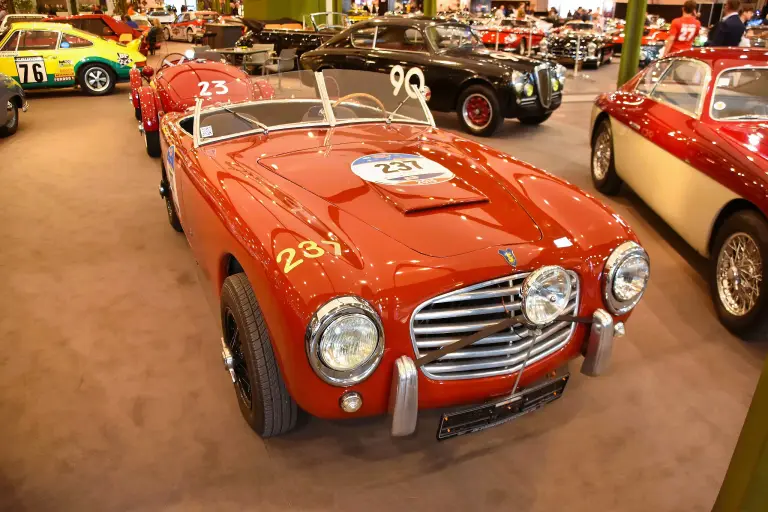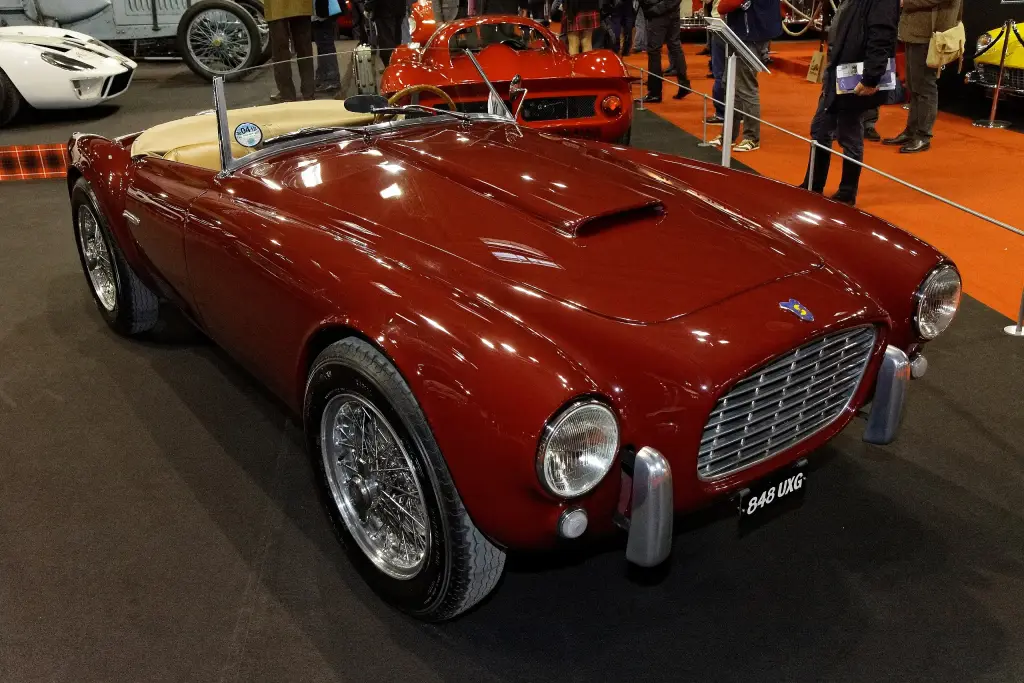
The Siata 208S is an Italian sports car that Siata presented in 1952. It was a lightweight two-seat spider with an aluminium body designed by Giovanni Michelotti and built by Rocco Motto, and it shared the V8 engine of the Fiat 8V. Only 35 examples were produced, including two Bertone-designed prototypes.
Siata 208S at a glance
| Maker | Siata, Turin, Italy |
|---|---|
| Presented | 1952 |
| Body | two-seat spider, aluminium |
| Designer | Giovanni Michelotti |
| Coachbuilder | Rocco Motto |
| Engine | Fiat Tipo 104 70° V8, 2 litres, all alloy |
| Power | 125 hp (93 kW) |
| Top speed | 200 km/h (124 mph) |
| 0–60 mph | 12.4 seconds (Road & Track test) |
| Suspension | four-wheel independent |
| Related model | Siata 208 CS coupé |
| Built | 35, including two Bertone prototypes |
Based on one source: the English Wikipedia article on the Siata 208S.
History of the Siata 208S
Siata presented the 208S in 1952. Its body was a lightweight aluminium spider designed by Giovanni Michelotti and built by the Turinese coachbuilder Rocco Motto, and in Siata’s range the open car was the roadster counterpart of the 208 CS coupé. The company built only 35 examples of the 208S, two of them to Bertone designs rather than the standard Michelotti shape.
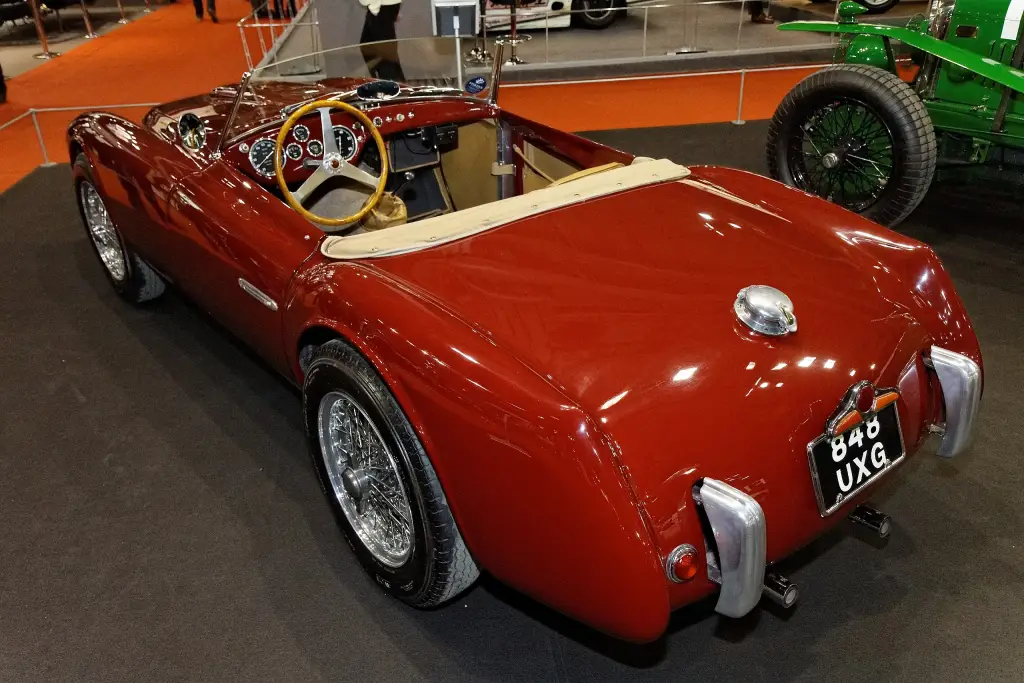
The car became known outside Italy after the actor and racing driver Steve McQueen bought one. His car, chassis BS523, was sold to him in the mid-1950s by Ernie McAfee, Siata’s importer in Los Angeles. McQueen is said to have replaced the Siata badges with Ferrari emblems and called the car his “Little Ferrari”, a name that has stuck to the model.
Mechanically the 208S was derived in part from the Fiat 8V. It used Fiat’s all-alloy Tipo 104 engine, a 70-degree V8 of two litres, which developed 125 hp (93 kW) and gave the little spider a top speed of 200 km/h (124 mph). Contemporary testing by Road & Track recorded a 0–60 mph time of 12.4 seconds and a quarter-mile time of 17.8 seconds.
The 208S wore all-aluminium bodywork and had four-wheel independent suspension, an advanced arrangement for a small Italian sports car of the early 1950s. The combination of the light body and the Fiat-derived V8 made it a quick car for its size, and the McQueen connection has made chassis BS523 the best known of the 35 examples.
Design and features
- Fiat 8V V8: the all-alloy Tipo 104 70-degree V8 of two litres, tuned to 125 hp.
- Lightweight aluminium body: a Michelotti-designed spider built by Rocco Motto.
- Advanced chassis: four-wheel independent suspension at a time when many rivals still used a live axle.
- Rare from new: only 35 cars built, including two Bertone prototypes.
Siata 208S versions
- 208S spider (1952): the standard Michelotti-bodied aluminium roadster built by Rocco Motto.
- Bertone prototypes: two of the 35 cars were built to Bertone designs.
- 208 CS: the closed coupé counterpart of the 208S in Siata’s range, using the same Fiat-derived V8.
The open 208S was the roadster counterpart of the 208 CS coupé. Siata’s other road car of the period was the Daina; the Spring is described separately. More models are in the Siata collection.
Sources
- Siata 208S, English Wikipedia: history, body, engine, performance, production