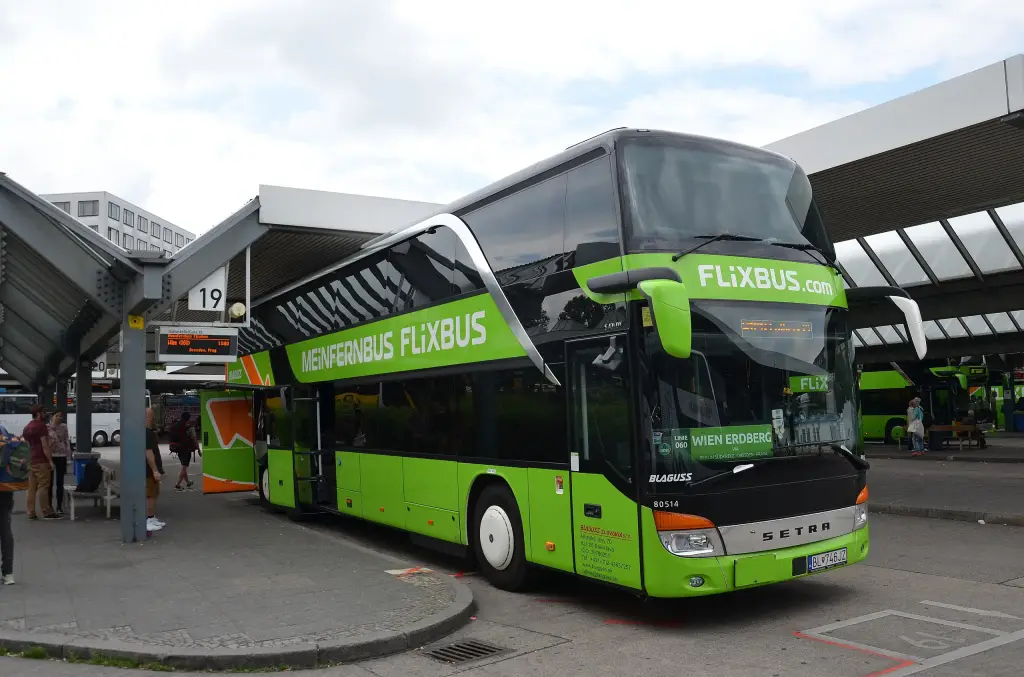
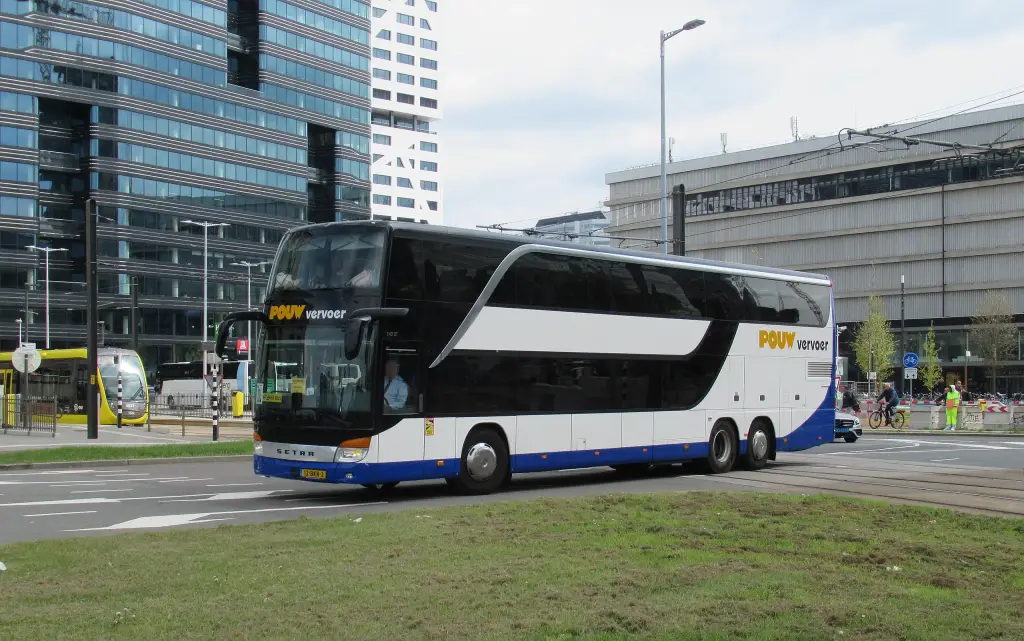
The Setra S 431 DT is a double-deck touring coach of the TopClass 400 range, built from 2002 at Setra’s plant in Neu-Ulm. It was the only double-decker in the range, and after a thorough revision in 2013 it received a Euro 6 engine and a new cockpit. Its successor, the S 531 DT, was presented in July 2017.
Setra S 431 DT at a glance
| Maker | Setra (EvoBus, Daimler) |
|---|---|
| Type | double-deck touring coach, TopClass 400 |
| Built from | 2002, at Neu-Ulm, Germany |
| 2013 revision | technical update, Euro 6 engine, new cockpit |
| Successor | S 531 DT, presented July 2017 |
| Engine from 2013 | OM 471 straight-six diesel, 12,809 cm³, 375 kW |
| Torque | 2.5 kN·m at 1100 rpm |
| Gearbox | eight-speed GO 250-8 Powershift automated manual |
| Luggage hold | 8.3 m³ under the lower deck |
| Seats | 78 in four-star trim, 83 to 93 in three-star trim |
| Fuel tank | 510 litres, optional extra 220 litres |
| Delivered | about 1,400 by August 2014; 2,500 by June 2015 per Daimler |
History of the Setra S 431 DT
The S 431 DT is a double-deck touring coach of the TopClass 400 range, which Setra built from 2002 through its EvoBus company. It was the only double-decker in that range. The type number follows the Setra system, in which the first digits give the seat rows and the letters the body type: DT stands for a double-deck touring coach. The coach was built in the Setra plant in Neu-Ulm. It gained particular importance from the fast-growing long-distance coach business in Germany, and the successor S 531 DT was presented in July 2017.
The original specification
Originally the S 431 DT was powered by a V8 diesel of the type OM 502, which produced 370 kW and met the Euro V emission standard. The engine was coupled to an automated twelve-speed ZF gearbox. In 2013 the coach was modernised extensively, with most of the changes under the skin and a Euro VI engine.
Body and layout from 2013
After the revision the S 431 DT was a three-axle double-decker with a self-supporting skeleton-frame body. Welded square tubes with surrounding ring frames form the basic structure, and the individual body modules are made of steel sheet and glass-fibre-reinforced plastic. The lower deck is low-floor and divided: passenger seats in the front part, the engine at the rear and, between the engine and the passenger compartment, a luggage hold of 8.3 m³ reached through several doors in the sides. In the passenger compartment there are two pneumatic single-leaf outward-swinging doors, each 900 mm wide, and the driver has a separate mechanically opened door at his place. One staircase rises behind the driver and another to the left of the rear door, leading to the upper deck, which is fitted as a passenger compartment continuously from the rear to the front and has its own windscreen with wipers.
Chassis
The front wheels are steered and individually suspended on double wishbones, with two air springs and two dampers. Drive goes to the middle axle, a rigid MB RO 440 axle with four air springs and four dampers. As at the front, the wheels of the trailing axle are individually suspended and steered; the axle is made by ZF and also has two air springs and two dampers. Front and drive axles have anti-roll bars. An electronically controlled level control adjusts the height of the coach, and steering is by a ZF Servocom recirculating-ball system. The S 431 DT runs on 9 × 22.5 steel wheels with 315/80 R 22.5 tyres.
Brakes
All wheels have disc brakes, and the system works with compressed air under electronic control. Ahead of the brakes sits a Voith secondary water retarder, which uses the engine’s cooling water instead of oil and can therefore be smaller and lighter than a conventional retarder. A light touch on the brake pedal first brings in the retarder, and the disc brakes join in only with stronger pressure; the retarder can also be operated by hand with the right steering-column stalk. The coach also has an engine brake and a spring-loaded parking brake. Anti-lock brakes, an electronic stability programme, traction control and a downhill brake assist are standard.
Engine and gearbox from 2013
The revised coach is driven by a turbocharged straight-six diesel of the type OM 471 with a displacement of 12,809 cm³. It produces 375 kW at 1800 rpm and a maximum torque of 2.5 kN·m at 1100 rpm. The engine has common-rail injection and an exhaust treatment system with an SCR catalytic converter, so it meets the Euro 6 standard. The torque goes to an eight-speed automated manual gearbox of the type GO 250-8 Powershift, designed for an input torque of 2.5 kN·m; unlike a torque-converter transmission it has no hydrodynamic converter, and it is operated, like the retarder, with the right steering-column stalk.
Equipment and reception
The interior is modular. The coach could be ordered in a three- or four-star version, which differ mainly in the seating: the four-star version has 78 seats, while the three-star version takes 83 to 87, or even 93 if the front staircase is rebuilt. The rear door can be widened by 250 mm for step-free access. On the lower deck there is a toilet, and a bistro with a galley can be supplied instead of seats. The diesel tank holds 510 litres and sits at the front left behind the front axle; an extra 220-litre tank above the right rear wheel was optional but takes part of the luggage hold. The exhaust treatment needs a urea solution carried in a 40-litre AdBlue tank, which Setra quotes as 50 litres. In Busmagazin of July/August 2014 Jürgen Görgler called the S 431 DT a comparatively good value when its high purchase price of 470,000 euros is set against its capacity, provided the vehicle runs full; he described the driver’s workplace as comfortable and functional and the engine as remarkably smooth. By August 2014 about 1,400 had been sold, and Daimler quoted 2,500 delivered vehicles by June 2015.
Design and features
- Double deck: the only double-decker of the TopClass 400, with a continuous upper passenger deck and its own windscreen.
- Three axles: a steered front axle, a driven rigid middle axle and a steered ZF trailing axle, all on air suspension.
- Water retarder: a Voith secondary retarder uses the engine coolant and works before the disc brakes.
- Euro 6 engine: from 2013 the OM 471 six-cylinder diesel of 12,809 cm³ with 375 kW and 2.5 kN·m.
- Flexible interior: three- or four-star trim, 78 to 93 seats, and a bistro in place of the lower-deck seats.
Setra S 431 DT versions
- Original Euro V version: OM 502 V8 diesel of 370 kW with a twelve-speed automated ZF gearbox.
- 2013 Euro 6 version: OM 471 six-cylinder of 375 kW with an eight-speed GO 250-8 Powershift gearbox and a new cockpit.
- Four-star trim: 78 seats, the most spacious layout.
- Three-star trim: 83 to 87 seats, or 93 with the rebuilt front staircase.
- Bistro version: a bistro with galley on the lower deck instead of seats.
The rest of the range is described in the article on the Setra TopClass 400, and the earlier intercity bus in the article on the Setra S 215 UL. More buses are in the Setra collection.
Video: Setra Doppeldecker S 431 DT Euro 6
Video by BUS TV on YouTube.
Sources
- Setra S 431 DT, German Wikipedia: history, body, chassis, brakes, engine, equipment
- Setra, English Wikipedia: naming system, company history