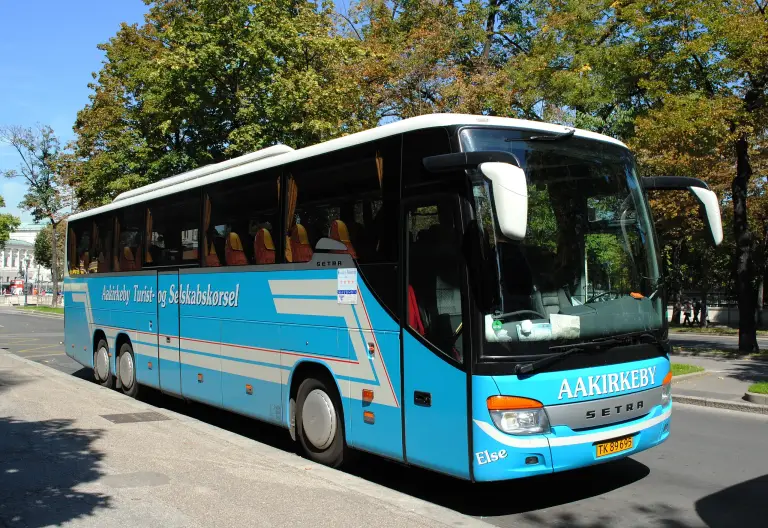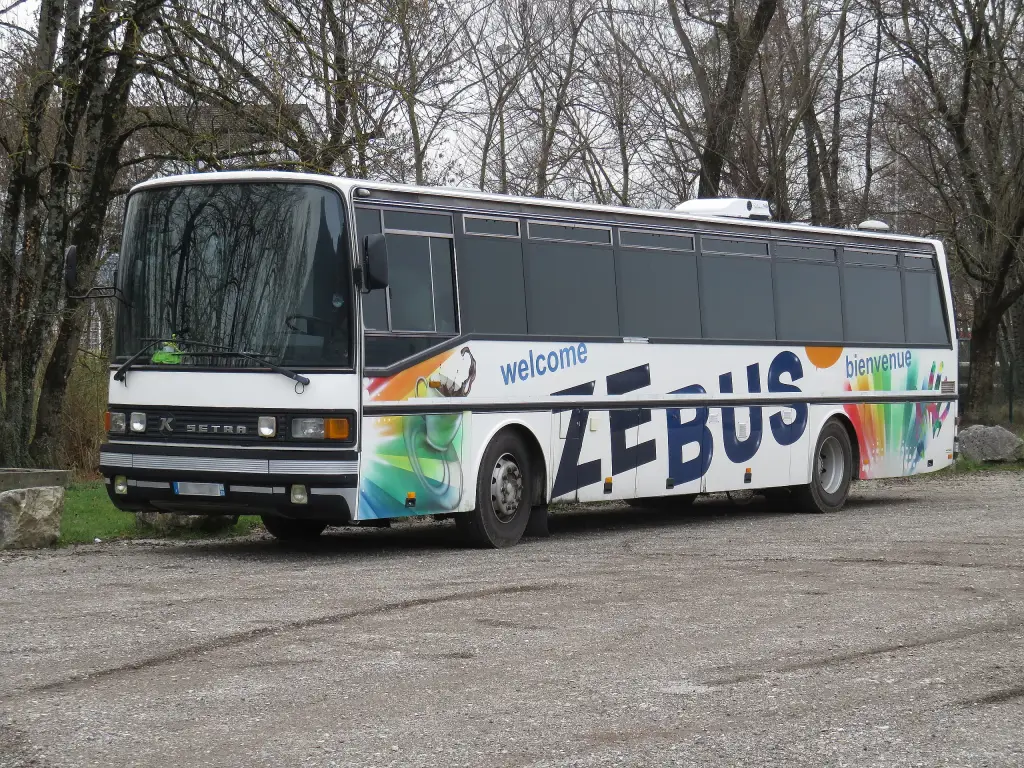
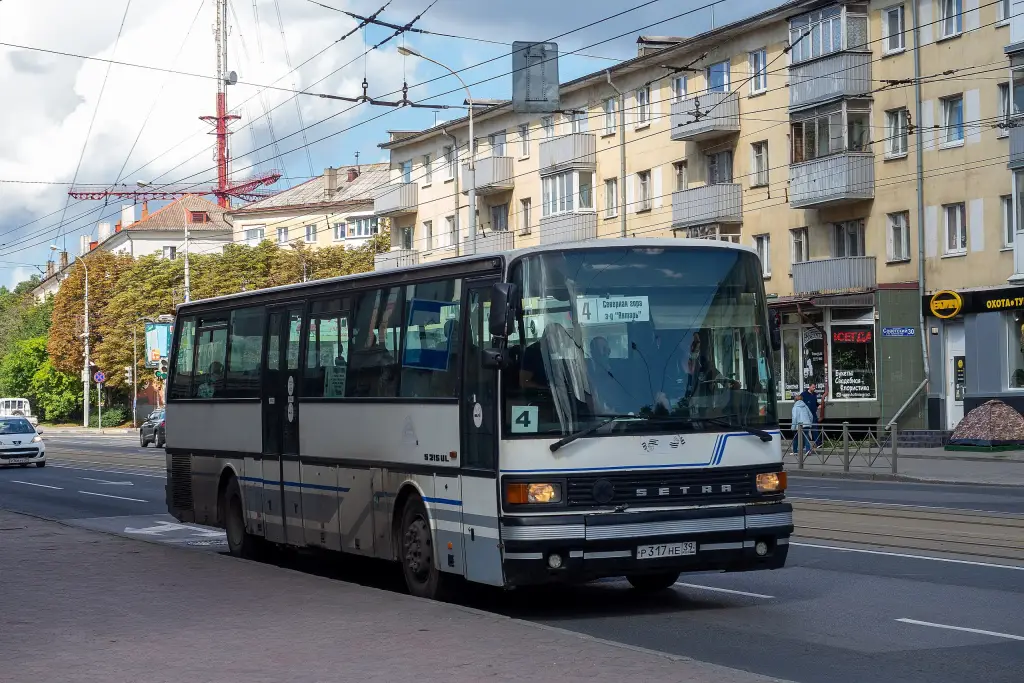
The Setra S 215 UL was an intercity bus of the Setra 200 series, designed by Kässbohrer and built from 1983 to 1995. Its 12-metre body held fifteen rows of seats, and it was developed into the low-entry S 215 NR as well as the shorter S 213 UL and two articulated versions.
Setra S 215 UL at a glance
| Maker | Karl Kässbohrer Fahrzeugwerke, later Setra |
|---|---|
| Series | Setra 200 |
| Production | 1983–1995 |
| Predecessor | Setra S 140 ES |
| Successor | Setra S 315 UL |
| Length | 12.00 m |
| Seat rows | 15 |
| Short version | S 213 UL, 11.29 m, 13 seat rows |
| Articulated versions | SG 219 UL (19 rows), SG 221 UL (21 rows) |
| Low-entry version | S 215 NR, from 1992 |
| Engines | Daimler-Benz or MAN diesel |
| Gearbox | five- or six-speed manual, automatic optional |
There is no English Wikipedia article on the S 215 UL, so the model facts come from the German article; the English article on Setra is used for the naming system and for the company history.
History of the Setra S 215 UL
The S 215 UL was developed in 1983 by Kässbohrer as an intercity bus of the 200 series and replaced the S 140 ES. At first it was called the S 215 UL Regional, but the word Regional was later dropped. Setra type numbers give the maximum number of seat rows, so the S 215 has fifteen; the letters UL stand for Überland, the intercity service for which the bus was intended.
Related lengths
Almost identical to the S 215 UL was the S 213 UL. The two differed only in length and the number of seat rows: the S 215 UL with fifteen rows measured 12.00 m, while the S 213 UL with thirteen rows measured 11.29 m. In Germany the shorter S 213 UL found comparatively few buyers, but in countries such as Switzerland it was preferred because its shorter length gave a smaller turning circle on narrow mountain roads. The Bundeswehr also bought the shorter S 213 UL. In addition, Setra offered the articulated SG 219 UL and SG 221 UL, with nineteen and twenty-one seat rows respectively.
The low-entry S 215 NR
In 1992 Setra brought out the low-entry S 215 NR on the basis of the S 215 UL. It had low-floor entrances at both doors, while the rear part of the passenger compartment behind the second door remained high-floor and was reached by a staircase. From this variant the three-axle prototype S 217 NR was derived, but it was never put into series production.
Against the VÖV-II buses
Göppel Bus had already built prototypes of the new VÖV-II intercity bus on behalf of Kässbohrer, but Kässbohrer dropped the project after Daimler-Benz and MAN withdrew their commitments to supply engines for the Kässbohrer buses. In the end the S 213/215 UL was considerably more successful on the market than the intercity versions of the VÖV-II buses, the Mercedes-Benz O 407 and the MAN SÜ 242.
End of production
The S 215 UL was replaced in 1995 by the S 315 UL. That same year the Kässbohrer company, which had built Setra buses since the 1950s, was sold to Daimler-Benz, and Setra has been a brand of the Daimler subsidiary EvoBus since then.
Design and features
- Fifteen seat rows: the number in the type designation gives the maximum number of seat rows, and the 12-metre body allowed fifteen of them.
- Intercity equipment: the UL suffix marks the Überland version, intended for regular interurban service rather than long-distance touring.
- Choice of engines: the bus could be ordered with a Daimler-Benz or a MAN diesel engine.
- Manual or automatic: a five- or six-speed manual gearbox was standard, with automatic transmission available as an option.
- Low-entry derivative: the 1992 S 215 NR used the same basis with low-floor entrances at both doors.
Setra S 215 UL versions
- S 215 UL: the standard 12-metre intercity bus with fifteen seat rows.
- S 213 UL (11.29 m): the shorter sister with thirteen seat rows, popular in Switzerland and bought by the Bundeswehr.
- SG 219 UL: articulated version with nineteen seat rows.
- SG 221 UL: articulated version with twenty-one seat rows.
- S 215 NR (1992): low-entry version with low-floor entrances at both doors.
- S 217 NR: a three-axle prototype derived from the NR, never series-produced.
The later Setra TopClass 400 coach range and the double-deck Setra S 431 DT are described separately. More buses are in the Setra collection.
Sources
- Setra S 215 UL, German Wikipedia: development, lengths, variants, engines
- Setra, English Wikipedia: naming system, company history