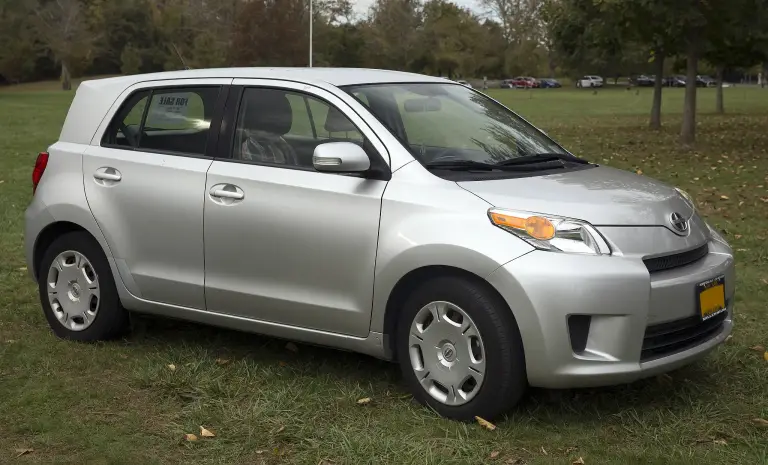
The Scion iQ was the North American version of the Toyota iQ, a city car designed to fit four occupants into as little length as possible. It was sold in the United States and Canada from the 2012 to 2015 model years, always with a 1.3-litre engine and a CVT automatic.
Scion iQ at a glance
| Maker | Scion (Toyota) |
|---|---|
| Production (Scion version) | 2012–2015 model years |
| Also sold as | Toyota iQ (Japan 2008–2016, Europe 2008–2015) |
| Designed at | Toyota European Design and Development, Nice, France |
| Body | three-door city car, four seats |
| Engine (North America) | 1.3 L 1NR-FE four-cylinder |
| Gearbox (North America) | CVT automatic |
| Other engines | 1.0 L three-cylinder; 1.33 L from 2009 |
| Airbags | nine, including a rear curtain airbag |
| Electric version | Scion iQ EV, deliveries from March 2013 |
| Award | Japanese Car of the Year 2008 |
Based on one source; the English Wikipedia article covers the Toyota iQ, of which the Scion iQ was the North American version.
History of the Scion iQ
Design and launch
Following a concept shown at the 2007 Frankfurt Motor Show, the production Toyota iQ debuted at the Geneva Motor Show in March 2008. Japanese sales began in November 2008 and European sales in January 2009, and in 2008 the car was named Japanese Car of the Year. The name is an initialism of intelligence quotient, and Toyota also read the letters as standing for individuality, innovation and quality, a hint at the car’s cubic form and a cue for owners to try new kinds of vehicle. The design was carried out at Toyota’s European Design and Development studio in Nice.
Packaging
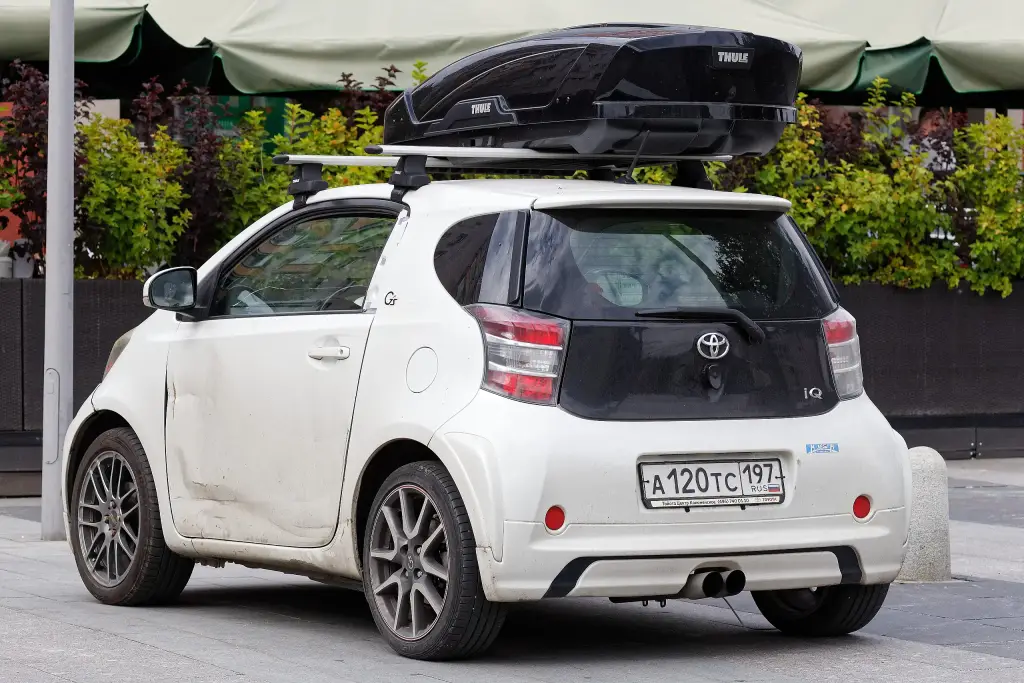
Six solutions made the compact body possible: a differential mounted further forward than usual, a centre take-off steering gear, a flat fuel tank under the cabin floor, rear-angled shock absorbers, a compact heater and air-conditioning unit behind the centre of the asymmetric dashboard, and slimmer seats. The gearbox differential sits ahead of the engine rather than behind it, the starter motor is built into the flywheel and the steering rack is mounted high, which lets the front passenger sit further forward than the driver and gives the rear passengers more legroom. In Japan the car was classified as a supermini because of its width and engine size, although its length met kei car regulations.
The Scion iQ in North America
The Scion version debuted at the 2010 New York Auto Show and went on sale for the 2012 model year, continuing until 2015 alongside the Toyota version. In North America it was offered only with the 1.3-litre 1NR-FE engine and a CVT. A limited-production Scion iQ EV followed: a prototype was shown at the 2011 Geneva Motor Show, deliveries of the electric car with a range of about 80 km began in the United States in March 2013, and production was planned at 600 units, with 400 staying in Japan and 100 each for the United States and Europe.
Design and features
- Space engineering: the front passenger sits ahead of the driver, freeing legroom in the back of a very short car.
- Nine airbags: including a front passenger seat cushion airbag and a rear curtain airbag for back-seat heads.
- Equipment: stability control, traction control, anti-lock brakes, brake assist and electronic brake force distribution were standard.
- Economy: the 1.0-litre version returned 65.69 mpg imp (4.3 L/100 km) on the European cycle.
Scion iQ versions
- 1.0-litre iQ: three-cylinder engine, the original Japanese and European unit.
- 1.33-litre iQ: added in 2009, with a start-stop system on manual cars.
- Scion iQ: the North American model, 1.3-litre engine and CVT only.
- Scion iQ EV: fleet and car-sharing electric version, about 100 cars for the United States.
- Aston Martin Cygnet: a rebadged European variant built from 2011 to 2013.
The iQ was the smallest car in the Scion range alongside the Scion xA and Scion xD. More models are in the Scion collection.
Sources
- Toyota iQ, English Wikipedia: design, packaging, Scion iQ section, EV