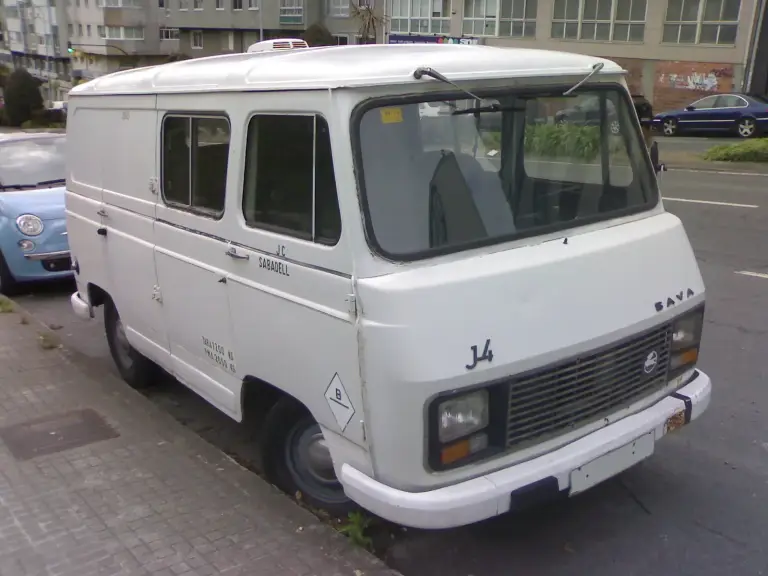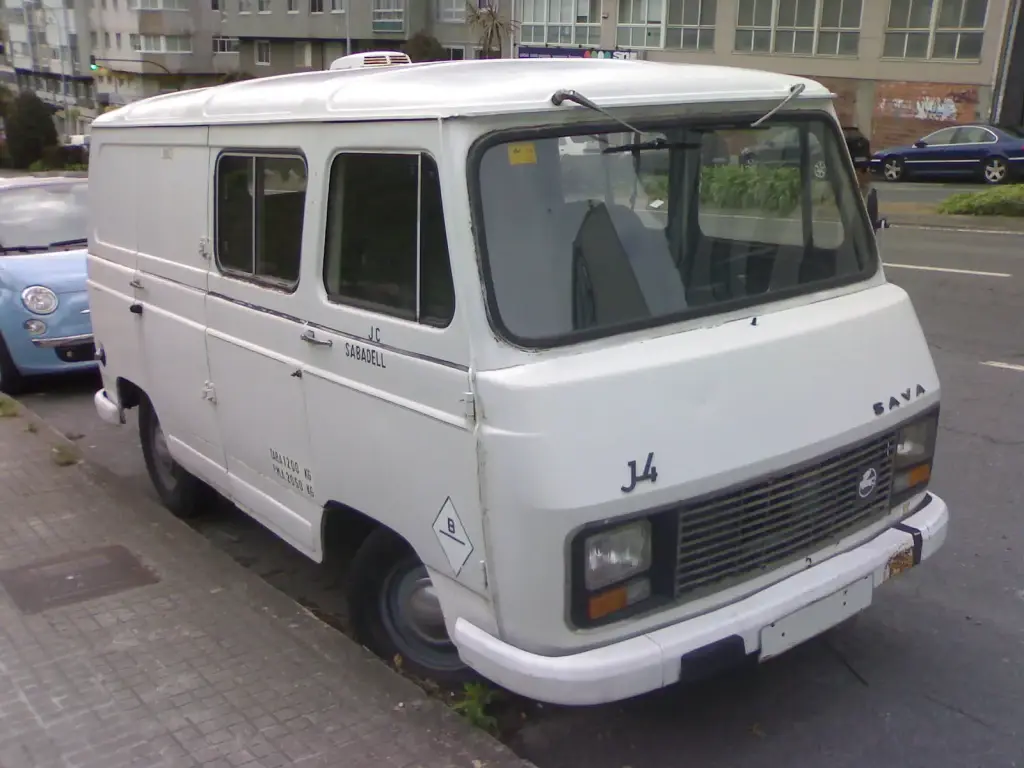
The SAVA J4 was a light van built in Valladolid, Spain, from 1965 to 1989 under licence from Morris. It was the Spanish edition of the British Morris Commercial J4 and stayed in production fifteen years after the original had been replaced, latterly as the Pegaso J4.
SAVA J4 at a glance
| Maker | Sociedad Anónima de Vehículos Automóviles (SAVA), Valladolid |
|---|---|
| Production | 1965–1989 |
| Based on | Morris Commercial J4 (also sold as Austin J4 and BMC J4) |
| Sold as | SAVA-Austin J-4, SAVA J-4, Pegaso SAVA J4, Pegaso J4 |
| Payload at launch | 850 kg |
| First series | 1965–1974, round headlamps |
| Second series | 1974–1978, rectangular headlamps and black grille |
| Third series | 1978–1989, larger rear windows |
| Engines | 1,500 cc diesel; 1,800 cc diesel from 1977 |
| Bodies | van, glazed 9-seat minibus, 5-seat combi, capitoné, pickup, chassis-cab |
| Price | 180,000 pesetas at launch; 236,000 pesetas for the 1977 version |
The English Wikipedia article on the Morris Commercial J4 covers the British van; the section on the Spanish version and the Spanish article on the SAVA J4 supplied the details of the Valladolid production.
History of the SAVA J4
A British van built in Spain
In the early 1960s Spain had no specialised maker of light commercial vehicles, and the market was filled by car-derived vans and imports. SAVA, based in Valladolid, had built BMC models under licence since 1962, and in 1964 its SAVA-BMC range included light and medium trucks and the 1,500 kg LDO-5 van. For a compact delivery vehicle the company chose the BMC J4 M10, the forward-control van sold in Britain as the Morris J4 and Austin J4, and began building it in 1965 with a payload of 850 kg. The official launch of the SAVA-Austin J-4 took place on 28 May 1965. The first Spanish vans were identical to the British ones apart from left-hand drive, and kept the sliding driver’s door that opened inwards, a convenience for delivery work. The gearbox came from Britain as well, which left the gate reversed: first and second to the right of the H, third and fourth to the left. The base price was 180,000 pesetas.
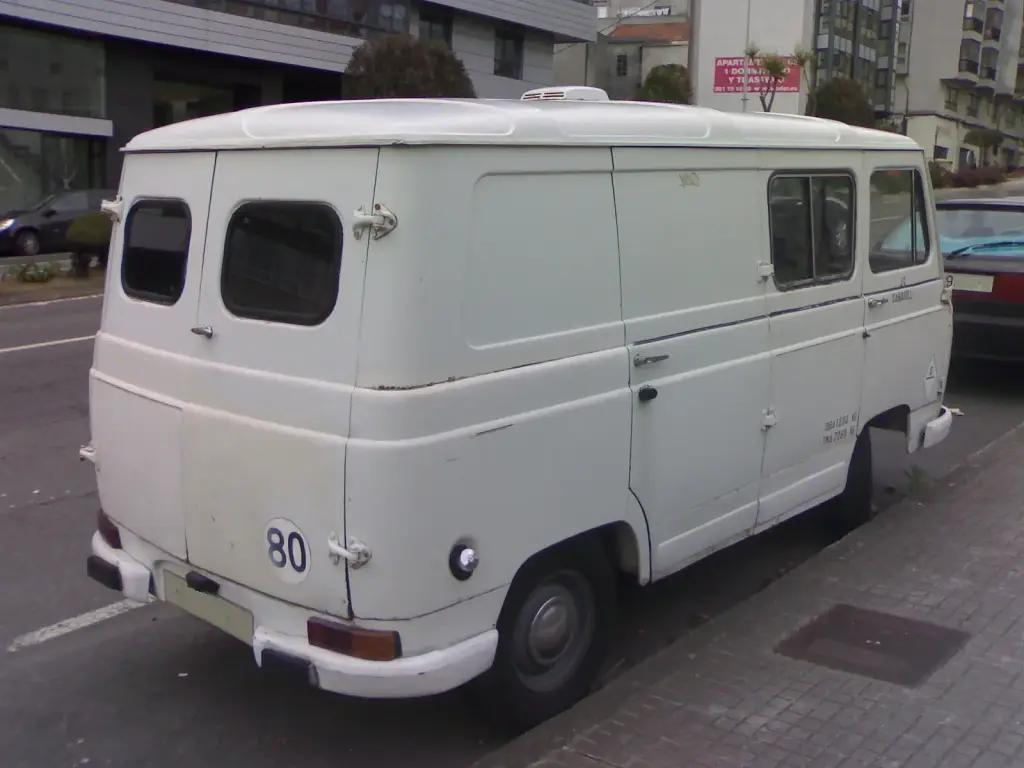
First series, 1965–1974
The original body carried round headlamps and a simple front. The instrument panel was changed in 1971 for one almost identical to that of the SEAT 124, and that panel stayed until 1978. The side door opening was extended down to the lower line of the body, with an access step on the combi and minibus versions. Buyers could have conventional front-hinged doors instead of the sliding one.
Second series, 1974–1978
The body was redesigned in 1974 and the van was renamed SAVA J4 5730. The new front, with a black grille, rectangular headlamps integrated into it and a Pegaso badge, was meant to separate the Spanish van from the Austin version. The first-series tail lamps were kept at first; rectangular lamps and modified front-door hinges arrived in 1975. In 1977 the 1,800 cc diesel was added and the range split into the SAVA J4 1000 with that engine and the SAVA J4 700 with the 1,500 cc diesel. The numbers were the net payload in kilograms. The gearbox was modified so that first gear was synchronised, removing the need to double-declutch on downshifts, and the fuel tank grew. Vented steel wheels replaced the smooth steel rims with hubcaps. The new version sold from 236,000 pesetas.
Third series, 1978–1989
Between late 1978 and early 1979 the body was modernised once more: new rear doors with larger glass, windscreen wipers moved from the top of the screen to the bottom, a new dashboard, key-operated solenoid engine stop in place of the cable that had cut the injection pump supply, and later front disc brakes. The payload designations rose with the gross weights, the J4-700 becoming the J4-800 and the J4-1000 becoming the J4-1100. After ENASA, the maker of Pegaso trucks, took over SAVA, the SAVA name was gradually dropped and the van was sold as the Pegaso SAVA J4 and then simply as the Pegaso J4 until production ended in 1989.
Design and features
- Licence-built Morris: the same shell and mechanical layout as the British J4, with left-hand drive and Spanish diesel engines.
- Payload names: the 700, 800, 1000 and 1100 badges stated the net load in kilograms.
- Three series: round headlamps, then a black grille with rectangular lamps, then larger rear windows and a modernised dashboard.
- Long career: built until 1989, fifteen years after the British J4 gave way to the Sherpa.
- Many bodies: panel van, glazed minibus, combi, capitoné, pickup and chassis-cab.
SAVA J4 versions
- SAVA-Austin J-4 (1965): the original name of the left-hand-drive Spanish van.
- SAVA J4, first series (1965–1974): round headlamps, sliding driver’s door.
- SAVA J4 5730 (1974–1977): rectangular headlamps, black grille and Pegaso badge.
- SAVA J4 700 and J4 1000 (1977–1978): 1,500 cc and 1,800 cc diesel, named for their payload.
- J4-800 and J4-1100 (1979–1989): third-series body with larger rear windows and front disc brakes.
- Pegaso J4: the final badge, used until production ended in 1989.
The J4’s larger stablemate was the SAVA Cosmos, the van SAVA designed without a foreign licence. More commercial vehicles are in the SAVA collection.
Video: Restauración Pegaso Sava J4 1100
Video by Talleres Hnos. Parada S.L. on YouTube.
Sources
- Morris Commercial J4, English Wikipedia: British original, engines, replacement
- SAVA J4, Spanish Wikipedia: three series, names, prices, bodies
- Sociedad Anónima de Vehículos Automóviles, Spanish Wikipedia: company history, ENASA takeover
- SAVA (Spain), English Wikipedia: company history, Pegaso years