The SAVA Cosmos was a range of large vans made by SAVA in Valladolid between 1972 and 1981. It was the first four-wheeled vehicle the company designed entirely on its own, without a foreign licence, and it used fibreglass body panels to keep the weight down and the payload up.
SAVA Cosmos at a glance
| Maker | SAVA, Valladolid, Spain |
|---|---|
| Production | 1972–1981 |
| Class | large van and light truck |
| Engine | Pegaso 4/98, 3.8-litre four-cylinder diesel |
| Power | 76 hp at 2,600 rpm |
| Injection | direct, without turbocharging |
| Compression | 16.5:1 |
| Gearbox | four-speed manual |
| Layout | engine under the front seats, rear-wheel drive |
| Body | steel structure with fibreglass panels |
| Versions | 5700, 5701, 5702, 5720, 5721, 5723, 5740, 5741, 5743, 5744 |
| Gross weight | 3,500 kg for class B licence; up to 6,000 kg |
Based on one source: the Spanish Wikipedia article on the SAVA Cosmos, with the company history from the English and Spanish articles on SAVA.
History of the SAVA Cosmos
A van without royalties
ENASA, the state-owned maker of Pegaso trucks, took over SAVA in 1966. The new owners wanted to cut the number of models that overlapped and competed with each other, and they disliked the foreign licences SAVA had brought with it, among them Berliet and BMC. To replace the LDO-5, which was based on the British Morris LD van, and the older S series, and to stop paying royalties on licensed designs, SAVA began work on a van of its own. The Cosmos was presented in 1972.
Design
The Cosmos was the first four-wheeled vehicle designed entirely by SAVA; the company’s earlier P-54 had three wheels. It did not start from a licensed model, unlike everything the Valladolid firm had built before. The body combined a steel structure with numerous fibreglass elements, which saved weight so that more of the gross weight could go into payload. Its very large windscreen gave the driver excellent visibility, a useful quality in town delivery work.
Engine and chassis
The whole series was powered by the Pegaso 4/98 diesel: four cylinders in line, 3.8 litres, 76 hp at 2,600 rpm, with direct injection but no turbocharger, and a compression ratio of 16.5:1. The engine sat under the row of front seats and drove the rear axle through a four-speed gearbox. The Cosmos was sold as a chassis-cab as well as a completed van, and coachbuilders such as Unicar turned the chassis into minibuses and other bodies.
Versions and the end of production
The range was identified by four-digit numbers according to size, engine and load capacity: 5700, 5701, 5702, 5720, 5721, 5723, 5740, 5741, 5743 and 5744. The 5741 was the long-wheelbase, high-roof model rated at 6,000 kg and 15 cubic metres, while the 5744 was the short-wheelbase, low-roof version at 4,000 kg. Every version could be ordered with a gross weight of 3,500 kg, which allowed it to be driven on an ordinary Spanish class B car licence. Production ended in 1981, and the Cosmos was not replaced by another SAVA design.
Design and features
- Designed in-house: the first four-wheeled SAVA without a foreign licence, so no royalties were paid on it.
- Fibreglass body panels: light for its size, which left more of the gross weight for cargo.
- Pegaso 4/98 diesel: 3.8 litres, 76 hp, direct injection and no turbocharger.
- Under-seat engine: the cab could be short and the load floor long, with rear-wheel drive through a four-speed gearbox.
- Class B option: a 3,500 kg gross weight version could be driven on an ordinary car licence.
SAVA Cosmos versions
- 5700: the base designation of the series.
- 5701 and 5702: chassis for a small bus and a completed bus.
- 5720: chassis-cab for coachbuilders.
- 5721: offered as a van, capitoné or mixed passenger and goods body.
- 5723: long-wheelbase version.
- 5741: long wheelbase, high roof, 6,000 kg and 15 m³.
- 5744: short wheelbase, low roof, 4,000 kg.
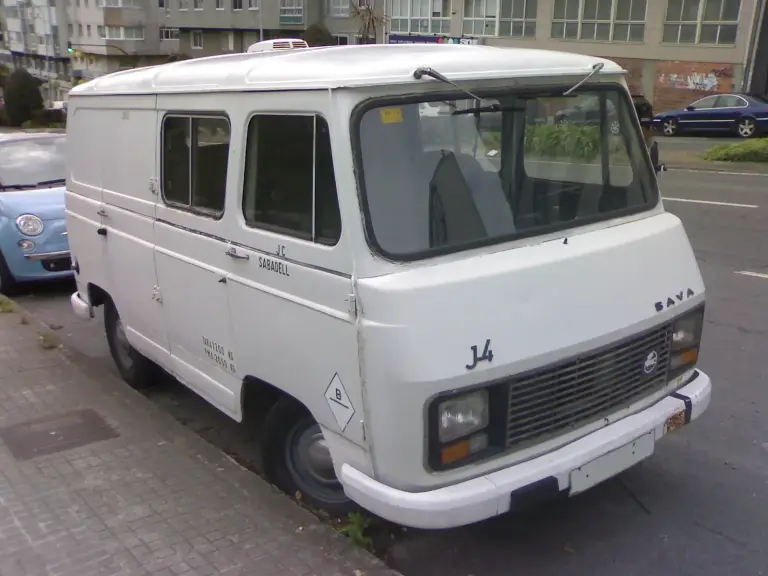
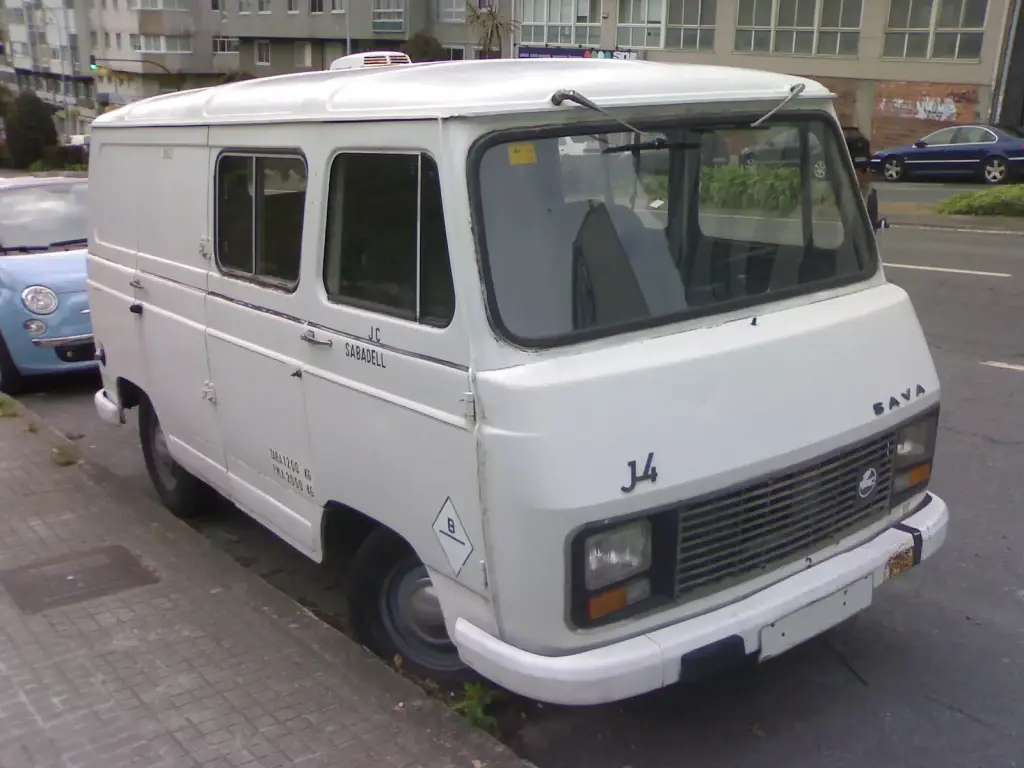
The Cosmos was sold alongside the smaller SAVA J4, the licence-built Morris van that stayed in production until 1989. More commercial vehicles are in the SAVA collection.
Sources
- SAVA Cosmos, Spanish Wikipedia: history, design, engine, versions
- SAVA (Spain), English Wikipedia: company history, ENASA takeover
- Sociedad Anónima de Vehículos Automóviles, Spanish Wikipedia: company history, model range