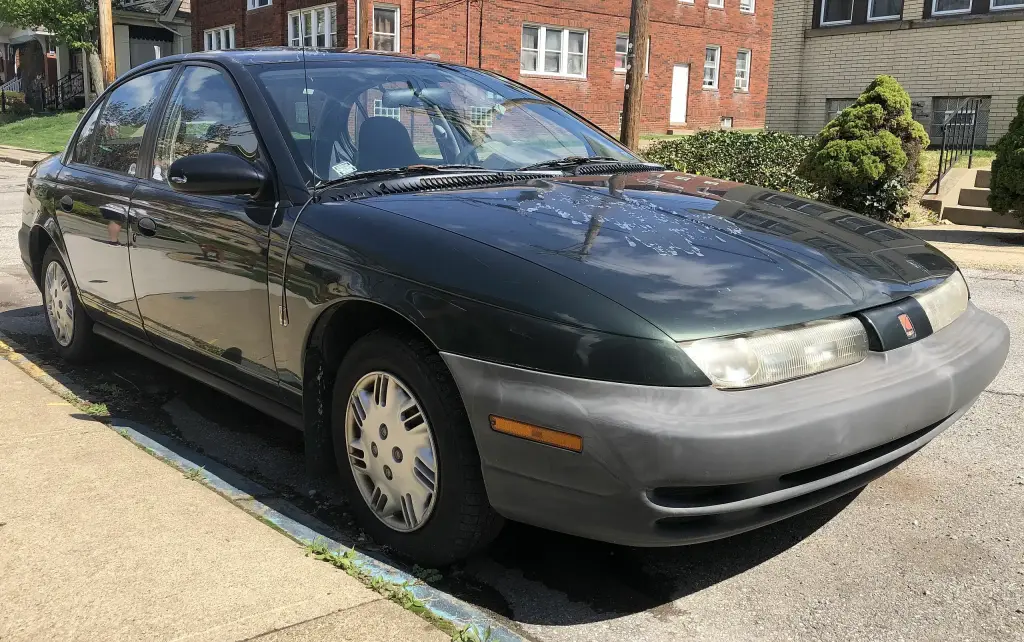
The Saturn S-Series was the car with which General Motors launched Saturn in 1990. It used a steel spaceframe clad in dent-resistant plastic panels, an engine designed in-house rather than borrowed from another GM division, and a single fixed price at every dealer.
Saturn S-Series at a glance
| Production | 1991–2002 model years |
|---|---|
| Assembly | Spring Hill, Tennessee |
| Platform | Saturn Z-body, developed in-house |
| Body styles | SL sedan, SC coupe, SW station wagon |
| Body panels | polymer panels on a steel spaceframe |
| Engine | 1.9 L four-cylinder, SOHC or DOHC |
| Transmissions | five-speed manual or four-speed automatic |
| Trim levels | level 1 with the SOHC engine, level 2 with the DOHC |
| Redesigns | for the 1997 and 2000 model years |
| Highway economy | up to 40 mpg in EPA tests |
| Replaced by | Saturn Ion for 2003 |
Written from the English Wikipedia article on the S-Series, which is the only source used; figures are those given there.
History of the Saturn S-Series
1991: a different kind of General Motors car
Saturn was created to build small cars in a new way, and the S-Series was its first product. Its platform, the Z-body, was developed inside Saturn and shared little with other GM platforms. The construction followed the spaceframe principle pioneered on the Pontiac Fiero: a steel frame carried the loads, while the doors, wings and other panels were made of polymer that resisted dents. Those panels stayed Saturn’s selling point for most of the brand’s life. The first car left the Spring Hill plant on 30 July 1990, a maroon car with a tan interior, and the S-Series went on sale for the 1991 model year with a coupe (SC) and a sedan (SL).
From the start the range was split by engine. The SC came only with the double-overhead-cam version of the 1.9-litre engine, while the SL could be ordered with the single-overhead-cam unit (SL1) or the twin-cam (SL2). The engine was a completely new design made by Saturn itself, not an existing GM unit.
1993–1995: wagons join the range
For 1993 the coupe gained a single-cam option, becoming SC1 alongside the twin-cam SC2, and the range was joined by the SW station wagon in SW1 and SW2 forms. Transmissions followed the same logic: the single-cam cars used the tall-geared MP2 manual and MP6 automatic for economy, the twin-cam cars the shorter MP3 manual and MP7 automatic for performance, and owners sometimes swapped the tall-geared manual into a twin-cam car to save fuel on the motorway. Level 2 cars also brought 15-inch wheels instead of 14-inch, a rear anti-roll bar, the option of rear disc brakes, colour-matched bumpers and more interior equipment. Externally a level 1 and a level 2 were almost impossible to tell apart, except for the SC2, which kept retractable headlamps until the end of the 1996 model year.
1997–2002: two redesigns and the end
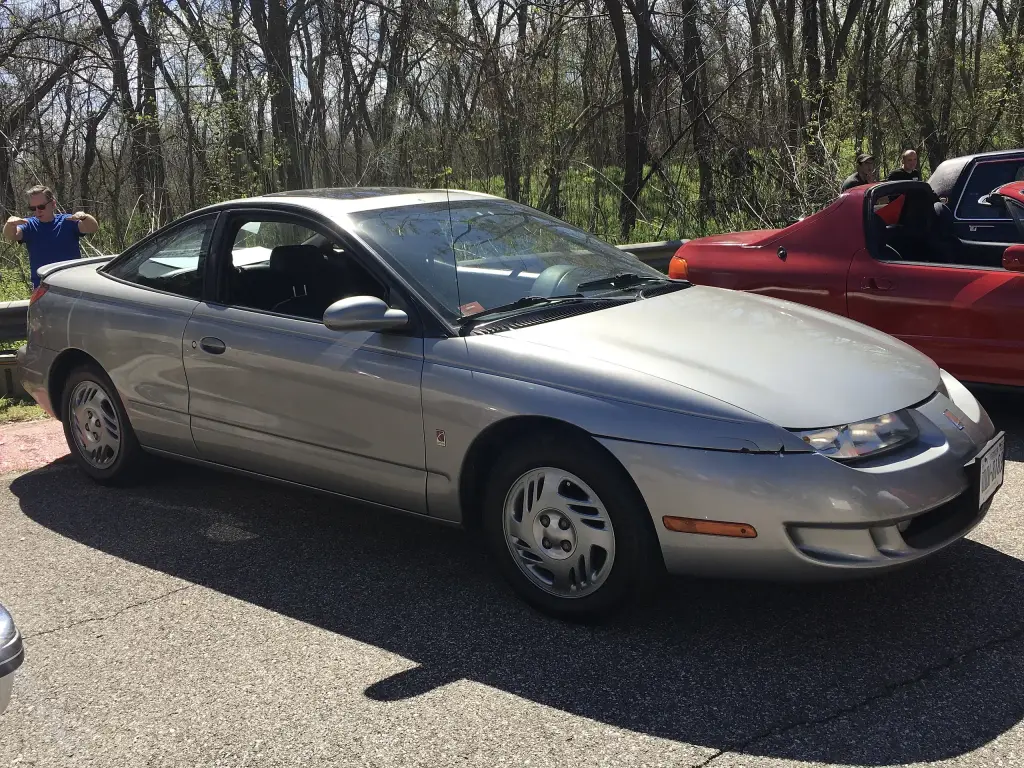
The range was changed twice, for the 1997 and 2000 model years. The redesign that began with the 1999 model year gave the coupe a small rear-hinged door on the driver’s side to improve access to the back seats; Saturn called it the world’s first three-door coupe. The idea of a clamshell door on a coupe had appeared on concept cars such as the 1997 Pontiac Rageous and Mercury MC4, and Mazda showed it again on the RX-8 concept in late 1999. Level 1 cars with the manual gearbox were among the most economical cars on sale in the United States, reaching 40 mpg on the highway in EPA tests of the time. The S-Series was also exported, to Canada from 1992 and to Taiwan and Japan, where right-hand-drive second-generation cars were sold between 1997 and 2001. Production ended with the 2002 model year, and the Saturn Ion took its place.
Design and features
- Polymer panels: a steel spaceframe with dent-resistant plastic body panels, a layout Saturn kept as its trademark.
- Own engine: the 1.9-litre four was designed in-house in single- and double-cam forms.
- Economy: tall gearing in the single-cam cars gave up to 40 mpg on the highway in EPA tests.
- Fixed pricing: the no-haggle policy that came with the brand was pioneered on this car.
- Clamshell coupe door: from the 1999 redesign the coupe had a small rear-hinged door for access to the back.
Saturn S-Series versions
- SL, SL1, SL2: the sedan, with the base SL, the single-cam SL1 and the twin-cam SL2.
- SC, SC1, SC2: the coupe, twin-cam only at first, joined by the single-cam SC1 in 1993.
- SW1, SW2: the station wagon added for 1993 in single- and twin-cam forms.
- Level 1 and level 2: the equipment split that ran across all three bodies.
- 1999-on coupe: the version with the small rear-hinged door on the driver’s side.
The S-Series was replaced by the Saturn Ion, and the bigger L-Series sat above it in the range. More cars are in the Saturn collection.
Sources
- Saturn S-Series, English Wikipedia: history, engines, trims, economy, export