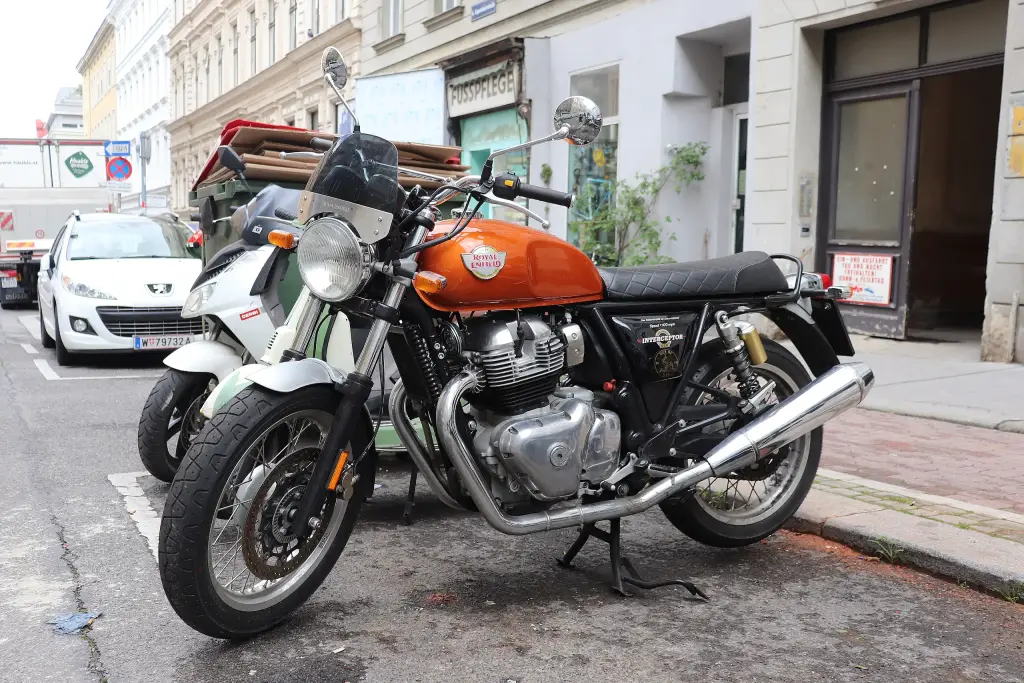
The Royal Enfield Interceptor is a British motorcycle that Royal Enfield built between 1960 and 1970. Its 700 and 750 cc twins were the company’s fastest road models, and the name was revived in 2018 on a 648 cc parallel twin designed in India.
Royal Enfield Interceptor at a glance
| Maker | Royal Enfield, Redditch and Bradford-on-Avon |
|---|---|
| Production | 1960–1970 |
| 700 Interceptor | 692 cc vertical twin, 1960–1961 |
| 750 Interceptor | 736 cc twin, 1962–1970 |
| Bore × stroke | 71 mm × 93 mm (736 cc) |
| 700 production | 158 machines, at most 170 |
| Markets | 700 sold only in the USA and Canada |
| Series 1A | coil ignition, GP7 and TT7 sub-models from 1967 |
| Series 3 prototype | 778 cc, never put into production |
| Revival | Interceptor 650, shown at EICMA in November 2017 |
Based on one source: the English Wikipedia article on the Royal Enfield Interceptor.
History of the Royal Enfield Interceptor
The 700 Interceptor, 1960
The first motorcycle to carry the name was the 700 Interceptor of 1960, a tuned version of Royal Enfield’s 692 cc vertical-twin Constellation. It was sold only in the United States and Canada, and all its engines carried the prefix letters “VAX”, which is why these machines are called VAX Interceptors. Compared with other Royal Enfields it had twin carburettors on all but some early models, a factory lightened and balanced crankshaft, high-performance “R” cams, a Lucas racing magneto with manual advance and several weight-saving changes. An Interceptor “S” with “highway trim” and quick-detachable lights was offered when the standard scrambler version did not sell well enough. The Redditch despatch ledgers record 158 of the 692 cc Interceptors, with a possible maximum of 170; the first left the factory in December 1959 and the last was despatched in July 1961.
Series 1 and 1A
Royal Enfield introduced an all-new 736 cc twin in 1962 on the 750 Interceptor, with a bore and stroke of 71 mm × 93 mm. The engine was similar to the 692 cc unit but hardly a part was left unmodified: the cases were strengthened for the extra torque, and the crankshaft was dynamically balanced at the factory, which made it one of the smoothest British twins. Series 1 had an automatic-advance magneto and a new seat, and a rare single-carburettor version was also built; it lasted until 1966. In 1967 the Redditch factory closed and production moved to Bradford-on-Avon in Wiltshire, where the Series 1A arrived in two sub-models, GP7 and TT7. Its main change was coil ignition in place of the magneto; American models also received a chrome tank, a new seat, instrument mounts, handlebar and mudguards, and all Series 1A Interceptors had twin Mark 1 Amal carburettors.
Series 2 and the end
The Series 2 engine was a major redesign of the Series 1A, with a wet sump for better oil flow to the crankshaft and the contact breaker points moved to the end of the exhaust camshaft, which meant a redesigned timing cover. This engine served until production ended in 1970. Floyd Clymer bought a batch of Series 2 engines for motorcycles he intended to sell under the Indian brand, but he died in January 1970 before production began; Rickman Motorcycles bought the whole batch, fitted each engine in a Rickman chassis and sold them as the Rickman Interceptor. A Series 3 prototype, bored to 73 mm for 778 cc and called the 800 Interceptor, was built to replace the Series 2, but the Bradford-on-Avon factory closed before series production began.
The 2018 Interceptor 650
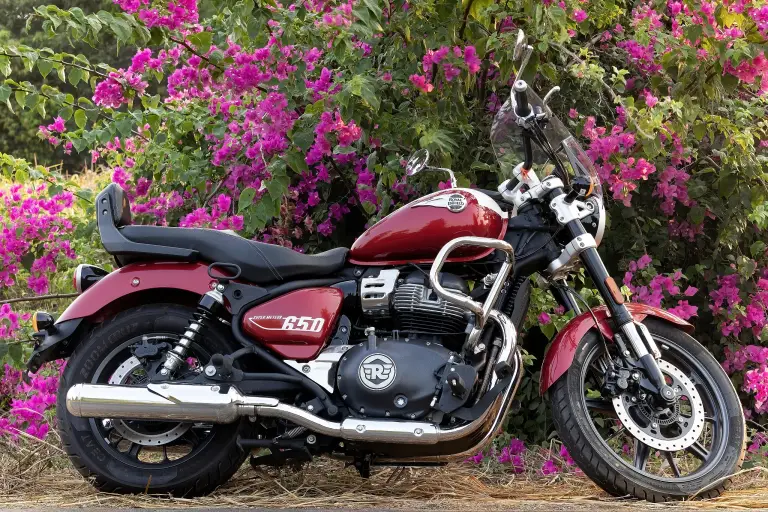
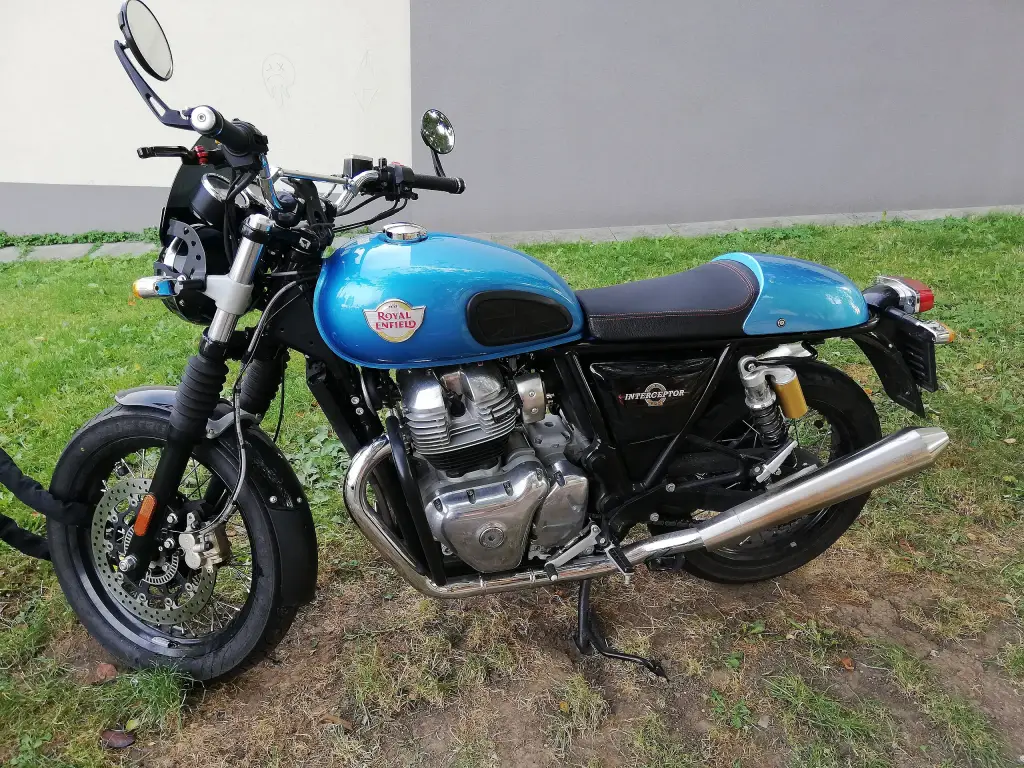
In November 2017 at EICMA Royal Enfield unveiled a new parallel twin, the Interceptor 650, presented by chief executive Siddhartha Lal and president Rudratej Singh. The modern machine is powered by an air-oil-cooled 650 cc parallel twin and draws heavily on the 1960s design, with a tubular cradle frame like the original, a teardrop tank with traditional badges and a Monza-style fuel cap.
Design and features
- Biggest British twin: the 736 cc engine of the 750 was Royal Enfield’s largest and smoothest twin.
- Balanced crankshaft: factory dynamic balancing set the Series 1 apart from other British twins.
- Racing electrics: the 700 used a Lucas racing magneto with manual advance.
- American market focus: the 700 was sold only in the USA and Canada.
- Modern revival: the 2018 Interceptor 650 uses an air-oil-cooled parallel twin in a tubular cradle frame.
Royal Enfield Interceptor versions
- 700 Interceptor (1960–1961): 692 cc VAX-engined twin for the USA and Canada, with an “S” highway-trim version.
- Series 1 (1962–1966): new 736 cc engine with automatic-advance magneto.
- Series 1A (1967–1970): GP7 and TT7 sub-models with coil ignition.
- Series 2: wet-sump engine with contact breakers on the exhaust camshaft.
- Rickman Interceptor: Series 2 engines fitted to Rickman chassis after 1970.
- Interceptor 650 (2018–): the modern 648 cc parallel-twin revival.
The Interceptor was the twin-cylinder flagship of the years when the single-cylinder Bullet was the mainstay, and the modern Interceptor 650 shares the range with the Meteor. More models are in the Royal Enfield collection.
Video: 1970 Royal Enfield Interceptor Series 2. Turn up the VOLUME.
Video on YouTube.
Sources
- Royal Enfield Interceptor, English Wikipedia: models, engines, production