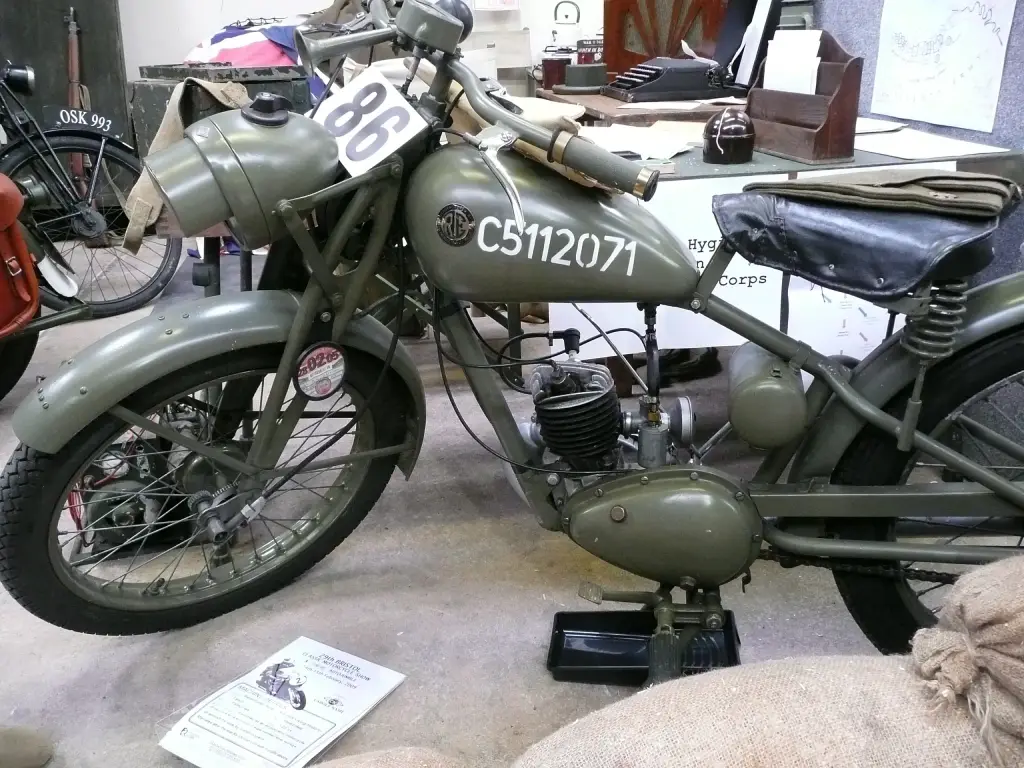
The Royal Enfield WD/RE, known as the “Flying Flea”, was a lightweight motorcycle developed for the British War Office as a way of carrying messages between airborne and assault troops where radio communication was not in place. It could be dropped by parachute or carried in a glider.
Royal Enfield WD/RE at a glance
| Maker | Royal Enfield, Calton Hill, Edinburgh |
|---|---|
| Role | airborne and assault troops messenger |
| Origin | enlarged DKW RT 100, designed by Ted Pardoe |
| Prototypes | two “Royal Baby” machines, Rotterdam, April 1939 |
| Engine | 125 cc two-stroke |
| Carburettor | Amal, later Villiers (marked V on the engine) |
| Production | from December 1942 |
| Delivery | parachute cradle or four per glider |
| Post-war | civilian RE 125, then RE2 (1951–1953) |
| Revival | electric Flying Flea C6 and S6 announced 2024 |
Based on one source: the English Wikipedia article on the Royal Enfield WD/RE.
History of the Royal Enfield WD/RE
Origins: the Royal Baby
In 1938 the German government stopped the Dutch importer of the DKW RT 100, RS Stokvis and Sons, from receiving further supplies because Stokvis was Jewish. Stokvis asked Royal Enfield to produce a similar motorcycle, and Royal Enfield’s replacement was designed by Ted Pardoe, who enlarged the engine to 125 cc. Two prototypes under the name “Royal Baby” were shown at Rotterdam in April 1939, and a few Model RE motorcycles with a less sophisticated but larger two-stroke engine in the same frame were made before the Second World War began.
The War Office order
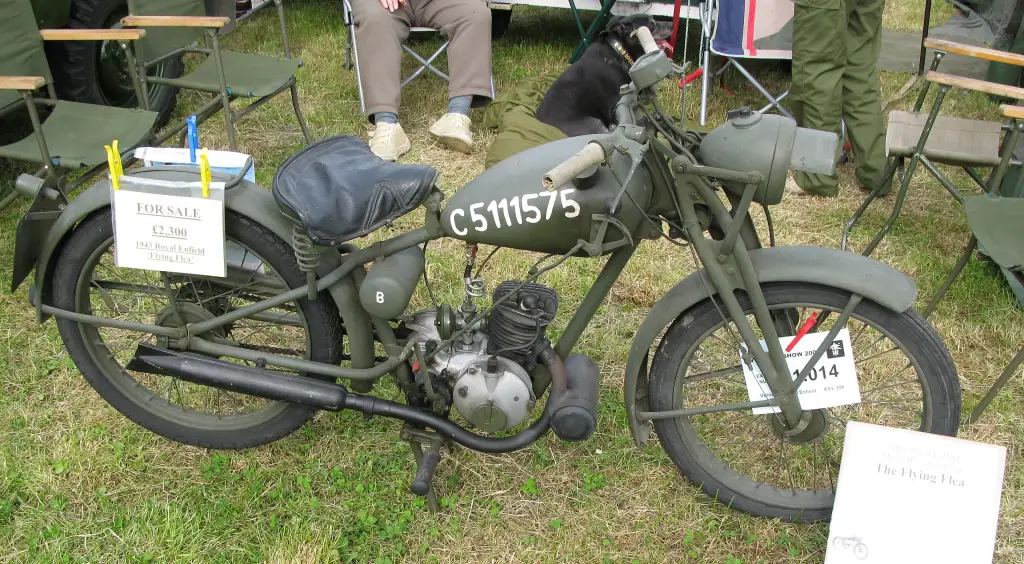
Early in 1942 the War Office ordered twenty WD/RE motorcycles for testing. Based on the 1939 civilian RE, the prototype had a right-hand brake, an Amal carburettor and a low-mounted toolbox. The trials went well and led to changes: a twin-box exhaust to silence the noisy two-stroke, a Villiers carburettor, a raised toolbox, a folding kick-start, footrests and folding handlebars so that the machine could be packed into the smallest possible space, a Miller lighting system, a sealed vent on the fuel filler to stop spillage in the drop carrier, and the foot brake moved to the left. The motorcycle had to survive a drop, so from summer 1942 experiments were made with a protective cradle; cradles were tested from the bomb racks of aircraft such as the Halifax and Lancaster, and the early versions bent the wheels on impact until heavier tubing and more bracing solved the problem. Production began in December 1942 at Royal Enfield’s Calton Hill factory in Edinburgh.
In service
The first significant orders came early in 1943. Few WD/REs were actually parachuted into battle: most were loaded four at a time into troop-carrying gliders without their protective frames and secured by a special harness. The machines were also used for beach landings in 1943 and 1944, carried inside landing craft for communication between the beaches and the nearest front-line forces. Early production examples had a small tail light and a military headlamp cowl to hide the motorcycle and rider from enemy aircraft; the WD/RE could run on any petrol, and a soldier could carry its light weight over terrain no vehicle could cross.
After the war
Post-war demand for cheap transport led to war-surplus WD/REs being stripped and repainted for civilian use, mostly at Enfield’s Bradford-on-Avon works in Wiltshire, and a few stayed in limited military use until the end of the 1940s. Royal Enfield developed a civilian version, the RE 125, with hand gear change and girder forks at first, updated in 1950 with foot gear change and a telescopic fork with damped springing. The RE2 followed in 1951 with a redesigned frame and engine and was built until 1953, when the Royal Enfield Ensign superseded it. In February 2020 Eicher Motors registered the “Royal Enfield Flying Flea” trademark with the European Union Intellectual Property Office, and on 4 November 2024 Royal Enfield announced that the name would return as a range of lightweight electric motorcycles, beginning with the C6 and S6.
Design and features
- Airborne transport: light enough to be dropped by parachute in a cradle or carried four at a time in a glider.
- Folding parts: folding kick-start, footrests and handlebars let the motorcycle be packed into a drop carrier.
- Silenced two-stroke: a twin-box exhaust tamed the noise of the 125 cc engine.
- Field simplicity: it ran on any petrol and could be carried over ground vehicles could not cross.
- Long afterlife: the design continued as the civilian RE 125 and RE2 until 1953.
Royal Enfield WD/RE versions
- WD/RE (1942–1945): the wartime Flying Flea, with Amal or Villiers carburettor.
- Civilian RE 125: post-war conversion with hand gear change and girder forks.
- RE 125 (1950): foot gear change and telescopic front fork.
- RE2 (1951–1953): redesigned frame and engine, replaced by the Ensign.
The Flying Flea was the wartime single that kept the Bullet company busy; after the war its civilian versions lived alongside the Classic line’s ancestors. More models are in the Royal Enfield collection.
Video: Royal Enfield flying flea 1946/47 (GoPro) (POV)
Video on YouTube.
Sources
- Royal Enfield WD/RE, English Wikipedia: development, service, post-war models