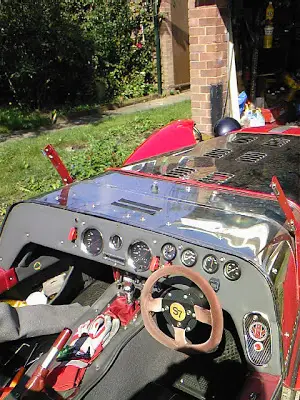
The Robin Hood S7 was the model that turned Robin Hood Engineering from a maker of Ferrari replicas into a producer of cheap Seven-style kit cars. Introduced in 1989, it copied the Lotus Seven Series 3 rather than the Series 4, whose rights Caterham Cars had bought, and it was sold to be built on Triumph and Ford running gear.
Robin Hood S7 at a glance
| Maker | Robin Hood Engineering Ltd, Nottinghamshire |
|---|---|
| Introduced | 1989 |
| Type | open two-seat kit car |
| Inspired by | Lotus Seven |
| Version copied | Series 3, not the Series 4 owned by Caterham |
| Donor vehicles | Triumph TR7, then Triumph Dolomite; later Ford Cortina and Ford Sierra |
| Engines | 1,100 cc to 2,000 cc from the donor |
| Price of the 1989 TR7-based car | £995 plus VAT for the kit |
| Legal action | High Court action by Caterham Cars, settled by agreement |
| Company years | kit car production 1980–2006 |
| Successor company | Great British Sports Cars Ltd, from 2006 |
Based on one source in two languages: the English and German Wikipedia articles on Robin Hood Engineering. The S7 has no page of its own, so the article uses the sections on the company and its early models.
History of the Robin Hood S7
From Daytona replicas to a Seven
Robin Hood Engineering began in Sherwood, Nottinghamshire, building Ferrari Daytona replicas on Rover SD1 running gear and later on Jaguar XJ12 mechanicals. In 1989 the product range was turned over completely: the company started making the Robin Hood S7, a kit car inspired by the Lotus Seven. The Seven it copied was the Series 3, not the Series 4 whose rights Caterham Cars had acquired after Lotus ended production.
Cheap kits and donor cars
In the same year a Robin Hood based on the Triumph TR7 was introduced at £995 plus VAT, and enthusiasts responded well enough for several kits to be sold. Development continued, and customer feedback showed that a range of engine sizes was needed so that more people could afford to run such a car. The Triumph Dolomite then replaced the TR7 as the donor vehicle, with engines from 1,100 cc to 2,000 cc proving popular. The company also built a sheet-steel monocoque chassis using the Triumph Dolomite, Ford Cortina and Ford Sierra as donors.
The Seven-inspired cars came with a promise that set Robin Hood apart: one kit plus one donor vehicle equalled a car on the road, instead of the builder hunting through scrapyards for a mixture of parts. That policy, and the low price, were the firm’s main selling points.
The Caterham court case
A High Court action by Caterham Cars almost stopped production. Legal advice found a remedy, an agreement was reached, and Robin Hood Engineering was careful afterwards not to depart from the guidelines set down as a result. Among the terms, the word ‘seven’ was not to be used in the company’s promotions, and the settlement also covered green cars with a yellow nose cone. The model was therefore marketed under the S7 name.
Peak years and the end
Sales of Robin Hoods peaked at over 500 kits a year in 1996 and 1997, which paid for larger premises at Mansfield Woodhouse and extensive new CNC machinery. The single vehicle approval test of 1998 then made buyers cautious and the whole kit car industry suffered. The company answered with a new tubular chassis and the 2B kit in 1999. In 2006 the assets of Robin Hood Sports Cars were sold and bought by Great British Sports Cars Ltd.
Design and features
- Seven Series 3 layout: an open two-seater copying the earlier Lotus Seven rather than the Caterham-owned Series 4.
- Low price: the 1989 TR7-based kit was advertised at £995 plus VAT.
- Simple donors: Triumph TR7, Dolomite, Ford Cortina and Sierra mechanicals, with engines from 1,100 to 2,000 cc.
- One kit, one donor: everything except the donor car came in the box.
Robin Hood S7 versions
- S7 (1989 onwards): the Lotus Seven Series 3-inspired kit.
- TR7-based Robin Hood (1989): the cheaper car introduced alongside it at £995 plus VAT.
- Dolomite-engined cars: the later and more popular donor choice, 1,100–2,000 cc.
- Monocoque models: sheet-steel chassis cars on Dolomite, Cortina and Sierra donors.
- 2B (1999): the tubular-chassis successor.
The S7 was followed by the Robin Hood 2B with its tubular chassis; the whole story is in the Robin Hood collection.
Video: Kit Car Robin Hood S7 Santa Pod RWYB 2013
Video by Daniel Sharman on YouTube.
Sources
- Robin Hood Engineering, English Wikipedia: company history, Lotus Seven copy, court case, donors
- Robin Hood Engineering, German Wikipedia: S7 introduction, prices, sales peak, takeover