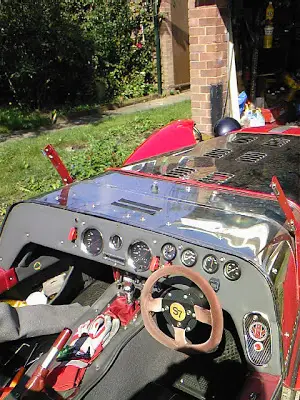
The Robin Hood 2B was the model with which Robin Hood Engineering of Mansfield Woodhouse, Nottinghamshire, replaced its ageing monocoque kit range at the end of the 1990s. Its new chassis was built from steel tube and nicknamed ‘tubey’ by the staff; ‘Project 2B’ became the name of the kit.
Robin Hood 2B at a glance
| Maker | Robin Hood Engineering Ltd, Mansfield Woodhouse, Nottinghamshire |
|---|---|
| Introduced | 1999 |
| Chassis | tubular steel space frame, nicknamed ‘tubey’ |
| Main tube diameter | 38 mm |
| Tube bending | about five minutes for the set |
| Jig assembly and welding | about one hour |
| Kits collected | 205 between 21 August and 11 December 1999 |
| Build principle | one kit and one donor vehicle |
| Earlier chassis | sheet-steel monocoque, no tubes |
| Company history | kit cars from 1980 to 2006 |
| Successor company | Great British Sports Cars Ltd, from 2006 |
Based on one source in two languages: the English and German Wikipedia articles on Robin Hood Engineering, which cover the 2B as part of the company history rather than on a page of its own.
History of the Robin Hood 2B
A company under pressure
Robin Hood Engineering was founded in Sherwood, Nottinghamshire, and began by making Ferrari Daytona replicas on Rover SD1 and later Jaguar XJ12 running gear before turning to Lotus Seven-inspired kit cars in 1989. By the middle of the 1990s the company was selling more than 500 kits a year, a figure reached in both 1996 and 1997, and it moved to a larger factory at Mansfield Woodhouse covering 30,000 square feet (2,800 m²) on a one and a half acre site. Its best single collection day, in 1997, accounted for 125 comprehensive kits.
The single vehicle approval test
The introduction of the single vehicle approval test in 1998 changed the market. Buyers were unwilling to begin a build while the rules were still unclear, and the government postponed the implementation dates several times, which affected the whole British kit car industry. Sales fell just as the firm had invested heavily in new CNC machinery, and the licence to manufacture its monocoque chassis was about to expire.
A new chassis and a new name
With a team of chassis designers the company developed an entirely new frame rather than extending the life of the old one. The result was a tubular steel chassis made mainly from 38 mm tube, which the workforce called ‘tubey’. According to the German Wikipedia account, bending the tubes took about five minutes and assembling and welding the frame about an hour — a recipe aimed squarely at a cheap, repeatable kit. The commercial name chosen for it was Project 2B, and the model is known as the Robin Hood 2B.
The 2B carried over the company’s central selling point: one kit plus one donor vehicle equalled a car on the road, instead of sending the builder around scrapyards for a collection of odd components. Between the bulk collection dates of 21 August and 11 December 1999 exactly 205 kits were taken by customers.
Design and features
- Tubular chassis: a space frame of 38 mm steel tube, nicknamed ‘tubey’, replacing the earlier sheet-steel monocoque.
- Quick to build: the designers aimed at a frame that could be bent, jigged and welded in about an hour.
- One kit, one donor: the company’s long-standing promise that a single donor car supplies everything else.
- Bulk collections: customers collected kits on fixed dates; 205 went out in under four months of 1999.
Robin Hood 2B versions
- 2B kit (1999 onwards): the standard kit as collected by customers.
- Earlier Robin Hood monocoque models: the sheet-steel cars the 2B replaced.
- Later Zero: the model sold by Great British Sports Cars after it bought the assets in 2006.
The 2B followed the Robin Hood S7 and the other Seven-inspired kits; the company’s story is in the Robin Hood collection.
Video: Nurburgring in the wet in a Robin Hood 2B
Video by thegrimcreeper on YouTube.
Sources
- Robin Hood Engineering, English Wikipedia: company history, production figures, 2B chassis
- Robin Hood Engineering, German Wikipedia: chassis dimensions, build times, takeover date