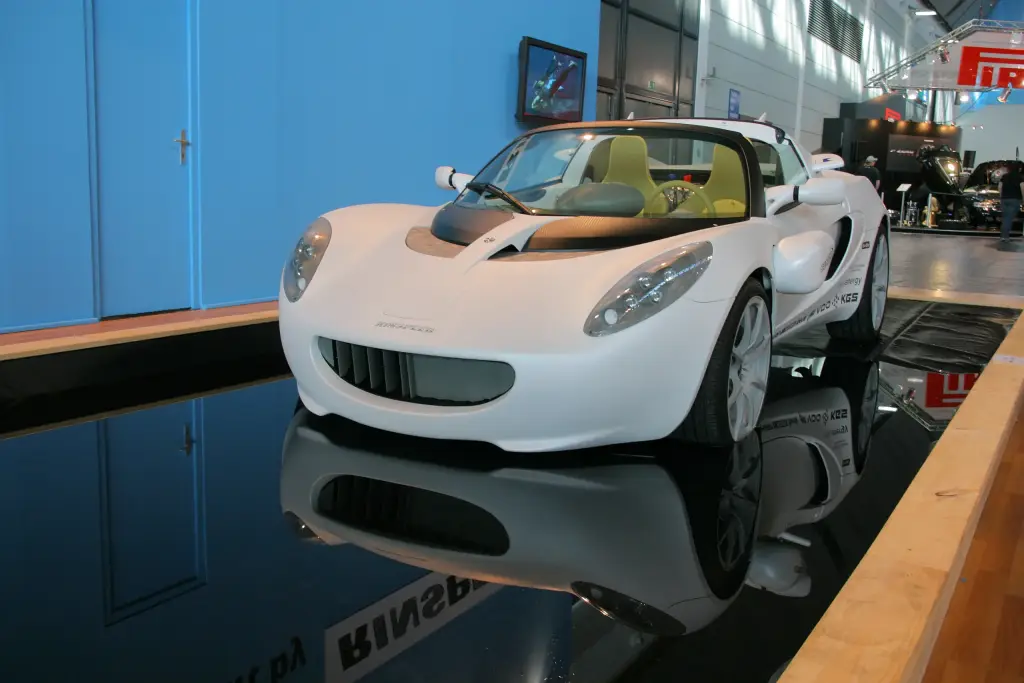
The Rinspeed sQuba is a concept car developed by the Swiss company Rinspeed and presented in Geneva in 2008. It is the world’s first car that can be driven both on land and underwater, and the idea came from the James Bond film The Spy Who Loved Me.
Rinspeed sQuba at a glance
| Maker | Rinspeed, Switzerland |
|---|---|
| Presented | Geneva Motor Show, 16 March 2008 |
| Base | Lotus Elise chassis |
| Drive | all electric, three motors |
| Batteries | rechargeable lithium-ion |
| Land top speed | 120 km/h |
| Surface speed on water | 6 km/h |
| Underwater speed | 3 km/h |
| Diving depth | up to 10 m |
| Crew | driver and one passenger |
| Prototype cost | more than US$1.5 million |
The sQuba is covered by its own article on the English Wikipedia; the company background comes from the article on Rinspeed.
History of the Rinspeed sQuba
The idea came from Rinspeed founder and CEO Frank M. Rinderknecht, inspired by the 1977 James Bond film The Spy Who Loved Me, and the chassis of the Lotus Elise serves as the base for the car. The sQuba was presented to the public for the first time at the Geneva Motor Show on 16 March 2008, thirty years after the film appeared.
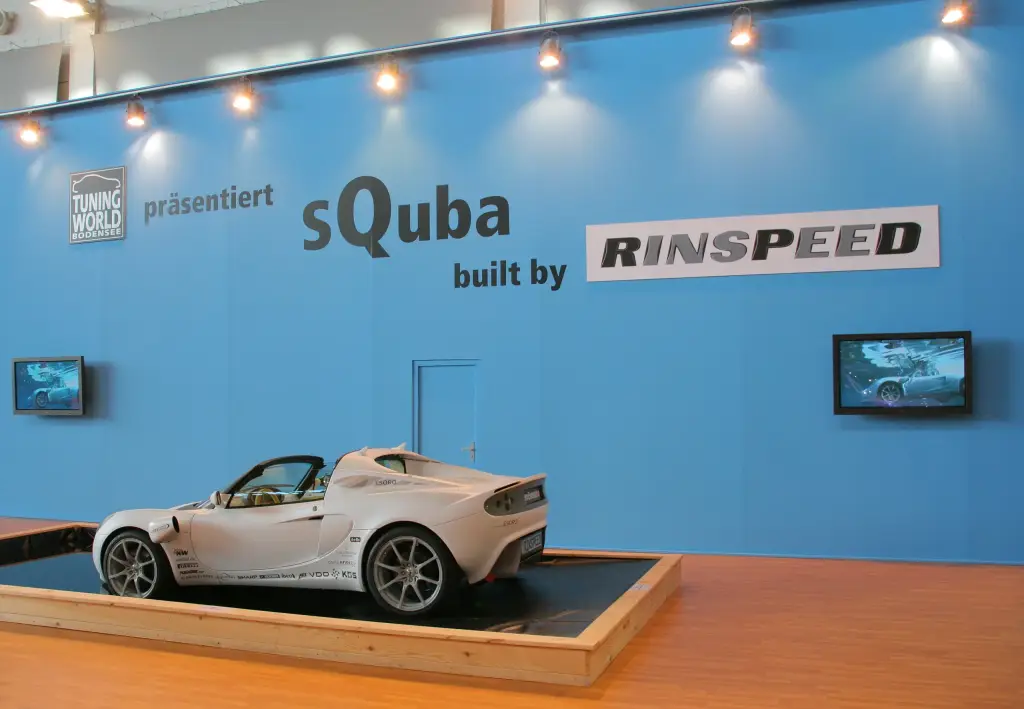
The car is a zero-emission, all-electric vehicle with three motors: one for land travel and two for water. It drives on land with an electric rear-wheel-drive powertrain fed by rechargeable lithium-ion batteries, and its top speed there is 120 km/h. On reaching water it floats until the driver floods the interior, which submerges it. Underwater it is driven by twin electric propellers helped by two Seabob water jets and travels like a submarine rather than along the bed, reaching 3 km/h; on the surface the speed is 6 km/h.
The vehicle has an open cockpit so that the occupants can get out easily in an emergency, and it carries a driver and one passenger. Underwater they breathe through scuba-style regulators from air carried in the car, and without occupants on board the sQuba surfaces automatically. The twin water jets sit on rotating louvres at the front and provide steering and lift, while the propellers at the rear push the car forward. The interior is resistant to water and salt so that the car can be used in the sea, and a laser sensor system from the cruise-control specialist Ibeo allows autonomous operation.
The working prototype cost more than US$1.5 million to build. Rinderknecht said that a production version would cost less than a Rolls-Royce, but no production schedule was ever made, and he admitted in 2008 that a car able to dive would have limited appeal; it was to be marketed as a toy for rich people. As of 2021 the 2008 sQuba was still listed on the Rinspeed website as a project, with no news of availability or price.
Design and features
- Land and water: the world’s first car that can be driven both on land and underwater.
- Three electric motors: one drives the car on land, two drive it in the water, all fed by lithium-ion batteries.
- Diving to 10 metres: the driver floods the interior to submerge, and the car travels like a submarine.
- Scuba breathing: occupants breathe through regulators from air carried on board, and the car surfaces on its own when empty.
- Autonomous option: a laser sensor system from Ibeo allows the car to operate without a driver.
Rinspeed sQuba versions
- sQuba prototype (2008): the only car built, shown in Geneva.
- Land mode: rear-wheel electric drive, 120 km/h.
- Water modes: 6 km/h on the surface, 3 km/h submerged.
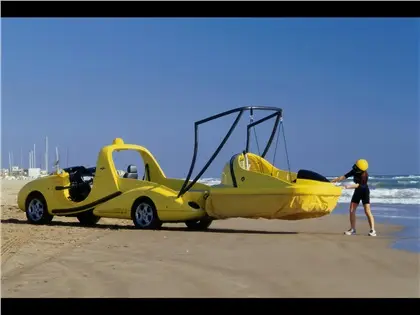
The surface equivalent of the sQuba is the hydrofoil Splash, and the Bedouin is another study that changes its body for a different job. All of them sit under Rinspeed.
Video: Rinspeed sQuba
Video on YouTube.
Sources
- Rinspeed sQuba, English Wikipedia: drive, depths, speeds, cost, history
- Rinspeed, English Wikipedia: company background