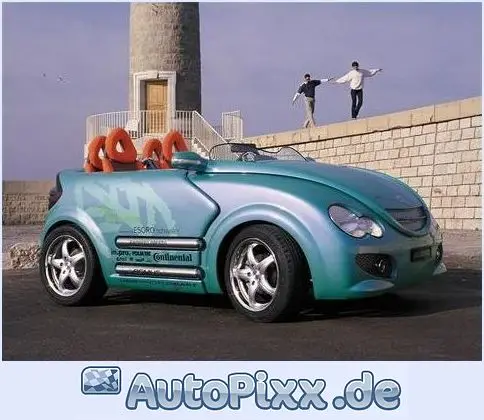
The Rinspeed Presto is a concept car from the Swiss company Rinspeed, unveiled in 2002. At the touch of a button it expands from a 2.7-metre, two-seat cabriolet into a 3.6-metre four-seater, and it runs on natural gas.
Rinspeed Presto at a glance
| Maker | Rinspeed, Switzerland |
|---|---|
| Unveiled | 2002 |
| Short length | 2.7 m, two seats, cabriolet |
| Long length | 3.6 m, four seats |
| Extension | 746 mm, to a full length of 3.74 m |
| Body | pre-preg composite plastic |
| Fuel | natural gas and diesel, dual-fuel |
| Engine | 1.7-litre four-cylinder common-rail turbo diesel |
| Engine basis | Mercedes-Benz A-Class |
| Roof and doors | none |
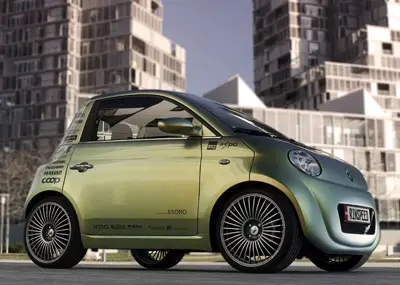
The Presto has no illustration on Commons, so this page uses the photograph already attached to the entry.
History of the Rinspeed Presto
The Presto was unveiled in 2002. In its short form it is a 2.7-metre, two-seat cabriolet; press a button and it becomes a 3.6-metre, four-seater. The body is made of pre-preg composite plastic and the car runs on natural gas.
The transformation is made possible by a centrally located electric motor, which stretches the vehicle with the help of two mechanical screw-and-nut gears by exactly 746 millimetres, to its full extended length of 3.74 metres. The longitudinal members run on low-friction precision rollers and disappear like a drawer in the rear of the floor pan. Despite the variable length, the engineers managed to give the adjustable floor pan the torsional rigidity needed in a roadster. To ensure operational safety the extension mechanism also has self-locking safety latches. The car has neither a roof nor doors.
The engine is a four-cylinder, 1.7-litre common-rail turbo diesel in dual-fuel configuration, based on a Mercedes-Benz A-Class unit, and it runs on a mixture of natural gas and diesel fuel in a 40/60 ratio. Natural gas is a clean-burning fuel consisting almost entirely of methane with a sulphur content close to zero, but a diesel engine has no spark plug to ignite it, so running on gas alone is technically impossible. Instead the gas is injected into the intake air, and the diesel injected into the combustion chamber ignites the mixture of gas and air.
To convert the turbocharged in-line engine to dual-fuel operation the car needed a tank for the natural gas and a gas-injection system; at the heart of the changes is a reprogrammed engine management system. If the system fails, it reverts to the standard diesel mapping, which gives the same reliability as the production car.
Design and features
- Variable length: a central electric motor and two screw-and-nut gears stretch the car by 746 mm.
- Drawer floor pan: the longitudinal members run on precision rollers and slide into the rear of the floor pan.
- Rigid when extended: the adjustable floor pan was designed with the torsional rigidity of a roadster.
- Dual-fuel diesel: natural gas and diesel at a 40/60 ratio, with a reprogrammed engine management system.
- Fail-safe mapping: a fault reverts the engine to its standard diesel settings.
Rinspeed Presto versions
- Short configuration: 2.7 m, two seats, open body.
- Extended configuration: 3.74 m with the mechanism fully out, four seats.
- Dual-fuel engine: the only power unit described for the car.
Two other studies from the same workshop are the Rinspeed Senso, which reads the driver’s mood, and the amphibious sQuba. The rest of the series is under Rinspeed.
Video: Rinspeed Presto
Video on YouTube.
Sources
- Rinspeed Presto, English Wikipedia: dimensions, mechanism, engine and dual-fuel operation