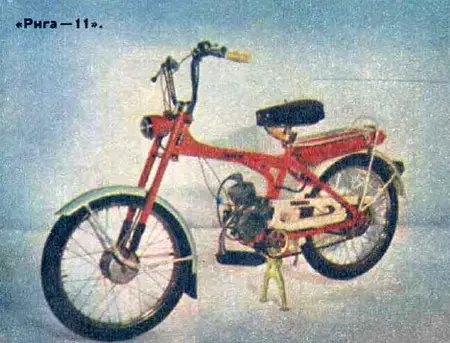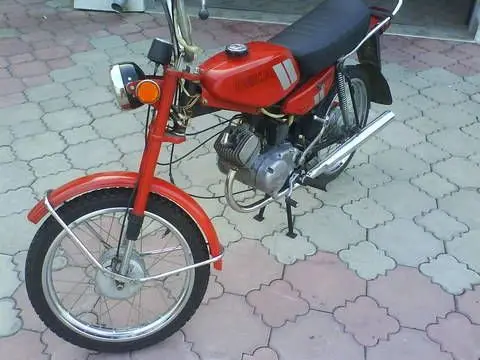
The Riga-13 was the light moped that replaced the Riga-11 at the Riga Motor Factory “Sarkanā zvaigzne”. It went into production in 1983 and stayed on the line until 1998, which made it the most mass-produced model of the whole Riga family.
Riga-13 at a glance
| Maker | Riga Motor Factory “Sarkanā zvaigzne”, Riga, Latvian SSR |
|---|---|
| Production | 1983–1998 |
| Predecessor | Riga-11 |
| Engine | 1.3 hp two-stroke |
| Early engines | D-8 |
| Most common engines | D-8E and D-8M |
| Top speed | 40 km/h |
| Lighting | good output, with a high-voltage transformer |
| Known weaknesses | ignition drift and a fragile clutch cover |
| Place in the range | the most mass-produced Riga moped |
The Riga-13 has no article of its own: it is described in one section of the Russian Wikipedia article on the Riga mopeds, which is the only source for the model. Based on one source.
History of the Riga-13
A light moped for the 1980s
The Riga-13 arrived in 1983 as the successor to the Riga-11. It was a light moped with a 1.3 hp engine and a top speed of 40 km/h, and in the course of its long production run it became the most numerous model the factory ever built.
Engines of the D-8 family
Early Riga-13s were fitted with the D-8 engine, while the most widespread versions used the D-8E and D-8M. These were simple two-stroke units of the kind that powered a whole generation of Soviet light mopeds, and their faults shaped the reputation of the model.
Lighting and ignition
One of the distinguishing points of the Riga-13 was its good lighting, helped by a high-voltage transformer that removed the frequent problems with the ignition coil. The ignition itself, however, often drifted out of adjustment: the getinax hammer of the breaker wore against the cam of the magnet, a typical failing of the D-series engines. On the D-6 the mounting of the magneto rotor had also been “modernised” by reducing the depth of the knurling, so the magnets could tear away from the central sleeve and the ignition stopped working altogether.
A long life
The model remained in production until 1998. Its most often mentioned defect was the frequent breakage of the clutch cover, a small weakness that did not stop the Riga-13 from becoming the most common moped to leave the Riga works.
Design and features
- 1.3 hp engine: a light two-stroke giving a top speed of 40 km/h.
- D-8 engine family: the D-8 on early bikes, with the D-8E and D-8M the most common units.
- Good lighting: a high-voltage transformer cured the usual ignition-coil troubles.
- Ignition drift: the getinax breaker hammer wore against the magnet cam, a known D-series weakness.
- Fragile clutch cover: the most frequently reported breakdown of the model.
Riga-13 versions
- Early Riga-13: fitted with the D-8 engine.
- D-8E version: one of the two most widespread engine fitments.
- D-8M version: the other common engine, built until the end of production in 1998.
The Riga-13 replaced the Riga-11 and was built alongside the factory’s later mokick, the Delta. More mopeds are in the Riga collection.
Video: Riga 13 taastamine
Video on YouTube.
Sources
- Рига (мопед), Russian Wikipedia: production years, engines, ignition faults, weaknesses
- Riga (moped), English Wikipedia: context of the Riga range