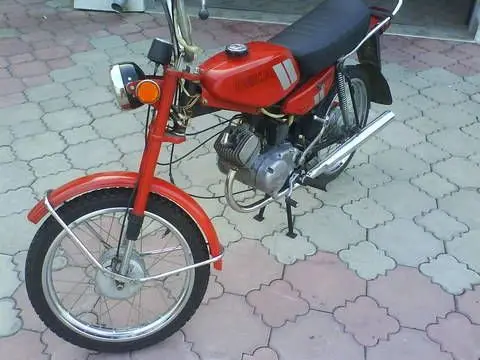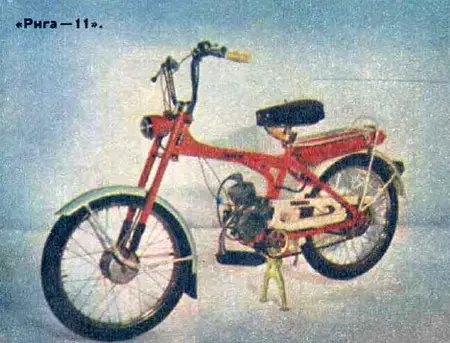
The Riga-11 was the moped that replaced the Riga-7 at the Riga Motor Factory “Sarkanā zvaigzne” in 1976. It was developed as a hybrid of the Riga-7 and the projected Riga-9, but the automatic-clutch engine intended for it was abandoned after testing, and the frame was reworked around the D-6 engine.
Riga-11 at a glance
| Maker | Riga Motor Factory “Sarkanā zvaigzne”, Riga, Latvian SSR |
|---|---|
| Production | from 1976 |
| Predecessor | Riga-7 |
| Conceived as | a hybrid of the Riga-7 and the projected Riga-9 |
| Intended engine | automatic-clutch unit, dropped after tests |
| Production engine | D-6 |
| Wheels | smaller diameter, with thicker tyres |
| Fuel tank | under the luggage rack |
| Frame | new design, proved weak in service |
| Successor | Riga-13 |
The Riga-11 has no article of its own: it is described in one section of the Russian Wikipedia article on the Riga mopeds. Based on one source.
History of the Riga-11
A replacement for the Riga-7
The Riga-7 had been in production since 1969, and in 1976 it was taken out of production and replaced by the Riga-11. The new moped was not a clean-sheet design: it came out as a hybrid of the Riga-7 and the prospective Riga-9, the more advanced machine that the factory was preparing at the time.
The automatic clutch that never was
Under the Riga-11 name the factory had intended to build a moped with an engine and an automatic clutch, following the direction promised by the Riga-9. After testing, however, the maker refused to fit that engine, and the frame of the Riga-11 was altered to take the D-6 engine instead. The production moped therefore kept the well-known engine of the earlier generation in a chassis of its own.
An original look with practical penalties
The Riga-11 was given wheels of smaller diameter but with thicker tyres, and its unusual appearance attracted buyers. In everyday use, though, the style worked against the machine. The fuel tank sat under the luggage rack, which made riding uphill more difficult, especially when there was little petrol left, and the original frame turned out to be fragile. The model was eventually replaced by the Riga-13.
Design and features
- Hybrid development: the Riga-11 combined the Riga-7 with ideas from the projected Riga-9.
- D-6 engine: fitted after the planned automatic-clutch engine was rejected following tests.
- Small wheels, fat tyres: a smaller wheel diameter with thicker tyres than the earlier mopeds.
- Tank under the rack: a layout that made the moped harder to ride uphill, particularly with a low fuel level.
- Weak frame: the original frame proved not strong enough in service.
Riga-11 versions
- Riga-11 (from 1976): the production moped with the D-6 engine.
- Planned automatic version: the Riga-9-based moped with an automatic clutch, abandoned after testing.
- Later production: built until the model was replaced by the Riga-13.
The Riga-11 was succeeded by the Riga-13, and the factory’s later mokick, the Delta, followed in 1986. More mopeds are in the Riga collection.
Video: Riga 11
Video on YouTube.
Sources
- Рига (мопед), Russian Wikipedia: development, engine, wheels, tank and frame
- Riga (moped), English Wikipedia: place of the model in the Riga range