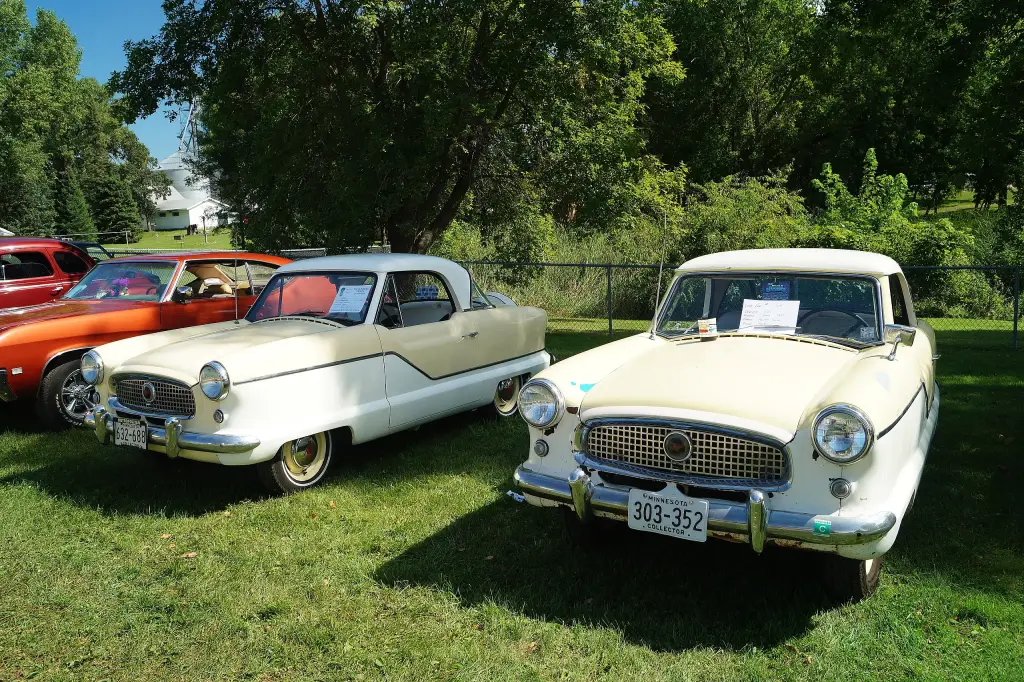
The Metropolitan was a small American car that was designed in Kenosha, Wisconsin, and built entirely in England by the British Motor Corporation. Marketed by Nash and then Hudson, it became a standalone brand in 1957, badged with a stylised M and sold alongside the Rambler range; in some markets it was known as the Rambler Metropolitan.
Rambler Metropolitan at a glance
| Marketed | Nash, then Hudson, then a standalone brand from 1957 |
|---|---|
| Production | 1953–1962 |
| Built in | England, by the British Motor Corporation |
| Designed in | Kenosha, Wisconsin |
| Based on | the NXI concept car by William J. Flajole |
| Body styles | convertible and hardtop |
| Wheelbase | shorter than that of the Volkswagen Beetle |
| Tooling cost | US$1,018,475.94 |
| Badge from 1957 | a stylised M on the hubcaps and grille |
| First spokesperson | Miss America 1954, Evelyn Ay Sempier |
The English Wikipedia page is about the Nash Metropolitan; in some markets and in later years the same car was sold as a Rambler.
History of the Rambler Metropolitan
The idea
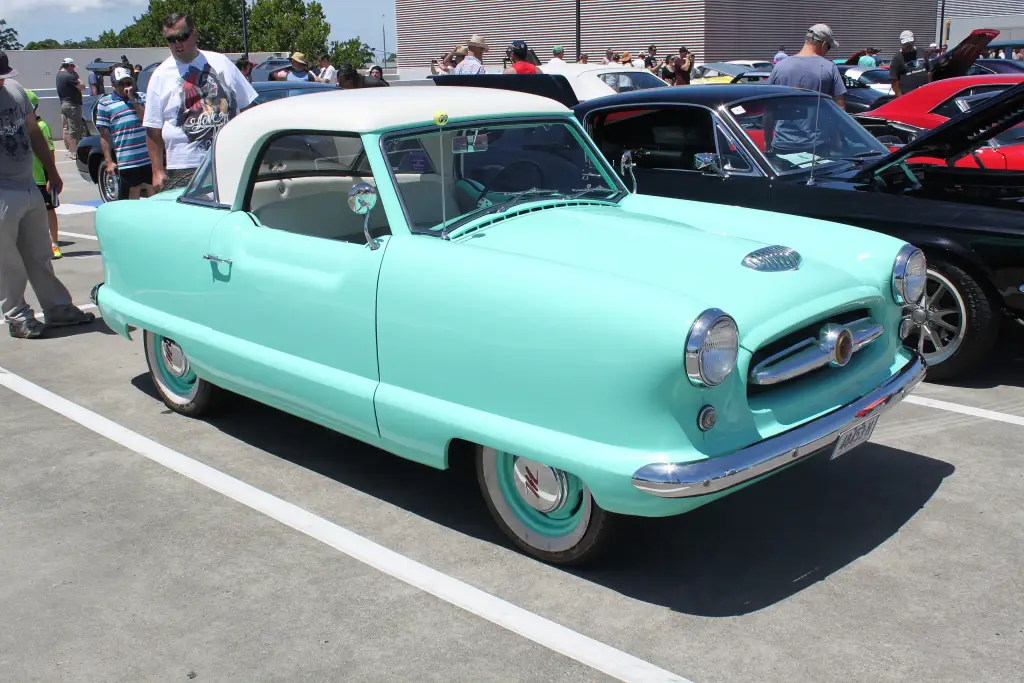
While most American makers followed a bigger-is-better philosophy, Nash executives looked for an economical alternative for American buyers. The Metropolitan was designed in Kenosha and patterned on a concept car, the NXI (Nash Experimental International), built by the independent Detroit designer William J. Flajole for Nash-Kelvinator. It was conceived as the second car in a two-car family, for shopping, the school run or the commute to the station: a commuter and shopping car that looked like a scaled-down Nash, with a wheelbase shorter than the Volkswagen Beetle’s. The concept used Nash’s unit body construction and was shown at a series of “surviews” from 4 January 1950 at the Waldorf-Astoria in New York, to test public reaction. The response convinced Nash that a market existed if the car could be built at a competitive price.
Built in England
Building the car from scratch in the United States would have cost too much in tooling. Instead Nash negotiated with European companies and on 5 October 1952 announced that it had chosen the Austin Motor Company, by then part of BMC, and Fisher & Ludlow, both based around Birmingham. Fisher & Ludlow made the bodywork, BMC supplied the mechanical components and Austin carried out final assembly. It was the first time an American-designed car had been marketed exclusively in North America while being built entirely in Europe, and it became a captive import sold and serviced through Nash dealers. Austin built five pre-production prototypes, the first completed on 2 December 1952, before production began. Total tooling cost was US$1,018,475.94, a fraction of what an American-built car would have required. The styling followed the Nash house look, with enclosed front wheels, notched pillow-style door pressings and a bar grille.
On the market
The Metropolitan came as a convertible and a hardtop, with a map light, electric windscreen wipers, a cigar lighter and a continental-type rear-mounted spare wheel as standard, and Bedford cord upholstery trimmed with leather. An AM radio, a Weather Eye heater and whitewall tyres were optional in the United States, although cars almost always left the factory with the first two fitted. When Nash and Hudson merged in 1954 the car was also sold as a Hudson, and in 1957, as the Nash and Hudson lines were phased out in favour of Rambler, the Metropolitan became a standalone brand with a stylised M on the hubcaps and grille. It was the first postwar American car marketed specifically to women; the Dodge La Femme followed a year later. Its first spokesperson was Miss America 1954, Evelyn Ay Sempier, and it was advertised prominently in Women’s Wear Daily. The cars were also sold in the United Kingdom and other markets, and production ended in 1962.
Design and features
- American design, British build: styled in Kenosha and assembled by Austin in Birmingham from BMC parts.
- Small package: a wheelbase shorter than the Volkswagen Beetle’s, and a scaled-down Nash look.
- Generous equipment: heater, radio, whitewall tyres and a rear-mounted spare were normal fittings.
- Unit body: Nash’s single-unit construction was used from the start.
Rambler Metropolitan versions
- Nash Metropolitan (1953–1954): the original version.
- Hudson Metropolitan (1954–1957): the same car sold through Hudson dealers after the merger.
- Metropolitan (1957–1962): a standalone brand with the stylised M badge.
- Convertible and hardtop: the two body styles offered throughout production.
The Metropolitan was sold alongside the Rambler American and the Rambler Six and V8. More cars are in the Rambler collection.
Video: 1957 Nash Metropolitan Rambler for sale in Nationwide, NC 27 #VNclassics
Video on YouTube.
Sources
- Nash Metropolitan, English Wikipedia: design, production in England, equipment, marketing