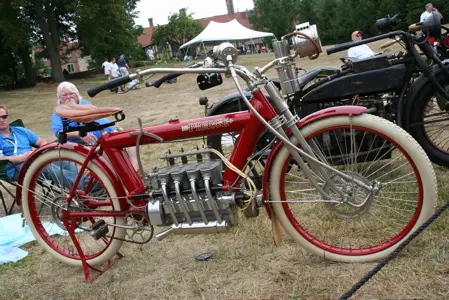
The Pierce Four was the first four-cylinder motorcycle produced in the United States. Introduced in 1909 by the Pierce Cycle Company, it used a stressed-member inline-four, a frame of large-diameter tubing that carried the oil and petrol, and shaft drive. Fewer than 500 were built before the model bankrupted its maker.
Pierce Four at a glance
| Maker | Pierce Cycle Company, Buffalo, New York |
|---|---|
| Production | 1909–1914 |
| Engine | inline four, T-head sidevalve, cam-driven inlet valves |
| Frame | large-diameter tubing, stressed engine, oil and petrol carried inside |
| Drive | shaft |
| Transmission | fixed gearing at first; clutch and two-speed from 1910 |
| Price | $325 at launch, $400 by 1913 |
| Claim | first four-cylinder motorcycle built in the United States |
| Built | fewer than 500 |
| Recognition | AMA Motorcycle Hall of Fame Classic Bikes; Guggenheim exhibition |
based on one source (English Wikipedia). No free photograph of the Pierce Four was found in the Commons search, so the article uses the existing cover image.
History of the Pierce Four
From birdcages to motorcycles
George N. Pierce’s company built refrigerators and bird cages in the 1890s and moved into bicycle manufacture by 1892, using the arrow logo; many of its bicycles had shaft drive to the rear wheel. In 1900 three directors travelled to Europe and bought a DeDion engine for a new automobile. Pierce’s son Percy, a competition driver of Pierce cars, was appointed head of the newly formed Pierce Cycle Company in 1907 with the intention of building motorcycles. Following the factory tradition he went to Europe for technical inspiration and acquired a Belgian FN Four in 1908, which was shipped back to Buffalo for study. The FN, the world’s first production four-cylinder motorcycle, was the reference for the Pierce engineering team’s own four, introduced in 1909.
Design
The Pierce Four had a stressed-member engine, shaft drive and a frame of very large-diameter tubing that hid the control cables and held the oil and petrol inside. The large tubes were said to strengthen the frame and to reduce the number of parts, making manufacture cheaper. Unlike the FN, the Pierce used a T-head sidevalve engine with cam-driven inlet valves instead of automatic inlet valves opened by atmospheric pressure, which made it an improvement on the Belgian design and the first four-cylinder motorcycle manufactured in the United States. Early examples had no clutch and fixed gearing; the 1910 model added a clutch and a two-speed transmission.
Fate
The motorcycle is said to have cost more to build than its selling price, and the Pierce Motorcycle Company went bankrupt after fewer than 500 had been made. The model is listed among the AMA Motorcycle Hall of Fame Classic Bikes and in the Barber Vintage Motorsports Museum, was shown in the Guggenheim Museum’s The Art of the Motorcycle exhibition in Las Vegas, and examples are held by the National Motorcycle Museum in Iowa, the Motorcycle Hall of Fame Museum in Ohio, the Barber Vintage Motorsports Museum in Alabama, the Sammy Miller Motorcycle Museum in England and the Dreamcycle Motorcycle Museum in British Columbia.
Design and features
- First American four: the first four-cylinder motorcycle produced in the United States, a step beyond the single-cylinder machines of the period.
- Stressed-member engine: the engine formed part of the frame instead of sitting in a separate cradle.
- Frame as a tank: oil and petrol were carried inside the large-diameter frame tubes, which also hid the control cables.
- Shaft drive: a cleaner arrangement than the chain drives common at the time.
- 1910 improvement: a clutch and a two-speed transmission replaced the fixed gearing of the first models.
Pierce Four versions
- 1909 original: no clutch and fixed gearing, like the FN Four it was modelled on.
- 1910 model: clutch and two-speed transmission.
- 1913 specification: the price had risen from $325 to $400.
The Pierce-Arrow company grew out of the same Buffalo business, while the modern Pierce fire apparatus of Wisconsin is unrelated. More in the Pierce collection.
Sources
- Pierce Four, English Wikipedia: design, development, price, production and museums