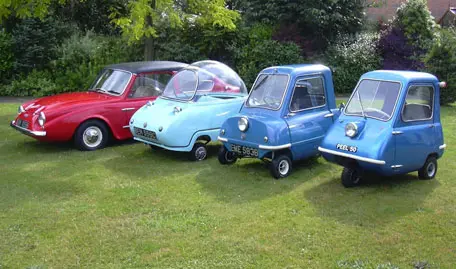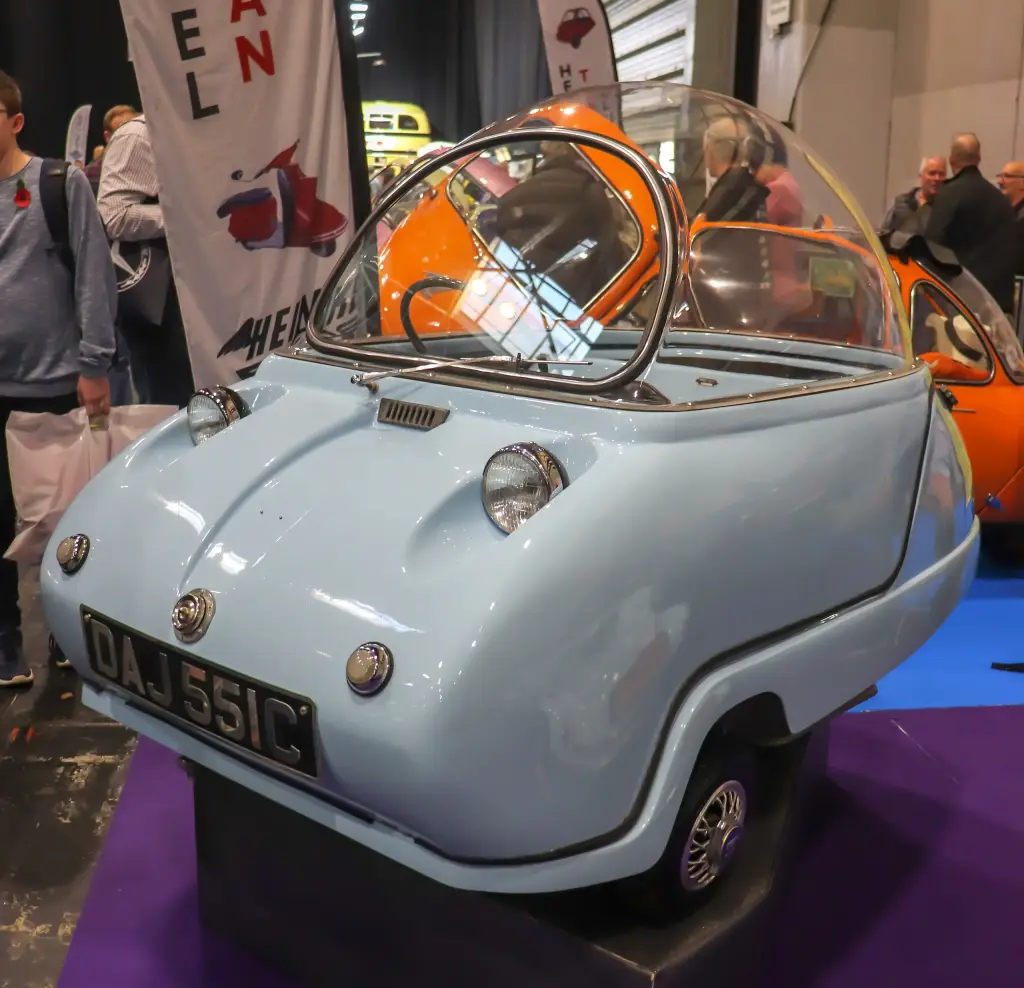
The Peel Trident is the second three-wheeled microcar built by the Peel Engineering Company on the Isle of Man. An all-new design from its one-seat counterpart the Peel P50, the Trident has two seats, and its clear bubble top earned it the nickname “The Terrestrial Flying Saucer”.
Peel Trident at a glance
| Maker | Peel Engineering Company, Isle of Man |
|---|---|
| Production | 1965–1966; again from 2010 |
| Launched | 1964 British Motorcycle Show, Earls Court |
| Body | glass-fibre monocoque with clear bubble top |
| Seats | two, or one with a detachable shopping basket |
| Engine | 49 cc DKW single-cylinder, 4.2 hp |
| Top speed | 28 mph (45 km/h) |
| Length | 73 in (1,854 mm) |
| Width | 39 in (991 mm) |
| Weight | 330 lb (150 kg) |
| Price when new | £190 |
History of the Peel Trident
The Trident was launched at the 1964 British Motorcycle Show at Earls Court. It was a completely new design rather than a development of the earlier side-engined P50, and it was manufactured in 1965 and 1966. The seat, stated as being 31 in (79 cm) wide, was intended to provide for use as an occasional two-seater; the German Wikipedia adds that the car could also be ordered as a single-seater.
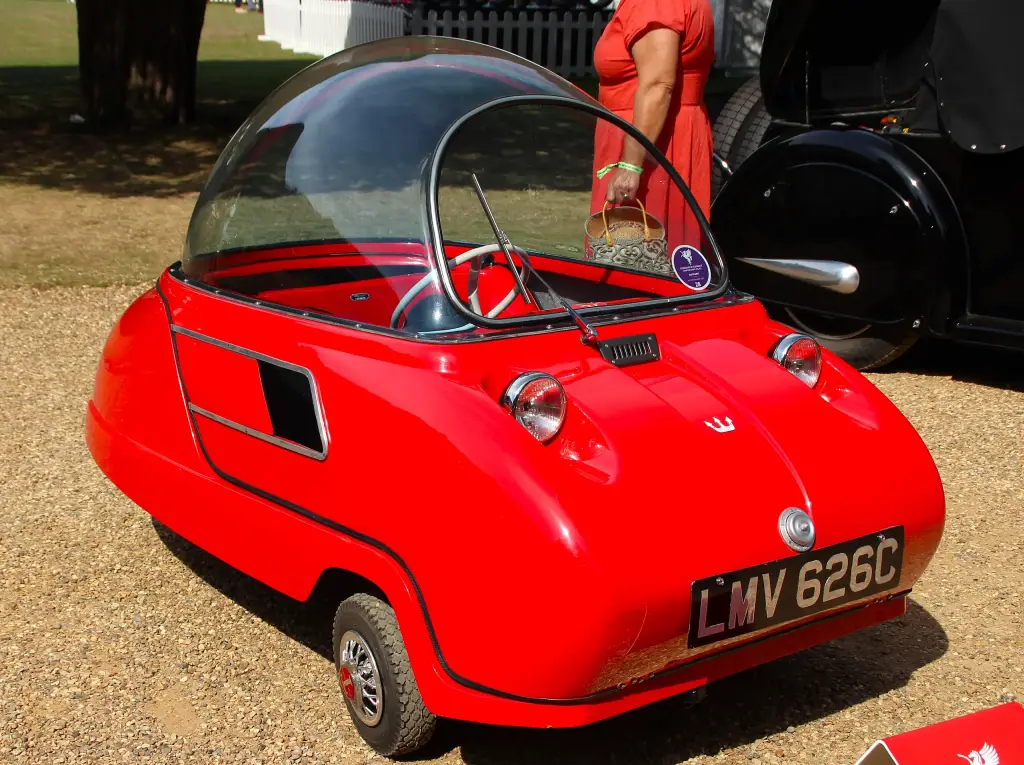
The bubble-top body
The glass-fibre shell was a monocoque with coil-sprung, undamped wheels. It featured a clear bubble top and either two seats or one seat with a detachable shopping basket. The Lakeland Motor Museum notes that the bubble top was the reason for the car’s nickname, “The Terrestrial Flying Saucer”. Like its predecessor, the Trident was marketed as a “shopping car” or a “Saloon Scooter”.
The car is 73 in (1,854 mm) long and 39 in (991 mm) wide, with a weight of 330 lb (150 kg). Like the P50 it uses a 49 cc DKW engine, which generates 4.2 hp and gives a top speed of 28 mph (45 km/h); the German article quotes 50 cc and the same 45 km/h. Peel advertised 100 miles per imperial gallon, “almost cheaper than walking”, and the original retail price was £190.
All engines supplied to Peel from Zweirad Union, for both the P50 and the Trident, were of the 49 cc, three-speed, 4.2 hp 804–1600 type. The Peel engines were unique in having the eighth digit as a 4, so their numbers took the form 80416004***.
After the original run
In 2011 Peel Engineering Ltd. reinstated manufacture of the Trident and the P50 in Sutton-in-Ashfield, near Nottingham, England. All vehicles are hand-built to order in petrol and electric form. In 2018 the company was reported to be selling around ten continuations of the Trident a year alongside about fifteen P50s. Some original cars also found their way abroad: in the Netherlands two original Peel Tridents are registered as motorized tricycles.
Design and features
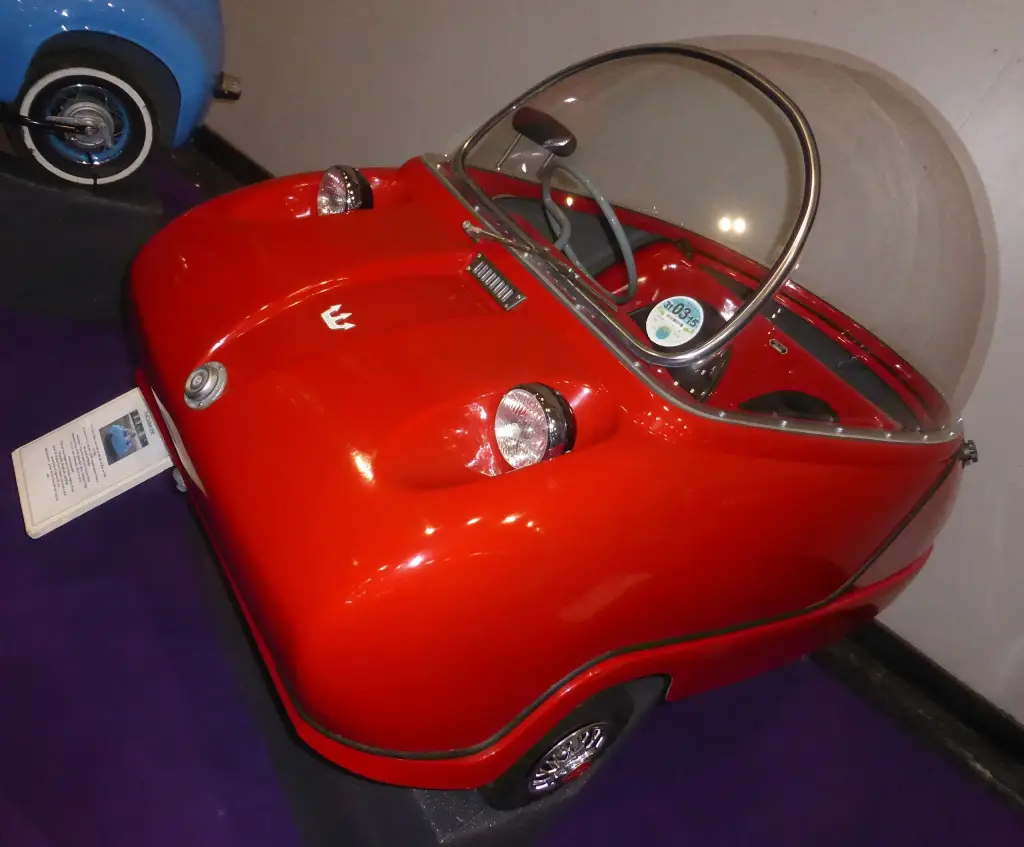
- Clear bubble top: the glass-fibre canopy that gave the car its flying-saucer nickname.
- Two seats: a 31 in wide bench, or a single seat with a detachable shopping basket.
- Monocoque shell: a glass-fibre body with coil-sprung, undamped wheels.
- Economy first: a 49 cc two-stroke and a claimed 100 mpg, sold as a shopping car.
- Still made by hand: petrol and electric continuations have been built to order since 2011.
Peel Trident versions
- Trident (1965–1966): the original two-seat bubble car with a 49 cc DKW engine.
- Single-seat Trident: listed as an alternative to the two-seater, with a shopping basket.
- Peel Engineering continuation (from 2011): hand-built petrol or electric cars made in Sutton-in-Ashfield.
- Replica with a 50 cc engine: registered in the Netherlands as a moped, with a 59 km/h top speed.
The Trident followed the one-seat Peel P50 and used the same 49 cc engine. More tiny cars are in the Peel collection.
Video: Peel 50 Peel Trident Bubble Cars
Video by Carsten Walter on YouTube.
Sources
- Peel Trident, English Wikipedia: history, body, dimensions, engine, price
- Peel Trident, German Wikipedia: launch, seating, top speed