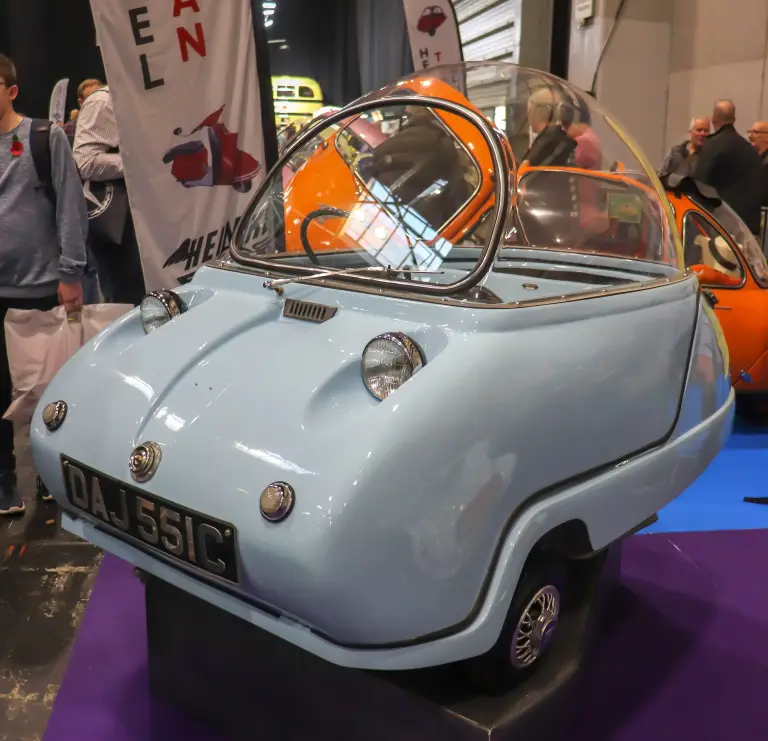
The Peel P50 is a three-wheeled microcar made from 1962 to 1965 by the Peel Engineering Company on the Isle of Man, and again from 2010 onwards. It was listed in the 2010 Guinness World Records as the smallest production car ever made, and it has no reverse gear: at the rear there is a handle so that the very light car can be lifted and pulled round by hand.
Peel P50 at a glance
| Maker | Peel Engineering Company, Isle of Man |
|---|---|
| Production | 1962–1965; again from 2010 |
| Layout | single-seat three-wheeler, glass-fibre body |
| Engine | 49.2 cc DKW single-cylinder |
| Top speed | about 61 km/h (38 mph) |
| Gearbox | three-speed manual, no reverse |
| Length | 54 in (137 cm) |
| Width | 39 in (99 cm) |
| Unladen weight | 130 lb (59 kg) |
| Price when new | £199 in 1963 |
| Built | about 50; 27 known to survive |
| Record | smallest production car ever made (Guinness, 2010) |
History of the Peel P50
The P50 was designed as a city car and advertised in the 1960s as capable of seating “one adult and a shopping bag”. Its only door was on the left side, and the equipment was as basic as the size: a single windscreen wiper and one headlight. Standard colours were Daytona White, Dragon Red and Dark Blue. At 54 in (137 cm) long, 39 in (99 cm) wide and 130 lb (59 kg) unladen, the car is small enough to be driven through a doorway and into a building.
The original car, 1962–1965
The original P50 used a 49.2 cc DKW single-cylinder engine, which gave a top speed of about 61 km/h (38 mph), with a three-speed manual gearbox that had no reverse. Turning in a confined space therefore meant pushing the car, or lifting it by the handle at the rear and pulling it round. The makers and users claimed fuel consumption of 100 mpg‑imp. The 1963 model retailed for £199 when new, although one source quotes about 47 cars sold at £299 each.
Peel also used the car for publicity. In 1963 a P50 was taken to the top of Blackpool Tower in the lift and driven around the observation balcony. About 50 P50s were produced and 27 are known to still exist, which makes the surviving cars valuable: in March 2016 one sold for a record US$176,000 at Sotheby’s, and in February 2013 a genuine 1964 car, registration ARX 37B, made more than US$120,000 (£80,000) at the Bruce Weiner RM Auction. At least one prototype also survives, the Peel P55 Saloon Scooter, which unlike the production P50 used a single wheel at the front and two at the back.
Top Gear and the replicas
Jeremy Clarkson reviewed the P50 in the third episode of Top Gear’s tenth series in 2007. Standing 6 ft 5 in tall, he drove a blue example across London and inside the BBC Television Centre, through its corridors and into a lift. He described the car as “perfect … for the roads of today” because of its size, low fuel consumption and low cost, and called it “the future” and “absolutely brilliant”, despite the missing reverse gear. He later built the P45, a smaller one-seater, which never reached production.
In 2010 Peel Engineering Ltd. in England restarted manufacture of the P50 and the Trident from premises in Sutton-in-Ashfield, Nottinghamshire. In 2011 the businessmen Gary Hillman and Faizal Khan raised £80,000 on Dragons’ Den to put the revised cars into production; three versions, Gas, Eco and Fun, were offered at first, later reduced to a petrol model with a 49 cc four-stroke engine and an electric model with a moped motor and gelled-electrolyte batteries. Both are limited to about 28 mph (45 km/h). The new cars look like the original and have the same dimensions and kerb weight, but the suspension, steering and drivetrain are different and there is a working reverse gear, so that they are road-legal today. They are hand-built to order in Sutton-in-Ashfield by Micro Car Specialists. In 2018 Peel Engineering was reported to be selling around fifteen P50s a year, at £14,879 for the petrol car and £13,679 for the electric one, with most demand coming from the United States.
Design and features
- Extreme size: 137 cm long and 59 kg, the smallest car ever put into series production.
- No reverse gear: the car is turned round by hand, using the handle at the rear.
- One door, one wiper, one headlight: everything not needed to move was left off.
- Tiny two-stroke: a 49 cc DKW engine and a three-speed gearbox, good for about 38 mph.
- Real record value: 27 of about 50 originals survive, and auction prices passed US$170,000 in 2016.
Peel P50 versions
- Original P50 (1962–1965): 49.2 cc DKW engine, three-speed gearbox without reverse, glass-fibre body.
- Peel P55 Saloon Scooter: a surviving prototype with one wheel at the front and two at the back.
- Peel Engineering continuation (from 2010): petrol 49 cc four-stroke or electric, with a reverse gear.
- Bamby P50 (from 2011): a replica by Bambycars of Gainsborough with a 50 cc four-stroke and automatic gearbox.
- P50 Cars P.50 (from 2015): replicas by Pendine Motors of Gosport.
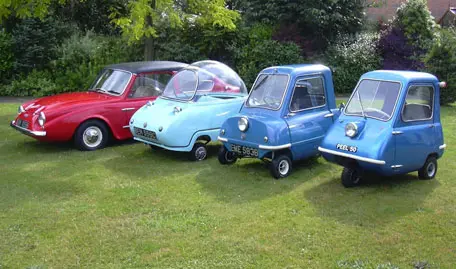
The P50 was followed by the two-seat Peel Trident, which used the same 49 cc engine. More tiny cars are in the Peel collection.
Video: The Smallest Car in the World
Video by Top Gear on YouTube.
Sources
- Peel P50, English Wikipedia: history, dimensions, prices, replicas, legal status
- Peel P50, German Wikipedia: technical layout, production numbers, replica makers