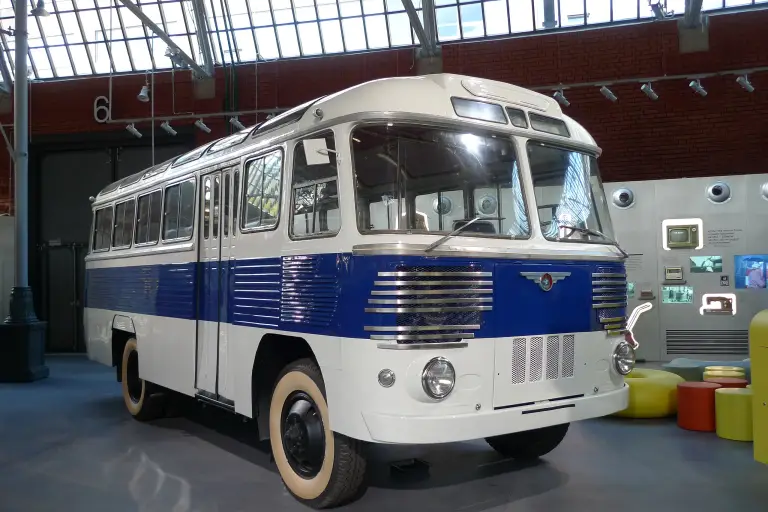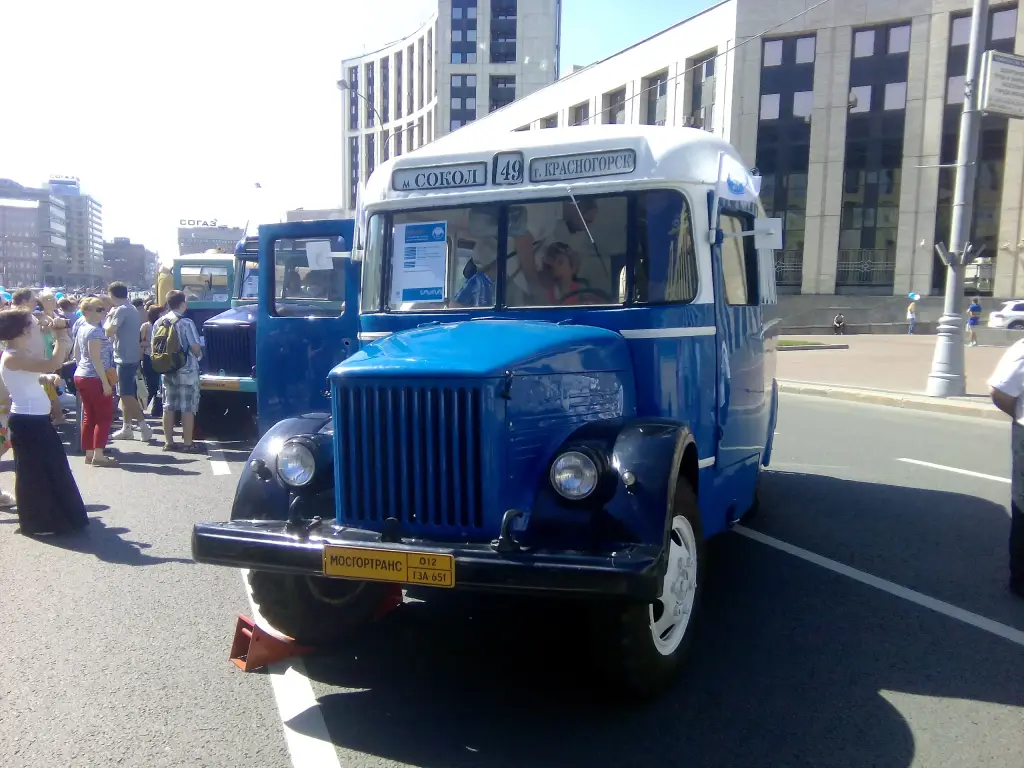
The PAZ-651 was the first bus built at the Pavlovo Bus Factory: a bonneted machine on the GAZ-51 lorry chassis, with a wooden body frame that could be repaired in almost any workshop. It was the Pavlovo version of the GZA-651, a bus that was also built at Gorky, Riga and Kurgan and stayed in production in one form or another for more than forty years.
PAZ-651 at a glance
| Maker | Pavlovo Bus Factory (PAZ), Pavlovo, Nizhny Novgorod Oblast |
|---|---|
| Production at Pavlovo | 1952–1961 |
| Family production | 1949–1973 at Gorky, Pavlovo, Riga and Kurgan |
| Chassis | GAZ-51 lorry |
| Layout | bonneted, front engine, rear-wheel drive |
| Body | wooden frame with steel panelling |
| All-metal version | PAZ-651A from 1957 |
| Ambulance | PAZ-651V |
| Special vans | PAZ-654, 655, 657, 659, 661 |
| Successor | PAZ-652 (1958) |
| Monuments | Zelva in Belarus, Shadrinsk and Iskitim in Russia |
The PAZ-651 is covered by the Russian Wikipedia article on the GZA-651 family, of which it is the Pavlovo-built version, so this article is based on that single source for the model itself.
History of the PAZ-651
From Gorky to Pavlovo
The bus began life at the Gorky bus plant as the GZA-651, a bonneted design with a wooden frame on the GAZ-51 chassis. In 1952 production was passed to Pavlovo, where the same vehicle was built as the PAZ-651; the first five buses were assembled on 5 August 1952. From 1953 the Riga repair plant No. 2 added RARZ-651s, and in January 1958 the Kurgan bus plant began building the all-metal 651A as the KAvZ-651A.
The all-metal 651A and the van family
The wooden body was simple to build but needed constant care, so in 1957 the factory put the all-metal PAZ-651A into series production. On the same chassis Pavlovo also built a family of vans: the PAZ-651V ambulance, the PAZ-657 bread van, the PAZ-659 mobile shop, the PAZ-661 clothing van and cargo version, the PAZ-654 staff bus and the PAZ-655 cash-in-transit van. Production at Pavlovo continued until 1961, when the PAZ-652 took over the line.
A design that travelled
Because the drawings were simple, the bus was built far beyond the four main factories: documentation went to dozens of repair plants and works, and some of them kept building similar bodies on overhauled GAZ-51A chassis until 1982, while the Skuratovsky repair plant in Russia did so until 1993. Surviving buses are kept as monuments in Zelva in Belarus and in Shadrinsk and Iskitim in Russia. Externally the GZA-651 family was easy to tell from most PAZ and KAvZ buses and from the GAZ-51 lorry: it had a rounded, streamlined radiator grille and a long “nosed” bonnet. Buses built before 1956 carried rectangular turn indicators, the same as those of the Pobeda car, under the windscreen, and some machines, especially export series, had chrome bumpers and headlamp rims.
Design and features
- Bonneted layout: the engine sat in front of the driver, as in the GAZ-51 lorry it was based on.
- Wooden body frame: simple to build and repair, which is why so many workshops could make the same bus.
- All-metal alternative: the PAZ-651A of 1957 replaced the timber frame with steel.
- Own front end: a rounded radiator grille and a long bonnet set it apart from later PAZ buses.
- Export trim: some buses, mostly export series, had chrome bumpers and headlamp rims.
PAZ-651 versions
- PAZ-651 (1952–1961): wooden-framed bus built at Pavlovo.
- PAZ-651A (from 1957): all-metal body, also built at Kurgan as the KAvZ-651A.
- PAZ-651V: ambulance version.
- PAZ-657, 659, 661: bread van, mobile shop and clothing van.
- PAZ-654, 655: staff bus and cash-in-transit van.
- KAvZ-651B (1971–1973): Kurgan version with a cabin heater.
The PAZ-651 was replaced by the PAZ-652 and then by the PAZ-672. More Soviet buses are in the PAZ collection.
Sources
- ГЗА-651, Russian Wikipedia: history, versions, dates, appearance
- Pavlovo Bus Factory, English Wikipedia: factory history, production dates