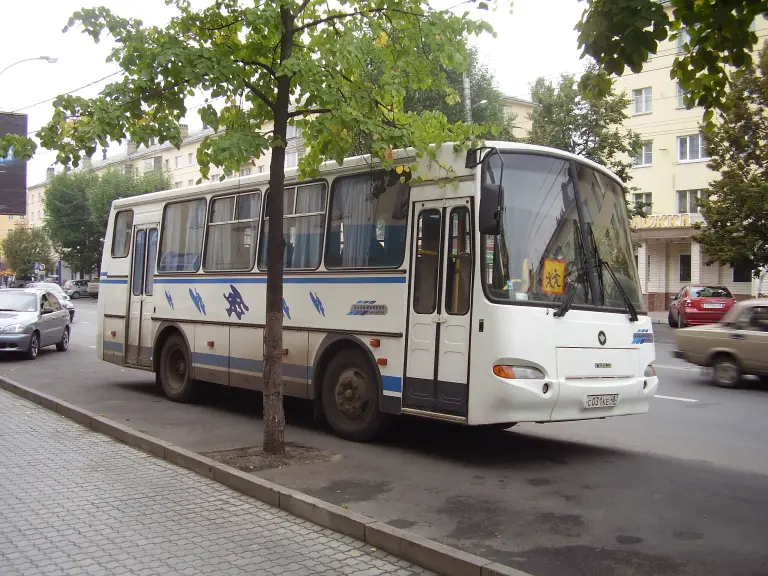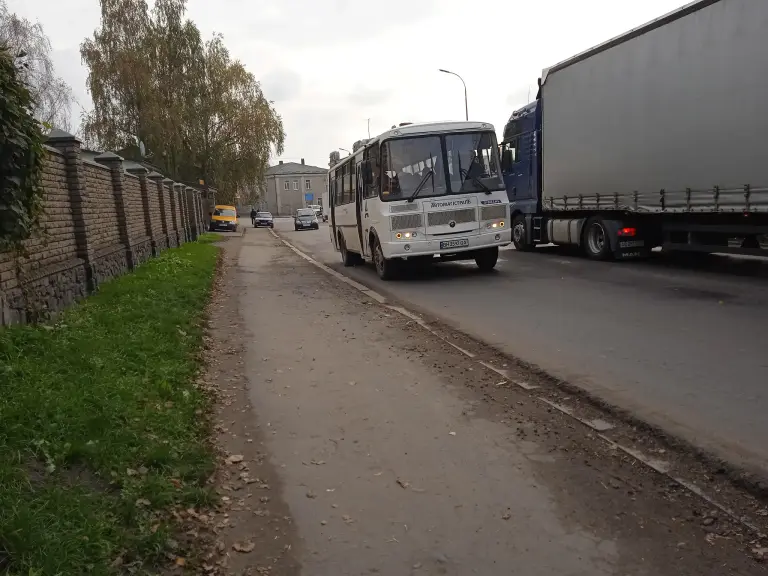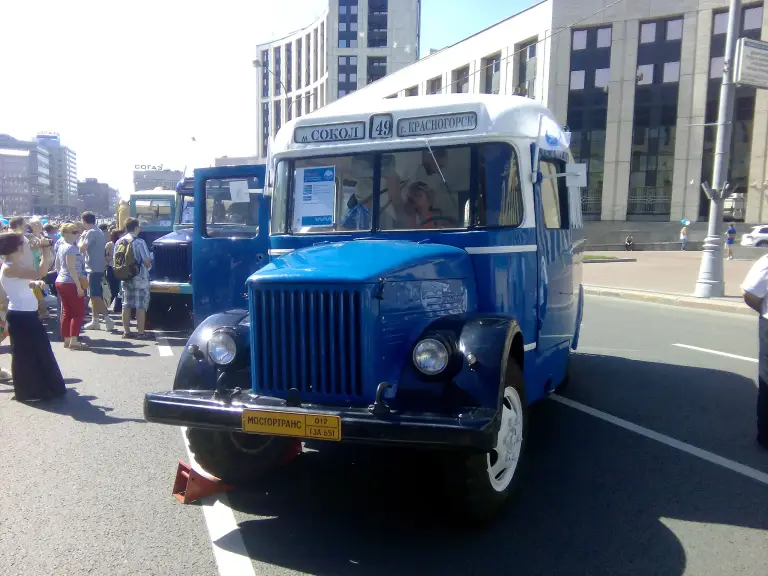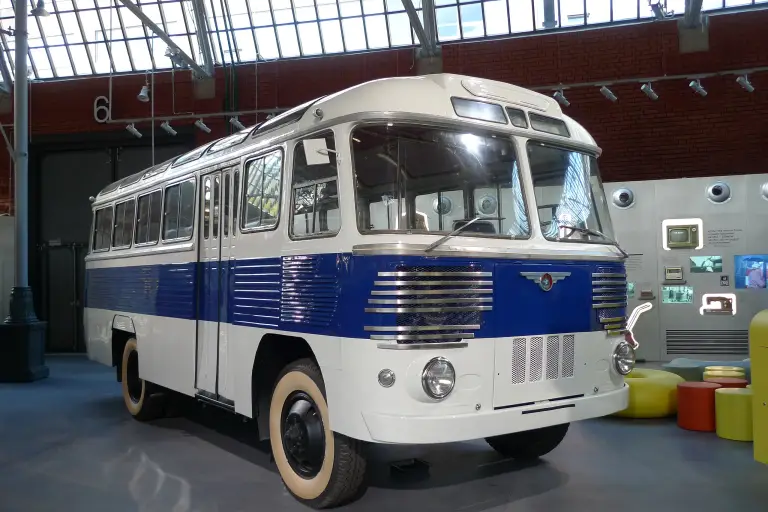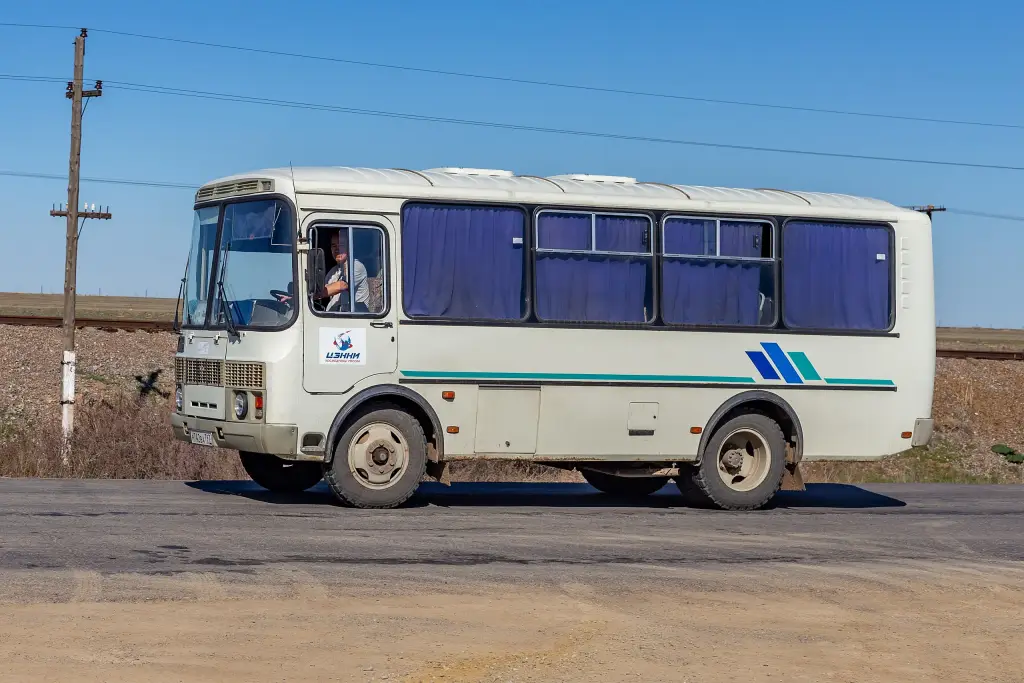
The PAZ-3205 is the bus that replaced the PAZ-672 on 1 December 1989 and has stayed in production ever since. A small high-floor midibus, it is used as a route bus, a marshrutka, a staff bus and even a hearse across Russia and much of Eastern Europe.
PAZ-3205 at a glance
| Maker | Pavlovo Bus Factory (PAZ), Pavlovo |
|---|---|
| Production | since 1 December 1989 |
| Class | small high-floor midibus |
| Engines | ZMZ-5234 petrol; MMZ-245.7 and 245.9, Cummins ISF 3.8, YaMZ-5342 diesels |
| From 2016 | ZMZ-5245 petrol or gas; YaMZ-5344 diesel, Euro-5 |
| Power | 120–140 hp |
| Top speed | 90 km/h |
| Brakes | pneumohydraulic; pneumatic in the 32053 and 32054 |
| Body life | 10 years after the 2007 upgrade |
| Restyling | 2014, 2020, 2022 |
| Milestone | 100,000th bus in June 2001 |
History of the PAZ-3205
Fifteen years of prototypes
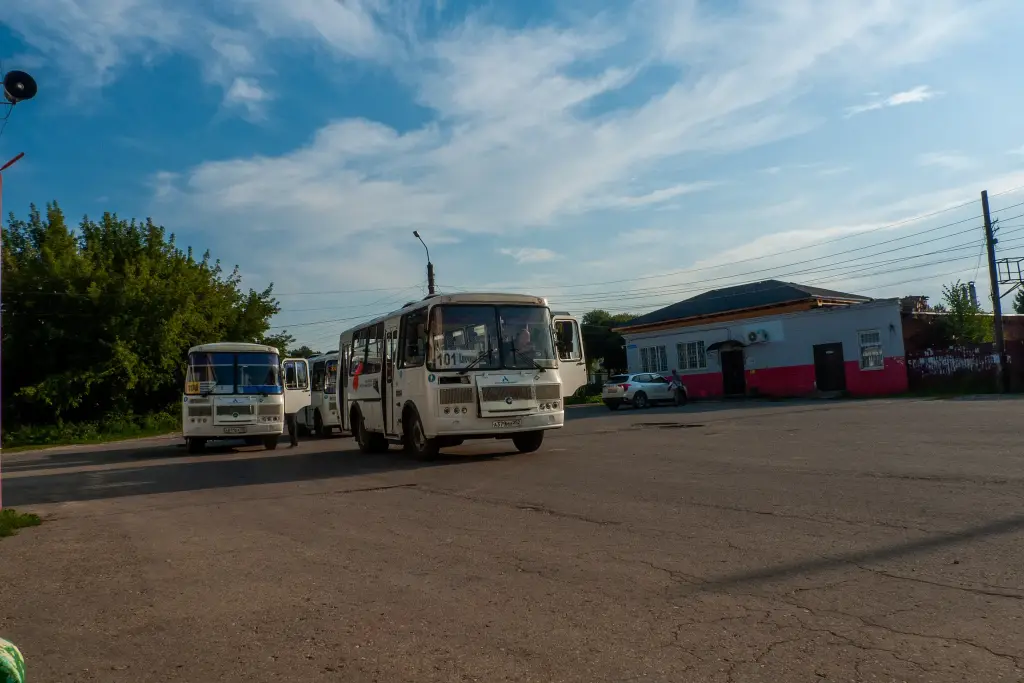
The PAZ-3205 grew out of the PAZ-3203, a bus developed between 1972 and 1977 and prepared for series production from 1979 but never put into it. Dozens of prototypes were built over almost fifteen years. The first pilot batch was made in 1979 and conveyor assembly began in 1984; pilot-industrial production started on 17 November 1985, the final design was approved in 1986, and mass production began on 1 December 1989, when the PAZ-672M left the line.
Engines and versions
The original PAZ-3205 and PAZ-32051 had a carburettor ZMZ-5234 and a single automatic door; their production ended in 2003. From 2001 the updated PAZ-32053 and PAZ-32054 arrived with pneumatic brakes instead of hydraulic ones. Over the years the bus has used MMZ-245.7 and 245.9 diesels, a Cummins ISF 3.8 and a YaMZ-5342, and since 2016 the injector ZMZ-5245, which can run on petrol or gas, and the Euro-5 YaMZ-5344. The 320530 and 320540 versions of 2017 came with factory gas equipment.
Modernisation
In 2007 the factory modernised production, which allowed the bus to be certified for busy routes and raised body life from five to ten years; the heater and seats were improved. A restyled version followed in 2014, and at the end of 2020 the bus received an electric step at the first door, a new window and seat layout, a new dashboard, a full-height driver partition and a handrail by the driver’s seat. In 2022, when imported parts became hard to get, PAZ presented a version with FG-140 headlights and a YaMZ-534 Euro-3 engine instead of Euro-5, but by the end of that year it had returned to the 2014 front end.
Paint and detail changes
Early buses were mostly red, sometimes with a white skirt or a white band under the windows. Between 1992 and 1998 they were white with a broad colour band under the windows and another on the skirt; the bands became narrower in 1998, and from 2000 to 2007 most buses were white with three thin coloured stripes. After the 2015 restyling the buses have been mainly plain white. Black plastic radiator grilles and headlamp surrounds gave way to grey ones in 2007, and larger bumpers appeared in 2000.
Design and features
- Small high-floor body: made for low-intensity routes, both urban and rural.
- Flexible engines: 120–140 hp ZMZ or MMZ units and a top speed of 90 km/h.
- Imported engines offered: Hino, Cummins, Andoria and BAMO for rear-wheel-drive models.
- Funeral version: rear door, floor rails and safety straps with benches facing the coffin.
- Emergency services: used by police and firefighters as mobile headquarters.
- Long-lived: the 100,000th bus was built in June 2001.
PAZ-3205 versions
- PAZ-3205 (1989–2003): base bus with one automatic door and the ZMZ-5234.
- PAZ-32051: original modification, built until 2003.
- PAZ-32053 and PAZ-32054 (from 2001): updated buses with pneumatic brakes.
- PAZ-320530 and PAZ-320540 (from 2017): factory gas equipment.
- PAZ-3206: four-wheel-drive version.
- Hearse version: rear door and coffin rails.
The PAZ-3205 was developed into the four-wheel-drive PAZ-3206 and the longer PAZ-4234. More buses are in the PAZ collection.
Sources
- PAZ-3205, English Wikipedia: engines, use, variants
- ПАЗ-3205, Russian Wikipedia: history, modifications, paint schemes