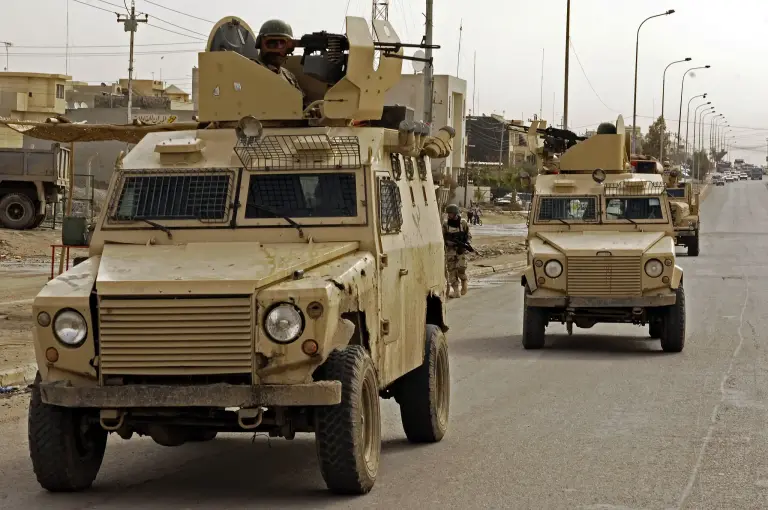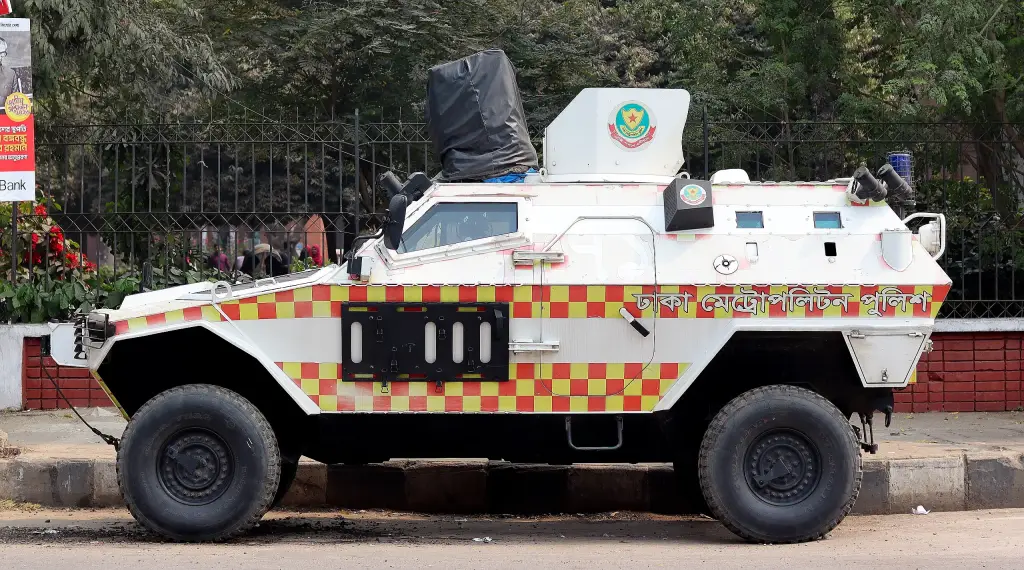
The Otokar Cobra is an armoured 4×4 tactical vehicle developed by the Turkish firm Otokar for infantry mobility, built around a monocoque steel V-hull and a common platform that can be adapted to a wide range of roles. It carries a crew of two and seven passengers and has been ordered by armed forces from Georgia and Kazakhstan to Nigeria and Bangladesh.
Otokar Cobra at a glance
| Maker | Otokar, Turkey |
|---|---|
| Name | Cobra (Turkish: Kobra) |
| Type | armoured 4×4 tactical vehicle |
| Capacity | 2 crew + 7 passengers |
| Weight | 6,700 kg |
| Dimensions | 5.48 m long, 2.24 m wide, 2.1 m high |
| Ground clearance | 0.4 m |
| Engine | turbocharged diesel, 190 hp |
| Maximum speed | 100 km/h; 8 km/h in water |
| Range | 600 km |
| Gradient | 60% climb, 40% side slope |
| Trench | 0.8 m trench, 0.4 m vertical step |
History of the Otokar Cobra
The Cobra family
The Cobra was developed by Otokar’s research and development team to meet the armed forces’ need for an infantry mobility vehicle. It borrows some subsystems from the Humvee, and it is the first generation of the Cobra family; a second generation, the Cobra II, is also in production. Otokar’s designers kept the same hull and chassis across the range so that many models and types can be built on one line, which makes maintenance, repair and spare parts easier even for vehicles made for quite different tasks.
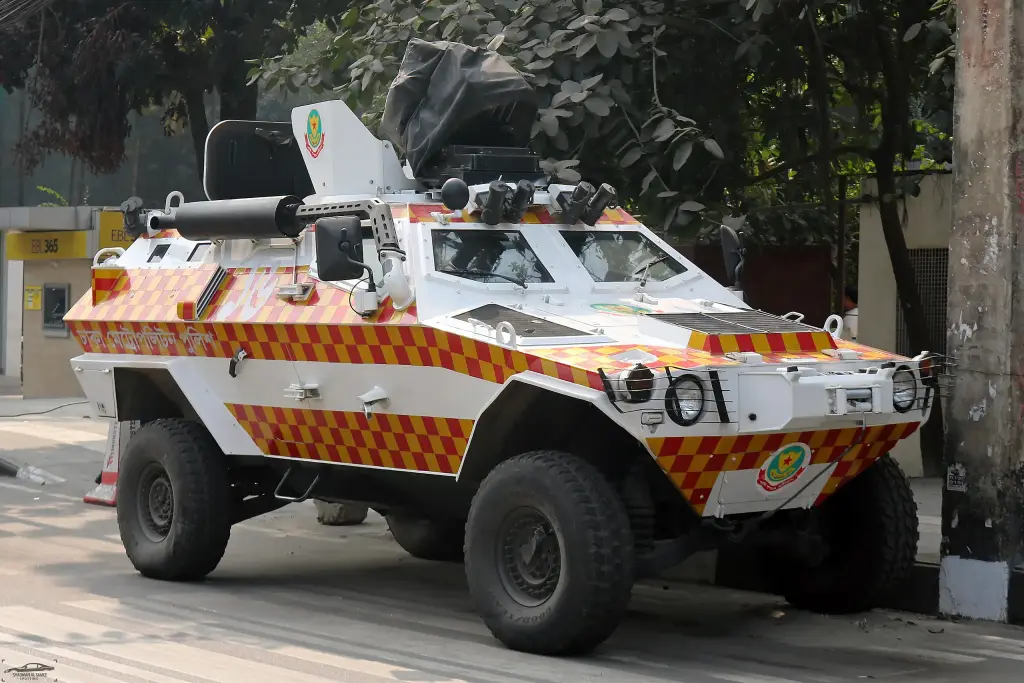
Hull and protection
The monocoque steel V-hull protects against small arms fire, artillery shell splinters and, to a degree, anti-personnel and tank mines and improvised explosive devices. The front wheel arches are designed to be blown away to free blast pockets, and the vehicle’s low profile makes it harder to hit. Cobras can be fitted with Q-Nets. In December 2016 footage circulated of a PKK attack on Turkish M-60 Sabra tanks in which the crew of a Cobra survived a direct hit from a shoulder-launched RPG-7.
One platform, many roles
Because the Cobra is a common platform, it can be adapted for armoured personnel carrier, anti-tank vehicle, reconnaissance, ground surveillance radar, forward observation, armoured ambulance or armoured command post duties, and as a turreted vehicle for a 12.7 mm machine gun (the turret produced by the Israeli firm Rafael), a 20 mm cannon, TOW or Spike anti-tank missiles or surface-to-air missiles. Cobras can also be used as amphibious combat vehicles. The amphibious version has a special hull, operates in NATO Sea State 2, turns on the spot in the water under joystick control and uses a hybrid cooling system for reliability afloat.
Combat record
The Cobra was first used in combat in the South Ossetia war of 2008, when Georgia bought more than a hundred (the exact number is not known). Georgian special forces used Cobras with 12.7 mm NSV machine guns and 40 mm automatic grenade launchers in the battle for Tskhinvali; one was destroyed and captured by the Russian army, whose officials then examined the armour closely. Cobras were also used by Georgian UN forces in the Central African Republic. The Nigerian military has deployed Cobras against Boko Haram in the north-east since 2013, and Turkish forces use them in anti-terrorism operations at home and with NATO’s ISAF and Resolute Support missions in Afghanistan. Turkish-backed militias used them against ISIS and the YPG during Operation Euphrates Shield. In Burkina Faso a Burkinabe army Cobra hit an IED near Kompienbiga; the explosion overturned the vehicle, which caught fire, killing three and wounding four.
Exports
According to the Turkish article, more than 1,300 Cobras are in use in Turkey. Nigeria has 194, Georgia some 300 bought for about $58 million, Algeria 600, Kosovo 100, Kazakhstan 30 or more, Mauritania 12, Azerbaijan 150, Slovenia 10, the Maldives five and Turkmenistan more than 100 from the mid-2010s for its State Border Service. Bangladesh took 24 for trials in 2007–2008 and the police bought seven in 2010. Bahrain, Chad, Gambia, Ghana, North Macedonia, Pakistan, Rwanda (30, used in UN peacekeeping in the Central African Republic), Saudi Arabia, Syria, Tunisia, the United Arab Emirates and the United Nations are also listed as users. A 2011 agreement with Kazakhstan Engineering provides for licensed joint production for the Kazakh armed forces.
Design and features
- Monocoque steel V-hull: protection against small arms, shell splinters and, to a degree, mines and IEDs, with blast-away front wheel arches.
- Common platform: the same hull and chassis serve personnel carrier, ambulance, command post, reconnaissance and anti-tank versions.
- Amphibious version: NATO Sea State 2, 8 km/h in water and joystick-controlled turning.
- Weapon options: open or closed turrets, 12.7 mm machine gun, 20 mm cannon, TOW and Spike missiles.
- Tested mobility: 60 per cent gradient, 0.8 m trench, 600 km range and a 190 hp turbocharged diesel.
Otokar Cobra versions
- Cobra with open turret: personnel carrier with a low profile and wide doors for quick dismounting.
- Cobra with closed turret: designed by Otokar for border security and fire support day and night.
- Cobra 40 mm / 12.7 mm: a turret that traverses fully around, allowing observation and fire from inside.
- Cobra ambulance: carries wounded and medical staff with first-aid equipment on board.
- Reconnaissance, command and EOD versions: surveillance, command-control and airfield bomb-disposal vehicles.
- Amphibious Cobra: special hull for water operations with joystick control.
The Cobra’s lighter stablemate is the Akrep, and Otokar’s civilian minibus of the same era is the M-2010. More vehicles are in the Otokar collection.
Video: Otokar Cobra 4×4 armoured vehicle promo
Video on YouTube.
Sources
- Otokar Cobra, English Wikipedia: design, protection, roles, operational history, operators
- Otokar Cobra, Turkish Wikipedia: development, specifications, numbers in service