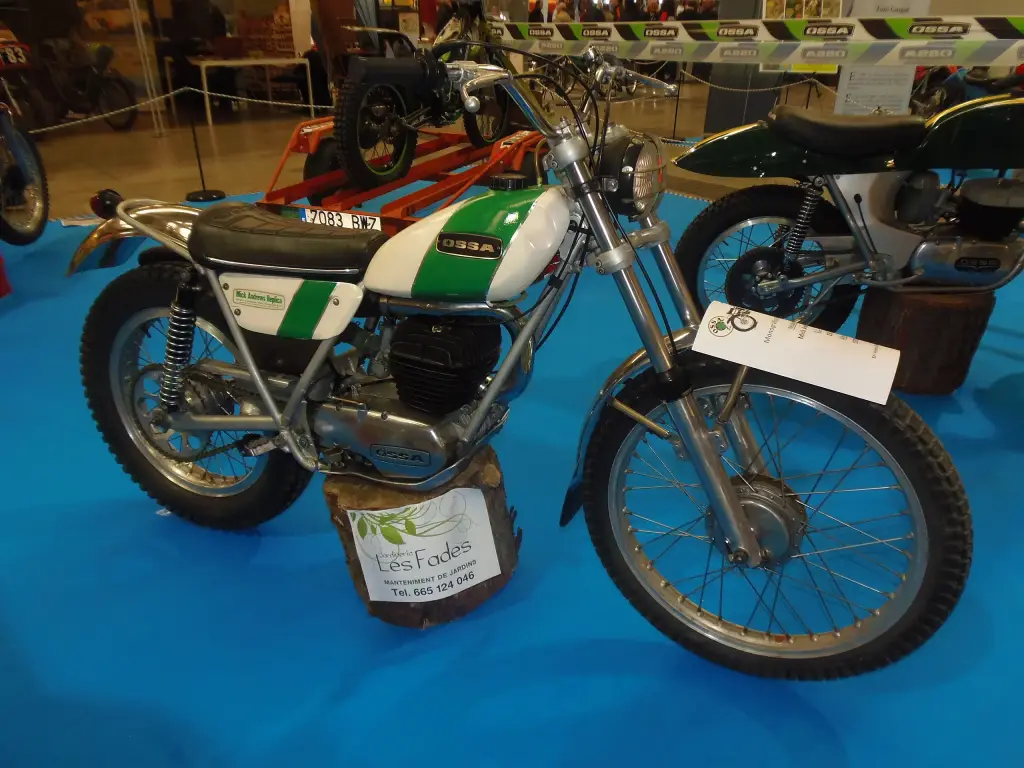
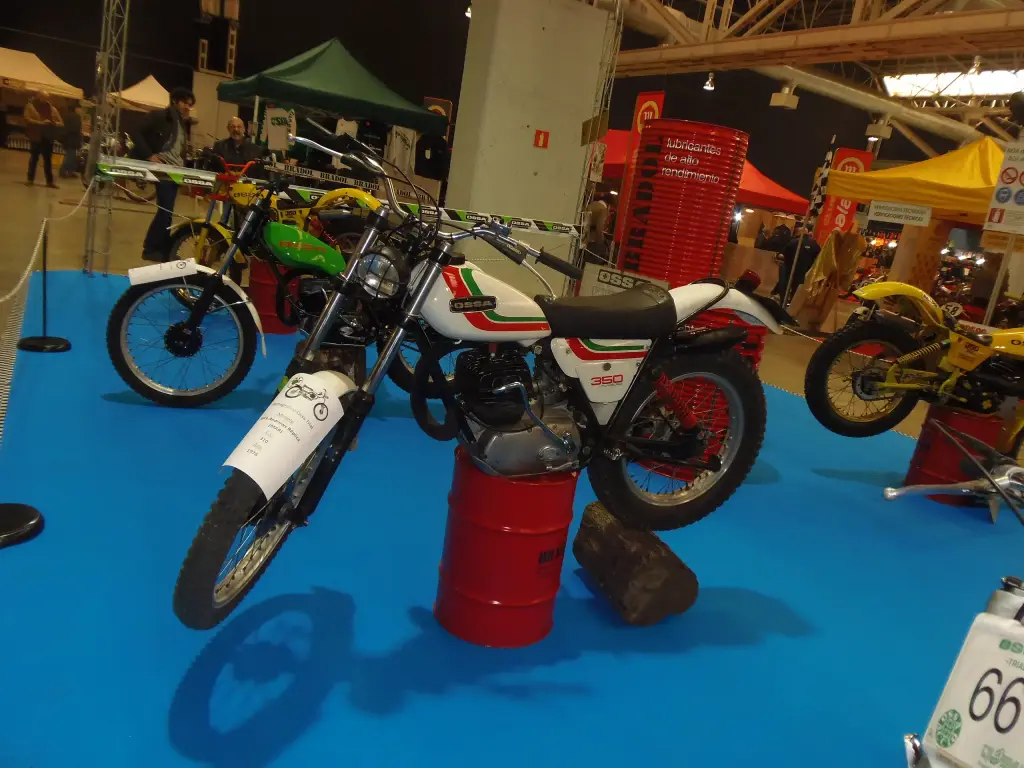
The Ossa MAR, short for Mick Andrews Replica, was the Spanish firm’s answer to the Bultaco Sherpa T and the Montesa Cota. Built from 1972 to 1977, it was a production copy of the trials prototype that the British rider Mick Andrews had developed with Ossa engineer Eduard Giró, and it became one of the three great trials machines of its era.
Ossa MAR at a glance
| Maker | Ossa, Barcelona |
|---|---|
| Production | 1972–1977 |
| Type | Observed trials |
| Engine | two-stroke single, air-cooled, 244 cc then 310 cc |
| Frame | double cradle, open underneath |
| Front suspension | conventional forks |
| Rear suspension | telescopic shock absorbers |
| Brakes | drum front and rear |
| Bodywork | white tank and filter covers with green stripes |
| Versions | four |
| Developed with | Mick Andrews and Eduard Giró |
The model is covered in detail by the Catalan Wikipedia article on the OSSA Mick Andrews Replica; the English Wikipedia article on the Ossa company supplies the wider background.
History of the Ossa MAR
In September 1966, more than a year after Bultaco had launched the Sherpa T, Ossa decided to enter the new sport of observed trials. Eduard Giró, son of the owner Manuel Giró and the engineer behind Santiago Herrero’s 250 cc monocoque racer, travelled to the International Six Days Trial at Villingsberg in Sweden to meet Mick Andrews. The English rider, a regular on the Scottish Six Days podium since 1963, tested Ossa’s Pluma 230 — sold as the Plonker in Britain and America — and signed with the factory in early 1967. He won the Trial de Reis near Barcelona on 8 January 1967, riding out of competition.
Andrews worked on the Pluma with Giró, and the results came gradually: third in the Scottish Six Days in 1968, second in 1969. The prototype they developed together was eventually put into production almost unchanged, and the MAR took its name from its rider. By 1971 Andrews had won the Scottish Six Days twice and the European Trials Championship on the works machine.
The production MAR (1972–1977)
The MAR went on sale in 1972 with a 244 cc air-cooled two-stroke single in a double-cradle frame, drum brakes and conventional forks. What set it apart was its look: a white tank and separate white filter covers with green diagonal stripes, while the Cota and the Sherpa T were red. Ossa also kept the tank and the seat as separate parts when Montesa had made them one piece, and gave the MAR a long, wide and comfortable seat at a time when rivals fitted almost symbolic ones. Contemporary reports called the bike extravagant, iconoclastic and a break with convention.
The engine was described as having no bottom end but plenty of power, and the MAR was smaller and lighter than its rivals; a well-chosen set of gear ratios made that power usable. The frame was a double cradle left open underneath, with a synthetic, later metal, sump guard. The long kickstart lever was the most criticised detail, thought awkward and even dangerous. In 1972 Andrews won the Scottish Six Days and the European Championship on a standard MAR, then accepted a lucrative offer from Yamaha and left Ossa. The model stayed in production until 1977 in four versions, the engine growing from 244 to 310 cc.
Design and features
- Distinctive livery: white bodywork with green diagonal stripes, unlike the red Bultaco and Montesa of the period.
- Rider-developed: a production copy of the prototype that Mick Andrews and Eduard Giró built from 1967.
- Light and compact: smaller and lighter than its rivals, with a punchy 244 cc engine and well-chosen gear ratios.
- Practical details: separate tank and filter covers, a long comfortable seat and a double-cradle frame left open underneath.
Ossa MAR versions
- First series (1972): 244 cc engine with the original white and green finish.
- Later 250s: updated versions of the 244 cc bike produced through the mid-1970s.
- 310 cc versions: the enlarged engine fitted in the final years of production.
- Works replica: the production machine was a close copy of Andrews’s championship prototype.
The MAR was one of the three great Spanish trials bikes of its day, alongside the Bultaco Sherpa T and the Montesa Cota, and it shared the Ossa range with the off-road Enduro and the road-going Ossa 250. More models are in the Ossa collection.
Video: OSSA MAR 1972
Video by bakores on YouTube.
Sources
- OSSA Mick Andrews Replica, Catalan Wikipedia: development with Andrews, design, engine, versions
- Ossa (motorcycle), English Wikipedia: company history and competition record