The Ossa 250 was the Barcelona firm’s road-going 250, built from 1969 to 1985 in a long series of versions. Its engine was the final development of the 160 cc design that the Italian engineer Sandro Colombo had drawn for Ossa in 1963, and the 250T of 1975, with its red, blue and white “Pepsi” paint, became the basis of the Copa Ossa one-make series.
Ossa 250 at a glance
| Maker | Ossa, Barcelona |
|---|---|
| Production | 1969–1985 |
| Type | Road / Turismo |
| Engine | two-stroke single, air-cooled, 244 cc |
| Frame | double cradle |
| Front suspension | conventional forks |
| Rear suspension | telescopic shock absorbers |
| 250 Sport top speed | 150 km/h |
| 250T gearbox | five-speed |
| 250T Copa | 27 hp, 112 kg, about 145–150 km/h |
| 250T Copa brakes | AJP front disc, rear drum |
| TE fuel consumption | 5 litres per 100 km |
The model is described in detail by the Catalan Wikipedia article on the OSSA 250; the English Wikipedia article on Ossa supplies the company background.
History of the Ossa 250
From the 160 to the 250 Sport (1963–1972)
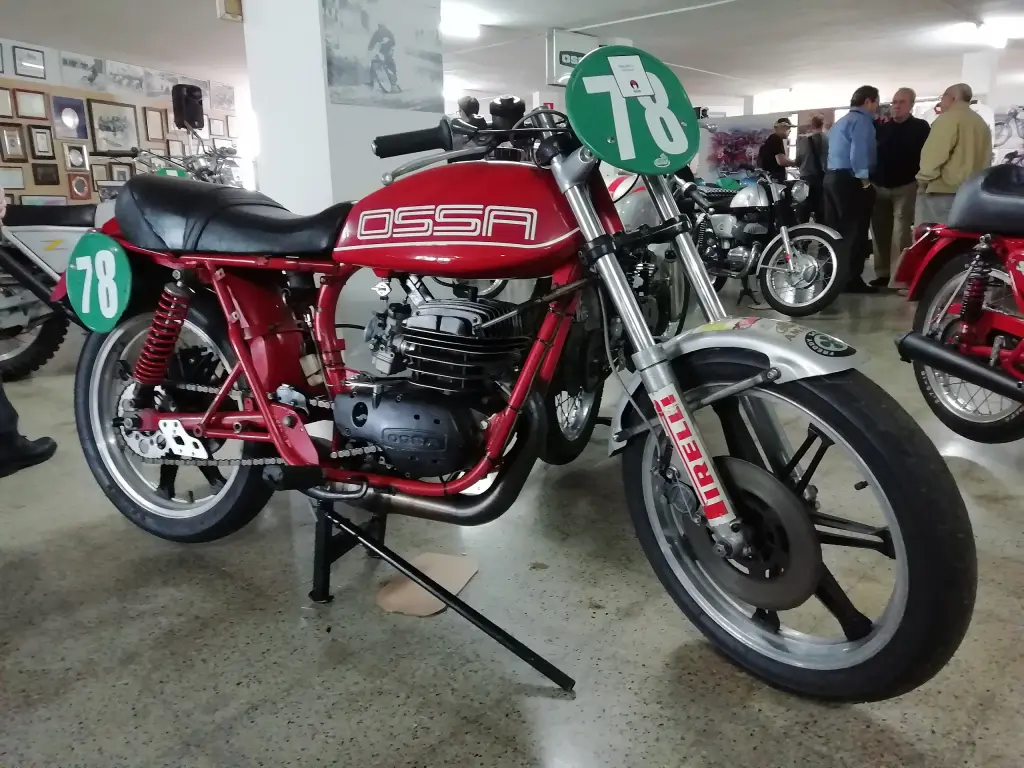
Ossa had used Sandro Colombo’s 160 cc four-speed engine in all its motorcycles since 1963. In 1966 the unit was enlarged to 230 cc for the new 230 Sport, and in 1969 it grew again to 244 cc for the 250 Sport. Apart from the new paint and the larger engine, the 250 Sport was practically the same motorcycle as the 230, and the “72” version of 1972 followed the same recipe. With a top speed of 150 km/h it was the fastest bike in its class in Spain at the time.
The Turismo and the Copa years (1975–1979)
The real renewal came in 1975 with the 250T, a five-speed, restyled Turismo that marked Ossa’s return to road bikes after years concentrated on off-road models; it revived the company’s sales. The success of the Copa Ossa, a one-make trophy for novice riders organised in 1976 and 1977 and reserved for 250T riders, led to two new versions in 1977: the 250T 77 and the 250T Copa. Their red, blue and white tank and side panels earned all three the nickname “Ossa Pepsi”. The 250T Copa, or Copa 77, sat between the touring 250T and the later Copa: 27 hp and 112 kg gave it quick acceleration, a top speed of about 145–150 km/h, an AJP front disc and a strong rear drum, electronic ignition and a 32 mm Bing carburettor. It was also thirsty, noisy and smoky, and its clutch was heavy.
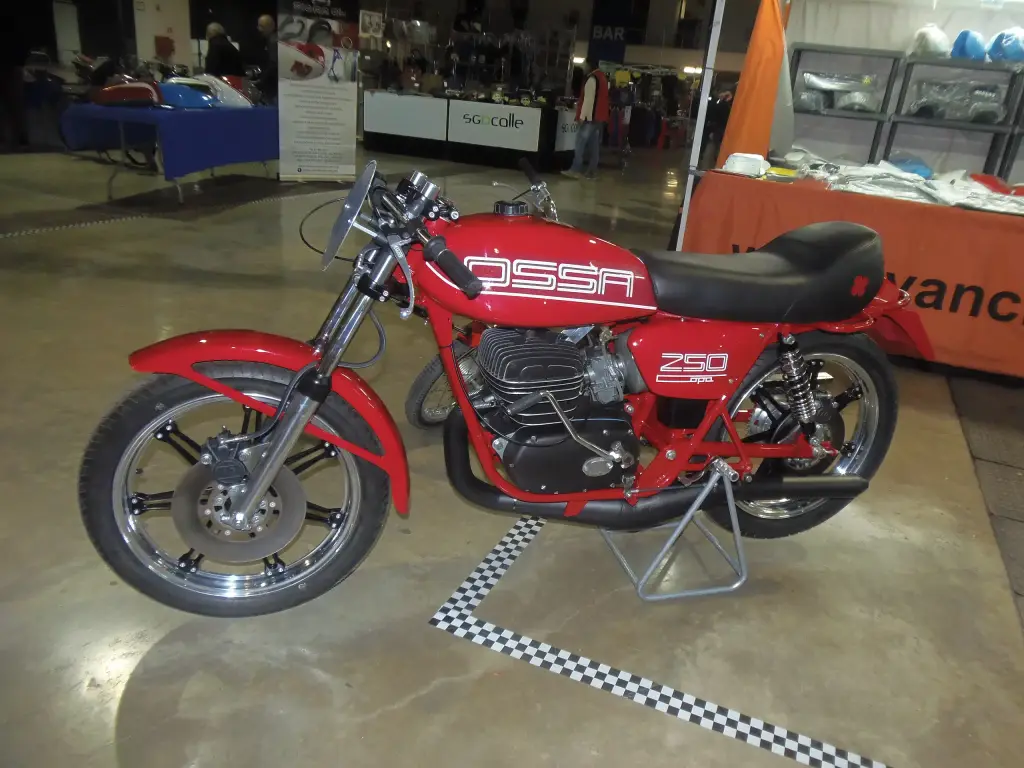
At the end of 1978 Ossa entered a deep crisis that ended with the departure of its owners, including Eduard Giró, and its conversion into a workers’ cooperative. Even so, the factory built the Copa 79 for production-class racing: it used the four-finned cylinder of the Phantom motocross bike, two disc brakes and red paint. The Copa was a success and accounted for half of the brand’s total sales, with demand exceeding the reduced capacity of the factory.
TE and Formula 3 (1980–1981)
In 1980, with the situation worsening, Ossa tried to boost sales with a cheaper 250, the TE. The initials stood for Turismo Especial, but buyers read them as Turismo Económica: it was based on the old 250T, now painted red and orange, and used only 5 litres of fuel per 100 km. In 1981 the magazine Motociclismo organised the first Motociclismo Series, with a Formula 3 class for two-strokes up to 250 cc. Ossa built the F3 from the Copa with a new exhaust, modified porting supplied as drawings, a cut-down screen, a five-piece low handlebar without instruments, rear-set footrests, 18-inch Akront rims with magnesium hubs and a lowered seat. A kit was also sold to convert a standard Copa, which multiplied the number of bikes on the grid. The F3 won its class and made the names of riders such as Juan López Mella, Rafael Falo Fernández and Carlos Muñoz. It could not save the company, which closed around 1985.
Design and features
- Colombo engine lineage: the final development of the 160 cc four-speed unit that Ossa had used since 1963.
- Copa Ossa: the 250T was the only machine allowed in the 1976–1977 one-make trophy for novice riders.
- Pepsi livery: the red, blue and white paint of the 250T and 250T Copa that gave the model its nickname.
- Racing success: the Copa 79 and the Formula 3 won their classes and launched several Spanish racing careers.
Ossa 250 versions
- 250 Sport (1969): 244 cc, practically a rebored 230 Sport, with a top speed of 150 km/h.
- 250 “72” (1972): the same motorcycle with new paint.
- 250T (1975): the five-speed Turismo and the basis of the Copa Ossa.
- 250T 77 and 250T Copa (1977): the Pepsi-liveried versions, the Copa with 27 hp and 112 kg.
- Copa 79 (1979): Phantom cylinder, two disc brakes and red paint, built for production-class racing.
- TE (1980) and Formula 3 (1981): the cheap economy model and the racing version for the Motociclismo Series.
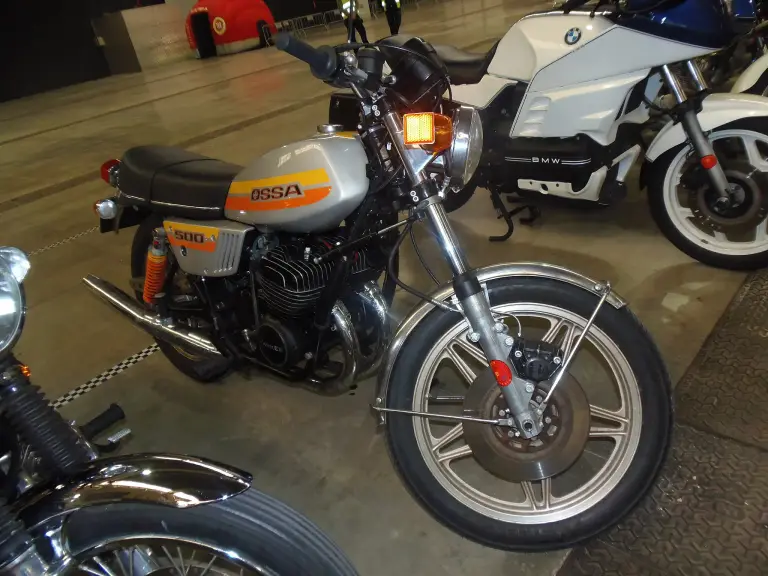
The 250 shared the Ossa range with the trials MAR and the twin-cylinder Yankee 500. More models are in the Ossa collection.
Video: Ossa 250 carrera Algueña 2010
Video by VYRECO on YouTube.
Sources
- OSSA 250, Catalan Wikipedia: versions, production years, technical data, racing
- Ossa (motorcycle), English Wikipedia: company history