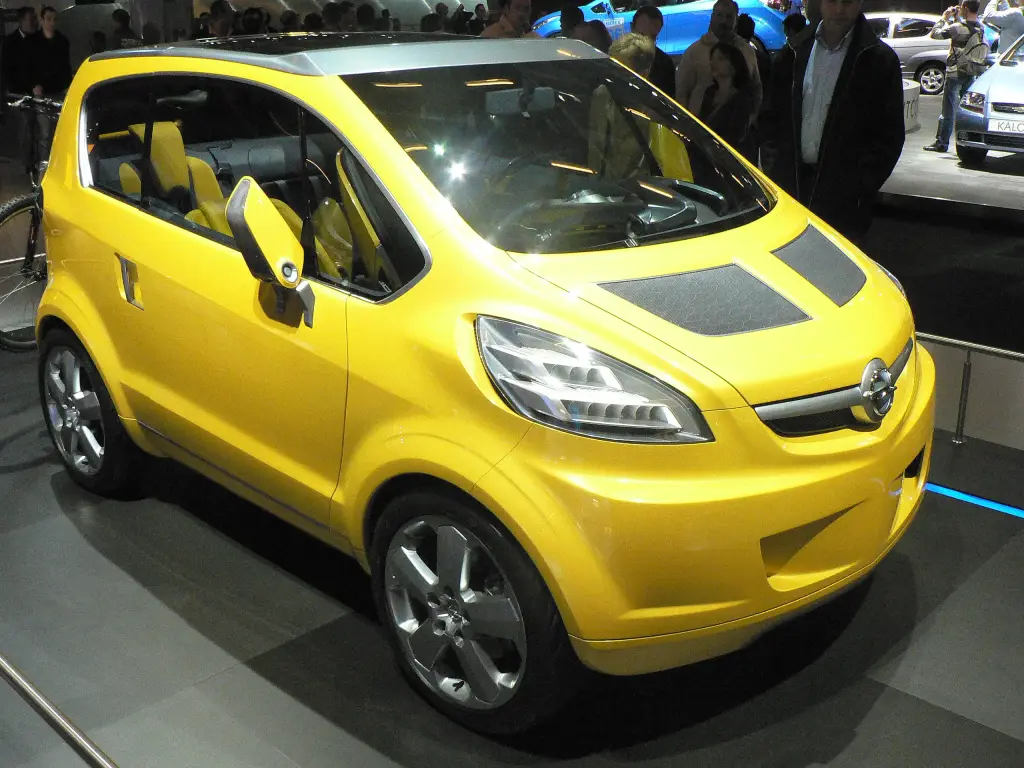
The Opel Trixx was a concept city car shown at the 2004 Geneva Motor Show. Three metres long, it had an asymmetric door layout with sliding doors, a sliding roof hatch for large loads and a rear seat that inflated when needed, and it influenced the design of the 2007 Opel Agila.
Opel Trixx at a glance
| Maker | Adam Opel AG |
|---|---|
| Type | concept city car |
| Shown | Geneva Motor Show, 2004 |
| Length | three metres |
| Doors | asymmetric layout with sliding doors |
| Roof | sliding roof hatch for large cargo |
| Extra | cycle rack concealed in the pull-out rear bumper |
| Seating | Flex 3 layout |
| Luggage | 1,010 litres in single-seat form |
| Engine | 1.3-litre common-rail diesel |
| Top speed | about 112 km/h |
| Built by | Carrozzeria Coggiola |
Based on one source, the English Wikipedia article on the Opel Trixx. The article is short, so this page is shorter than usual.
History of the Opel Trixx
The brief
The Trixx was created to a brief set by Opel chief executive Carl-Peter Forster for the Opel and Saab design studios. The work was led by executive director of design Martin Smith and chief designer Stefan Arndt, and the car itself was built by Carrozzeria Coggiola in Italy, a coachbuilder used by several manufacturers for show cars.
A city car that carries things
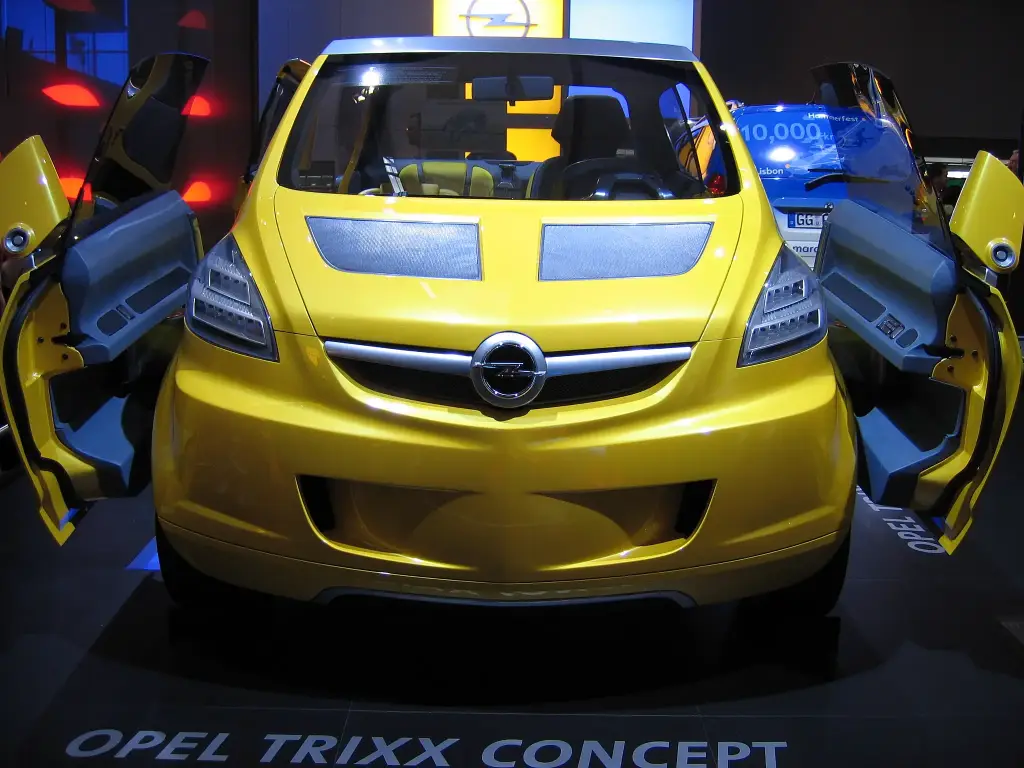
The car was three metres long, which put it in the smallest class on European roads, and its layout was unusual. The doors were asymmetric, with sliding doors to save space in tight parking, and a sliding roof hatch allowed long or tall objects to be carried. A cycle rack was hidden in the pull-out rear bumper. The interior used a layout Opel called Flex 3, which could seat three adults and one child on a folding seat, or be turned into a single-seater with a luggage area of 1,010 litres. The rear passenger seat was inflatable so that it took up no space when not in use: it was inflated by pulling up the head restraint.
Power and influence
The Trixx was powered by a 1.3-litre diesel with common-rail direct injection, which gave a claimed top speed of about 112 km/h, enough for a city car and a sign that Opel was thinking about efficiency rather than performance. Its ideas were carried into production thinking: the concept influenced later small Opel designs, in particular the 2007 Opel Agila. An electric concept based on the Ampera and the Trixx was expected to follow in 2009, but it never appeared.
Design and features
- Three metres long: a true city car, shorter than a Corsa.
- Sliding doors: an asymmetric layout that works in tight spaces.
- Roof hatch and cycle rack: practical ideas hidden in the bodywork.
- Inflatable seat: a rear seat that takes no space until it is needed.
Opel Trixx versions
- Flex 3 four-seat layout: three adults and one child.
- Single-seat layout: 1,010 litres of luggage space.
The Trixx influenced the Agila that followed, and shared its city-car thinking with the Corsa. More cars are in the Opel collection.
Sources
- Opel Trixx, English Wikipedia: concept, layout, engine, designers