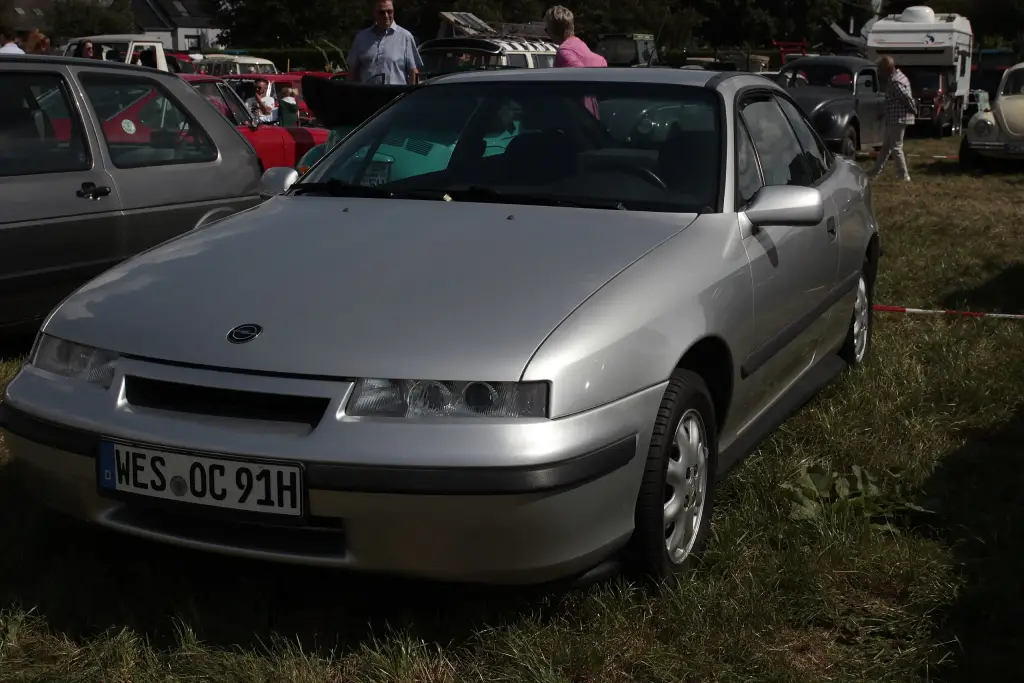
The Opel Calibra was a coupé built by Opel between 1989 and 1997 on the running gear of the first Vectra. When it was launched on 10 June 1989 it was the most aerodynamic production car in the world, with a drag coefficient of 0.26, and it kept that title for ten years.
Opel Calibra at a glance
| Maker | Adam Opel AG, Rüsselsheim |
|---|---|
| Production | 1989–1997 (Vauxhall until 1999) |
| Class | sport coupé |
| Based on | Opel Vectra A |
| Styling | Wayne Cherry and Erhard Schnell |
| Drag coefficient | 0.26 at launch |
| Body | three-door hatchback coupé, four seats |
| Luggage | 300 litres |
| Drive | front-wheel drive; four-wheel drive from November 1990 |
| Plants | Rüsselsheim, Germany; Uusikaupunki, Finland |
| Replaced | Opel Manta |
Based on one source, the English Wikipedia article on the Opel Calibra.
History of the Opel Calibra
Aerodynamics as the design brief
The Calibra was styled by GM designer Wayne Cherry and the German designer Erhard Schnell, and its shape was driven by the wind tunnel. A 7 cm high headlamp, made possible by new ellipsoid technology developed with Hella, was central to both the look and the airflow. The prototype was tested at the DNW wind tunnel in the Netherlands, where models could be run above a rolling road. Tapering the rear waistline and the rear side windows by about 50 mm compared with earlier mock-ups brought about 0.035 Cd, and changes to panel lines, an integrated front spoiler, the engine shield and a panel between the fuel tank and the lower rear bumper brought another 0.035. The result was 0.26, a record for a production car until the Honda Insight appeared in November 1999 with 0.25. Later 16-valve, V6, four-wheel-drive and turbo cars were less slippery at 0.29.
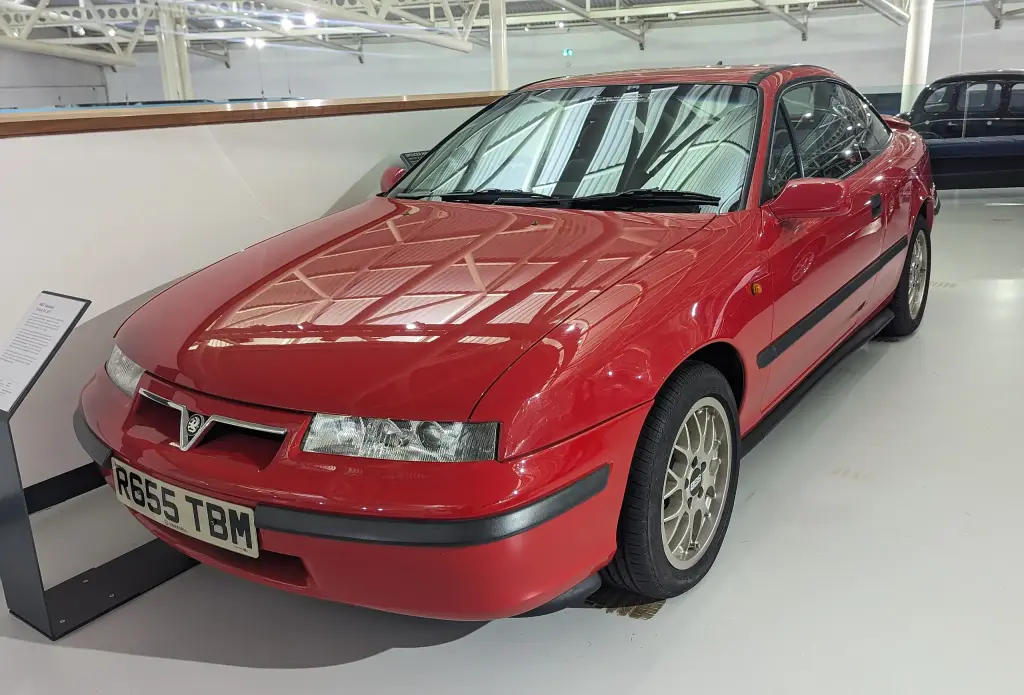
A practical coupé
Under the skin the Calibra used the chassis of the Vectra A, which had been launched in October 1988, and its ride and handling were not far from those of the large family car it grew out of, though the body was stiffer in torsion. The four-wheel-drive turbo version had independent rear suspension based on the Omega A axle, and the sporting limited editions used Irmscher suspension. The hatchback tail made the Calibra unusually usable for a coupé of its size: it seated four adults and took 300 litres of luggage.
Production and special editions
The Calibra was built in Rüsselsheim and, from the middle of its life, at Valmet Automotive in Uusikaupunki, Finland, where more than 90,000 were made; production was consolidated there in November 1995. Four-wheel drive became available in November 1990. Sales of the Vauxhall-badged British version began in June 1990, although the hoped-for 15,000 cars a year were never reached. A light facelift came in the summer of 1994, when the badge moved from the bonnet edge into the grille. Special models ran from the Tickford conversion of October 1991, of which only 26 were made, through Vauxhall’s SE1 to SE9 editions, to continental cars such as the Keke Rosberg, DTM, Cliff, Colour and Last editions, some with lowered Irmscher suspension and a numbered plaque on the ashtray.
Design and features
- 0.26 drag coefficient: the most aerodynamic production car in the world from 1989 to 1999.
- Slim headlamps: 7 cm high ellipsoid units developed with Hella.
- Vectra A running gear: a coupé that was as usable as the saloon it came from.
- Four-wheel drive: available from November 1990, with the Omega A rear axle on turbo cars.
Opel Calibra versions
- Calibra (1989): front-wheel-drive coupé with 8- and 16-valve engines.
- Calibra 4×4 (1990): four-wheel drive, and a turbo version with independent rear suspension.
- 1994 facelift: badge moved into the grille, more equipment and safety.
- Vauxhall SE editions: SE1 in 1993 through SE9 in 1997.
- Keke Rosberg, DTM, Cliff, Colour and Last editions: continental specials, some with Irmscher suspension.
The Calibra replaced the Manta and was built on the Vectra platform. More cars are in the Opel collection.
Video: Telemotor test Nissan 200sx VW Corrado Opel Calibra
Video by bvos1234 on YouTube.
Sources
- Opel Calibra, English Wikipedia: design, aerodynamics, plants, special editions