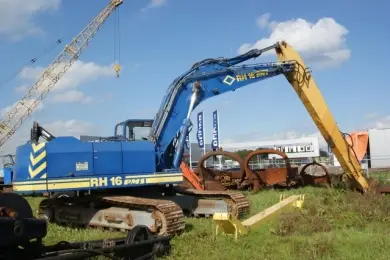
The O&K RH is an excavator of Orenstein & Koppel, the German engineering company whose name stood for construction machinery for more than a century. Excavators were the branch the firm concentrated on last, and they were also the part of its business that outlived the rest.
O&K RH at a glance
| Maker | Orenstein & Koppel (O&K), Berlin, Germany |
|---|---|
| Founded | 1 April 1876, by Benno Orenstein and Arthur Koppel |
| First speciality | railway vehicles |
| First tracked steam shovel | 1922 |
| Diesel replaced steam | 1926 |
| Construction equipment | excavators, graders, dump trucks, forklift trucks, compressors, crawler and wheeled loaders, road rollers, truck cranes |
| Railway business | left in 1981 |
| Escalator division | spun off to Krupp in 1996 |
| Construction equipment sold | to New Holland Construction (Fiat Group) in 1999 |
There is no Wikipedia page for this model: the article rests on the English Wikipedia history of Orenstein & Koppel, based on one source. Detailed model data are not given in that source and are not invented here.
History of the O&K RH
A company built on railways
Orenstein & Koppel was founded in Berlin on 1 April 1876 by Benno Orenstein and Arthur Koppel. It began as a general engineering works and soon specialised in railway vehicles, building locomotives and wagons at Schlachtensee in the Zehlendorf district of Berlin and, from 1899, at Nowawes near Potsdam, later called Babelsberg. Field-service locomotives for the Imperial German Army, narrow-gauge equipment and industrial shunters made the name familiar far beyond Germany, and a worldwide system of branch offices grew out of the company’s export trade.
Into construction machinery
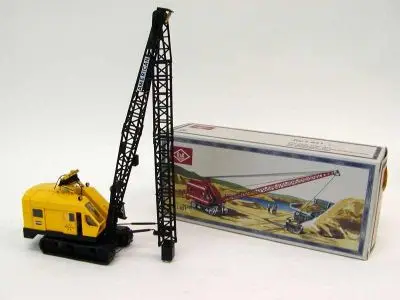
Alongside the railway work O&K expanded into freight and passenger cars and, above all, into excavators for construction. The catalogue of heavy equipment grew to include graders, dump trucks, forklift trucks, compressors, crawler loaders, wheeled loaders, road rollers and truck cranes. The company built its first continuous-track steam shovel in 1922; in 1926 diesel engines replaced steam, and earlier steam-driven machines were converted to diesel power as the need arose. The Spandau factory in Berlin specialised in cable-operated excavators and bucket-wheel excavators for the lignite mines of eastern Germany.
The RH line and the end of the company
The RH designation belongs to the excavator family that carried the O&K name in the second half of the twentieth century, when the company was selling construction machines rather than locomotives. O&K left the railway business in 1981. Its escalator division was spun off in 1996 to the majority shareholder of the time, Friedrich Krupp AG Hoesch-Krupp, which left the firm focused primarily on construction machines. In 1999 that construction-equipment business was sold to New Holland Construction, at the time part of the Fiat Group, and the machines continued under a new owner.
Design and features
- Excavator heritage: O&K was building tracked shovels from 1922 and moved them to diesel power in 1926.
- Mining experience: the Spandau works produced cable-operated and bucket-wheel excavators for the lignite mines.
- Wide catalogue: excavators stood beside graders, loaders, rollers and cranes in the O&K construction range.
- Late focus: after 1996 construction equipment was the only business left in the company.
O&K RH versions
- Early steam shovels: the continuous-track machines from 1922 onwards.
- Diesel excavators: from 1926, plus steam units converted to diesel.
- Cable-operated and bucket-wheel machines: the Spandau speciality for open-cast lignite mining.
- RH excavators: the line the O&K name is best known for in earthmoving.
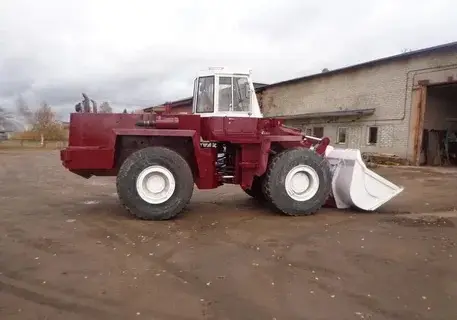
The RH is one of three O&K machines on this site; the company’s wheeled loaders are described with the O&K L651 and the O&K L25. More machines of the firm are in the O&K collection.
Video: Farmakidis Bros- O&K RH 9.5 Loading Iveco Truck
Video on YouTube.
Sources
- Orenstein & Koppel, English Wikipedia: founding, railway work, construction equipment, 1922 and 1926, Krupp and New Holland