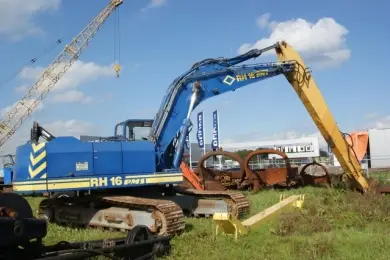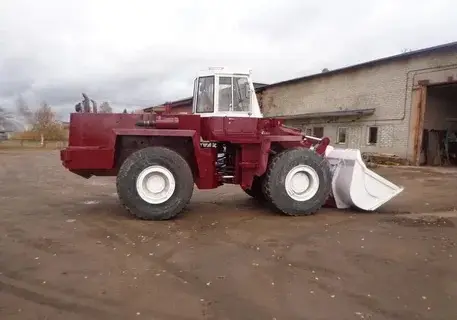
The O&K L651 is a wheeled loader carrying the name of Orenstein & Koppel, the Berlin engineering company founded in 1876. Wheeled loaders were one of the construction machine types O&K built in the last decades of the firm’s independent life.
O&K L651 at a glance
| Maker | Orenstein & Koppel (O&K), Berlin, Germany |
|---|---|
| Founded | 1 April 1876, by Benno Orenstein and Arthur Koppel |
| Machine type | wheeled loader |
| Construction equipment | excavators, graders, dump trucks, forklift trucks, compressors, crawler and wheeled loaders, road rollers, truck cranes |
| First tracked steam shovel | 1922 |
| Railway business | left in 1981 |
| Escalator division | spun off to Krupp in 1996 |
| Construction equipment sold | to New Holland Construction (Fiat Group) in 1999 |
There is no Wikipedia page for this model: the article rests on the English Wikipedia history of Orenstein & Koppel, based on one source. Detailed model data are not given in that source and are not invented here.
History of the O&K L651
From locomotives to loaders
Orenstein & Koppel began in Berlin on 1 April 1876 as a general engineering works and quickly turned to railway vehicles. The firm built locomotives and wagons in Schlachtensee and from 1899 at Nowawes near Potsdam, later Babelsberg, and its export business produced a worldwide network of branch offices. O&K also made freight and passenger cars and, above all, excavators for construction, and that widening range came to include graders, dump trucks, forklift trucks, compressors, crawler loaders, wheeled loaders, road rollers and truck cranes.
The loaders in the range
Wheeled loaders such as the L651 belong to the construction side of the O&K catalogue, the business the company kept when the railway years ended. The works built its first continuous-track steam shovel in 1922 and moved to diesel power in 1926, and the Spandau factory became known for cable-operated and bucket-wheel excavators in the lignite mines of eastern Germany. Loaders served the same customers as those larger machines: contractors, quarries and earthworks that needed a machine to pick up and carry loose material rather than dig a face.
The last decades
O&K pulled out of the railway business in 1981. The escalator-manufacturing division was spun off in 1996 to Friedrich Krupp AG Hoesch-Krupp, then the majority shareholder, so that the company could concentrate on construction machines. In 1999 that construction-equipment business passed to New Holland Construction, at the time part of the Fiat Group, and O&K loaders and excavators continued to be built under the new owner.
Design and features
- Wheeled loader: a carrying machine for loose material, on wheels rather than tracks.
- Construction range: loaders stood alongside excavators, graders, rollers and cranes in the O&K catalogue.
- Diesel era: O&K moved from steam to diesel power in 1926 and kept to diesel machines.
- Contractor market: the loaders served the same customers as the firm’s excavators.
O&K L651 versions
- Wheeled loaders: the L-series machines, of which the L651 is one.
- Crawler loaders: tracked versions listed in the same construction range.
- Excavators: the larger O&K earthmoving machines, from cable-operated to hydraulic.
- Other equipment: graders, dump trucks, road rollers and truck cranes from the same works.
The L651 belongs with the O&K L25 wheeled loader, and the company’s excavators are described with the O&K RH. More machines of the firm are in the O&K collection.
Sources
- Orenstein & Koppel, English Wikipedia: founding, product range, 1922 and 1926, Krupp and New Holland