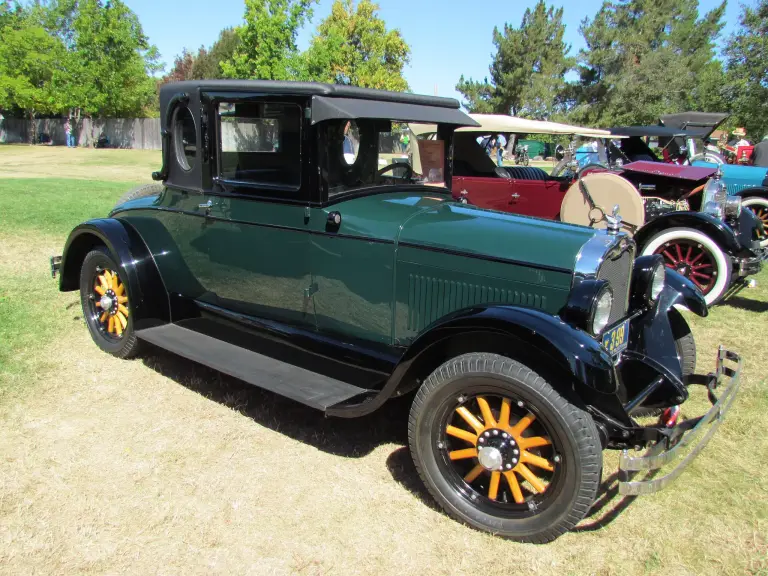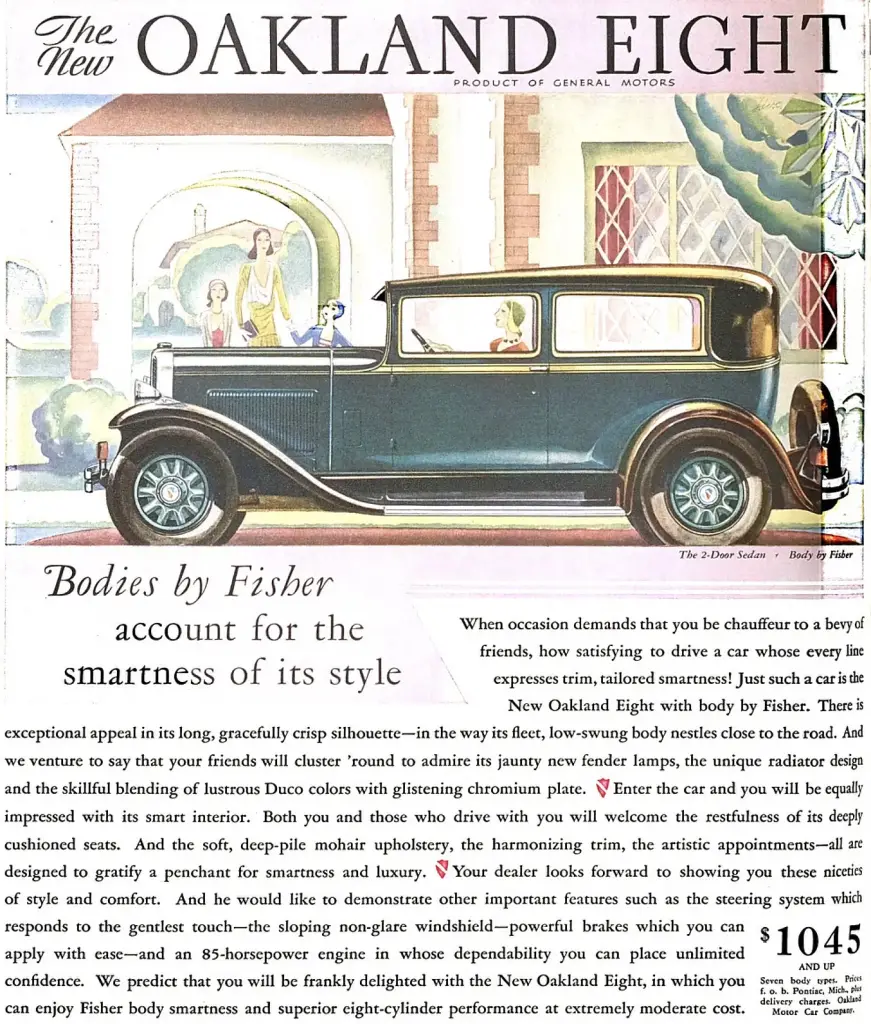
Oakland used a V8 engine in two separate periods. The Model 50 of 1916 was the first, a big seven-passenger touring car with a Northway flathead; the Model 101 of 1930 was the second, and it was the last car to wear the Oakland name before the division became Pontiac.
Oakland Eight at a glance
| Maker | Oakland Motor Company, Pontiac, Michigan (GM division) |
|---|---|
| First V8 | 1916 Model 50, 365 cu in (6.0 L) flathead from Northway |
| Model 50 body | seven-passenger touring sedan, 127 in wheelbase |
| Model 50 price | US$1,600 |
| Oakland production in 1917 | 35,000 cars |
| Second V8 | 1930 Model 101, 117 in wheelbase |
| Model 101 bodies | roadster, phaeton, coupe, closed sedan and sport coupe |
| Model 101 price | US$895 for the roadster or phaeton to US$1,045 for the Custom Sedan |
| Shared engine | the V8 was shared with the Viking, Oldsmobile’s companion make |
| Last model | 1931 Model 301 V8 |
| Successor | 1932 Pontiac Series 302 V8, 251 cu in (4.1 L), 85 hp |
There is no separate Wikipedia article on an Oakland Eight; this page is based on the sections on the V8 models in the English article on the Oakland Motor Car Company, so it rests on one source.
History of the Oakland Eight
The Model 50 of 1916
Oakland introduced its first V8 in 1916, one year after the six-cylinder range had settled into annual model names. The Model 50 used a 365 cu in (6.0 L) flathead V8 sourced from the Northway Motor and Manufacturing Company, the same GM division that had supplied the engine of the 1913 Oakland Six. The engine used a flathead design shared with the Oldsmobile Light Eight and the Cadillac Type 51. The Model 50 was sold only from 1915 to 1917 and only as a seven-passenger touring sedan on a 127 in wheelbase, listed at US$1,600. With the V8 above it and the Six Model 34 below, Oakland production soared to 35,000 cars in 1917. Unusually, the Model 50 did not return for 1918, and the six-cylinder Model 34-B carried the range alone through 1919.
The Model 101 of 1930
A V8 came back only in 1930, as the Model 101 on a 117 in wheelbase. It again used a flathead architecture and was offered as a roadster, phaeton, coupe, closed sedan and sport coupe, with prices from US$895 for the open cars to US$1,045 for the Custom Sedan. The engine was shared with the Viking V8, the companion make of Oldsmobile, and in the Model 101 it was Oakland’s only product at the top of the range. A short-wheelbase “light six” called Pontiac had been added to the division in 1926 at a price just above Chevrolet, and it sold 49,875 cars in its first year; by 1929 GM sold 163,000 more Pontiacs than Oaklands.
The end of Oakland
1931 was the last year for the Oakland V8, as the Model 301, with very few changes from the 1930 car and the V8 as the only engine available. The design did not disappear: it was renamed the 1932 Pontiac Series 302 V8, with an oversquare bore and stroke of 3.4375 in by 3.375 in (87.3 mm by 85.7 mm) displacing 251 cu in (4.1 L) at a compression ratio of 5.2:1. It was rated at 85 hp at 3200 rpm, with three main bearings, solid valve lifters and a Marvel one-barrel carburettor. Pontiac then switched to a straight-eight for 1933, an engine it kept until 1954. The discontinuation of Oakland itself was announced with the onset of the Great Depression in 1931.
Design and features
- Northway power: the 1916 Model 50 used a 365 cu in flathead V8 from GM’s Northway division.
- Shared with Cadillac and Oldsmobile: the same flathead design served the Cadillac Type 51 and the Oldsmobile Light Eight.
- One body only: the Model 50 came solely as a seven-passenger touring sedan on a 127 in wheelbase.
- Revival in 1930: the Model 101 brought the V8 back in five body styles on a shorter 117 in chassis.
- A Viking twin: the 1930 V8 was shared with Oldsmobile’s companion make, the Viking.
Oakland Eight versions
- Model 50 (1916–1917): the first Oakland V8, a seven-passenger touring sedan at US$1,600.
- Model 101 (1930): roadster, phaeton, coupe, closed sedan and sport coupe, from US$895.
- Model 301 (1931): the final Oakland, essentially the 1930 car with minor changes.
- Pontiac Series 302 (1932): the same V8 under a new name, 251 cu in and 85 hp.
The six-cylinder cars that carried Oakland through the 1910s and 1920s are described in Oakland Six, and the company’s history from 1907 to 1931 is in the Oakland collection.
Sources
- Oakland Motor Car Company, English Wikipedia: V8 models, prices, Pontiac