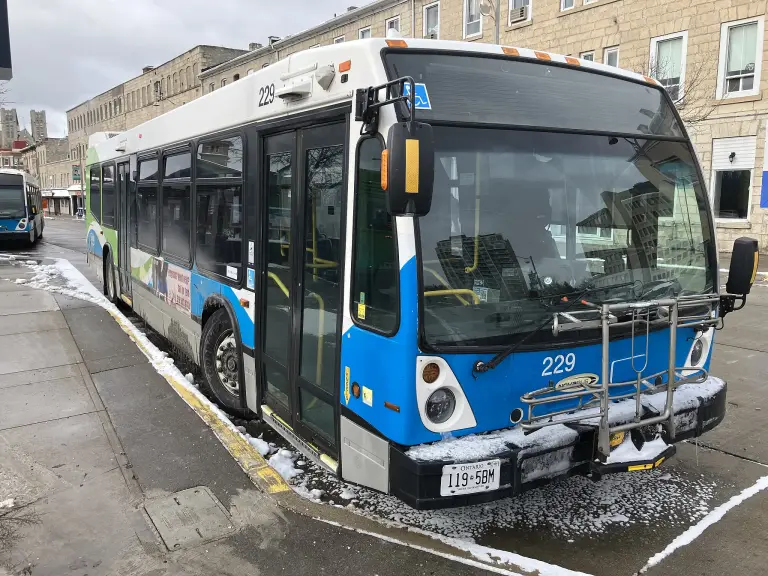
The Classic was the high-floor city bus that Nova Bus inherited when it bought the Saint-Eustache plant in 1993. An updated version of the General Motors New Look of the 1950s, it stayed in production until 1997, by which time its own replacement, the low-floor LFS, was already being delivered.
Nova Bus Classic at a glance
| Makers | General Motors, then Motor Coach Industries, then Nova Bus |
|---|---|
| Production | from 1982 to 1997 |
| Nova Bus years | 1993–1997 |
| Plant | Saint-Eustache, Quebec |
| Class | high-floor transit bus |
| Derived from | GM New Look of the late 1950s |
| Structure | riveted, galvanised steel |
| Known problem | premature corrosion of the galvanised body |
| 1995 version | Cummins-powered T-Drive, troubled from the start |
| Replaced by | Nova Bus LFS low-floor bus |
The Classic has no Wikipedia article of its own; this page uses the sections on it in the English, French and German articles about Nova Bus.
History of the Nova Bus Classic
Before Nova Bus
The Saint-Eustache factory opened as a General Motors plant in 1979 and built the New Look bus until 1983 and the Classic from 1982 for the Canadian market. In 1987 GM sold its bus-building business to Greyhound Dial, the parent of Motor Coach Industries, and the plant passed to MCI. By the early 1990s Dial wanted to sell its transport divisions and the Saint-Eustache works faced closure. Nova Bus was formed in 1993 by people from Nova Quintech and the Fonds de solidarité des travailleurs du Québec, with a $2.5-million interest-free loan and $10 million in loan guarantees from the Quebec government, which also promised to buy more than 300 buses in 1993–94. The sale took place on 6 July 1993.
The Classic under Nova Bus
The Classic was a high-floor bus based on the GM New Look, a design of the late 1950s, and by the 1990s it was an updated version of it. Its body was riveted and made of galvanised steel, and it suffered from corrosion; the problems were serious enough that the Quebec transport ministry threatened to stop subsidising its purchase. Negotiations with nine Quebec transit agencies ended with an order for 330 Classics and 60 low-floor buses, the second part of which forced the young company to design a bus it had never built. A Cummins-powered “T-Drive” Classic introduced in 1995 was underdeveloped and plagued with severe reliability problems. Nova Bus decided to put its engineers on the new low-floor LFS and to stop the Classic as soon as the LFS was in full production. The last Classic was built in 1997.
Design and features
- New Look ancestry: the body went back to a General Motors design of the late 1950s, updated over three decades.
- Riveted galvanised structure: cheap to build, but prone to corrosion in Canadian service.
- High floor: passengers climbed steps, unlike in the low-floor LFS that followed.
- Stopgap model: it kept the Saint-Eustache line busy while Nova Bus learned to build its own bus.
Nova Bus Classic versions
- GM-built Classic: assembled at Saint-Eustache from 1982 under General Motors.
- MCI-built Classic: the same bus after the 1987 sale of the plant.
- Nova Bus Classic: built in Quebec from 1993 to 1997.
- Classic T-Drive (1995): Cummins-engined version with a poor reliability record.
The Classic was replaced by the low-floor LFS, and it shared the Saint-Eustache plant with the RTS. More buses are in the Nova Bus collection.
Sources
- Nova Bus, English Wikipedia: plant history, Classic production, T-Drive problems
- Nova Bus, French Wikipedia: galvanised body, corrosion, Quebec order
- Nova Bus, German Wikipedia: end of the Classic era at Saint-Eustache