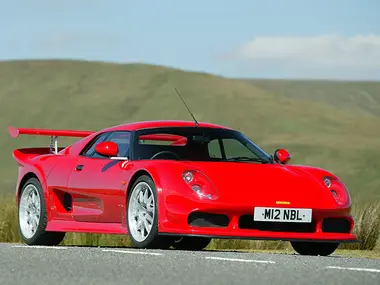
Noble Automotive Limited, usually called simply Noble, is an English sports car manufacturer based in Leicester. It was established in 1999 by Lee Noble in Leeds, West Yorkshire, to build high-speed sports cars with a rear mid-engine, rear-wheel-drive layout. The company changed hands in 2006, and Lee Noble left in 2008, but the name has stayed on some of the fastest low-volume cars ever made in Britain.
Noble Automotive at a glance
| Founded | 1999, by Lee Noble, in Leeds, West Yorkshire |
|---|---|
| Based in | Leicester, England |
| Layout | rear mid-engine, rear-wheel drive |
| First model | M10 (1999–2000) |
| Best known for | M12 and M400 (2000–2007) |
| Bodies built by | Hi-Tech Automotive, Port Elizabeth, South Africa |
| Sold | August 2006 |
| Founder left | February 2008 |
| US exports | 220 GTO-3Rs and M400s, the only Nobles officially sold there |
| Latest model | M600, 2009, 4.4-litre twin-turbo V8, 650 bhp |
This page is based on one source: the English Wikipedia article on the company.
History of the Noble Automotive
1999: Lee Noble and the M10
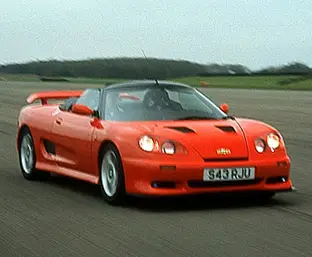
Lee Noble set the company up in 1999 in Leeds to make quick, light, mid-engined cars rather than grand tourers. The first product, the M10, was a two-seat glassfibre convertible on a tubular steel frame with a 2.5-litre Ford V6. It was offered first as a kit car, which proved too expensive and too complex for most buyers, and after an investment from the tour operator Tony Moy the engine was upgraded. Only a handful were completed before customers moved their deposits to the next model.
2000–2008: the M12 family
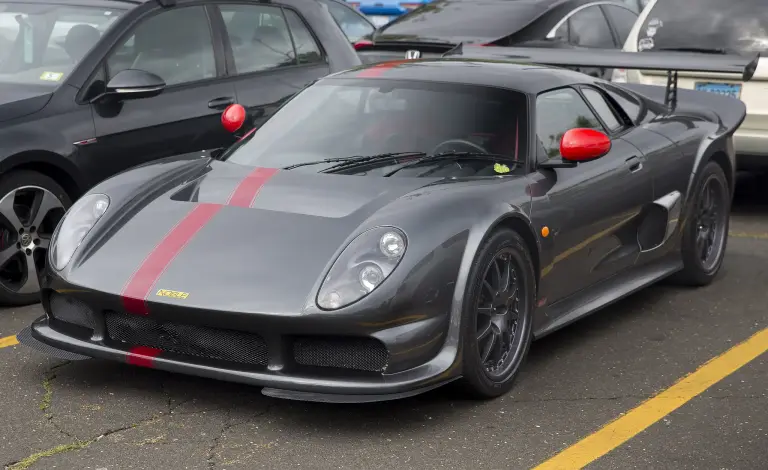
The M12 of 2000 established the formula the company became known for: a steel frame and roll cage, glassfibre clamshell bodywork and a specially tuned twin-turbocharged Ford Duratec V6 behind the seats. It evolved through the GTO, GTO-3 and GTO-3R and ended with the track-focused M400 of 2004. The M12 GTO-3R and the M400 share chassis and body but differ in engines and suspension.
2004–2011: prototypes and change of owner
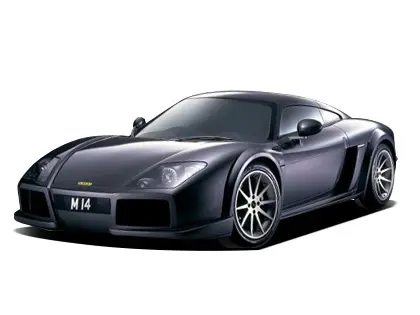
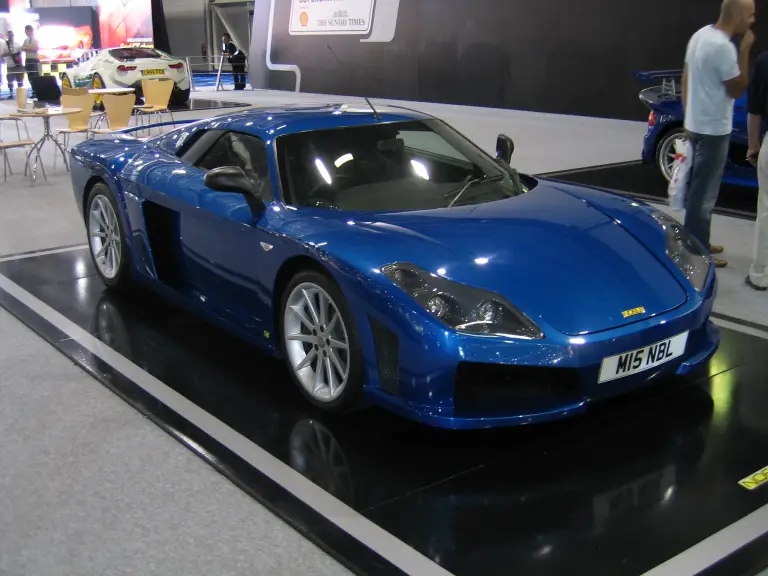
The M14 show car of 2004 was meant to move Noble upmarket towards the Porsche 911 Turbo and Ferrari F430, but Lee Noble decided it was not different enough from the M12 to justify the higher price, and development passed to the new M15. The M15, with a bigger, more usable body and a 455 bhp version of the 3.0-litre V6, was the first Noble designed for European and US type approval. The company was sold in August 2006 and Lee Noble left in February 2008; in 2009 he announced a new venture, Fenix Automotive.
The M600
In 2009 Noble released the M600, a hand-built car with a stainless steel and carbon fibre construction and a 4.4-litre Volvo-derived, Yamaha-built twin-turbo V8 giving 650 bhp through a Graziano six-speed manual gearbox. It used the steel backbone and aluminium chassis originally developed for the stillborn M15 and remained the company’s flagship.
Design and features
- Mid-engined layout: every Noble has the engine behind the driver and drives the rear wheels.
- Ford V6 power: the M10, M12, M400 and M15 all used specially tuned Ford engines, turbocharged in every case but the M10.
- South African bodies: body shells are built by Hi-Tech Automotive in Port Elizabeth alongside Superformance cars, then shipped to Leicester for engines and transmissions.
- Small numbers: production has always been in tens or low hundreds, which is why Nobles are rare and sought after.
Noble Automotive versions
- M10 (1999–2000): the first car, a glassfibre convertible with a 2.5-litre V6.
- M12 GTO and GTO-3 (2000–2008): the coupé that made the name, with 2.5- and 3.0-litre twin-turbo V6s.
- M12 GTO-3R: the later 3.0-litre car with 352 bhp.
- M400 (2004–2007): the track version with more than 400 bhp per ton.
- M14 (2004): a show prototype that never reached production.
- M15 (2006–2011) and M600 (2009): the move towards a more usable supercar.
The car that made the marque is the Noble M12, and the fastest of them all is the Noble M600. More cars are in the Noble collection.
Sources
- Noble Automotive, English Wikipedia: company history, models, production arrangements