The Nismo 380RS is the Nismo-tuned version of the Nissan 350Z, the two-seater Z33 of 2002–2009. Nismo, Nissan’s motorsport department, built its own take on the car in 2004 and added a more powerful R-Tune version on the same basis.
Nismo 380RS at a glance
| Maker | Nissan, tuned by Nismo |
|---|---|
| Based on | Nissan 350Z (Z33), 2002–2009 |
| Nismo version | 2004 |
| Engine | 3.5-litre VQ35DE V6 |
| Power, standard 350Z | 206 kW (280 PS) at 6,200 rpm |
| Torque, standard 350Z | 363 Nm at 4,800 rpm |
| Power, R-Tune | 305 hp |
| Gearbox | six-speed manual |
| Drive | rear-wheel drive |
| Wheels, Nismo version | 19-inch Nismo alloys |
| Seats | Alcantara sports seats built by Nismo |
| Body kit | developed with Polyphony Digital |
The Nismo version of the 350Z is described in a section of the Italian Wikipedia article on the car; this short page is based on that section together with the English and German articles.
History of the Nismo 380RS
The Z33
The 350Z went on sale in Japan in July 2002 and in Germany in October 2003, a two-seat sports car with a front-mid-mounted 3.5-litre V6 driving the rear wheels. The VQ35DE all-aluminium engine had four valves per cylinder and four camshafts; German sources quote 206 kW (280 PS) at 6,200 rpm and 363 Nm at 4,800 rpm, enough for 0–100 km/h in 5.9 seconds and a top speed limited to 250 km/h. A six-speed manual was standard, a five-speed automatic was offered in some markets, and the gearbox was joined to the rear axle by a one-piece carbon-fibre propshaft. Weight distribution was 53:47.
The Nismo version
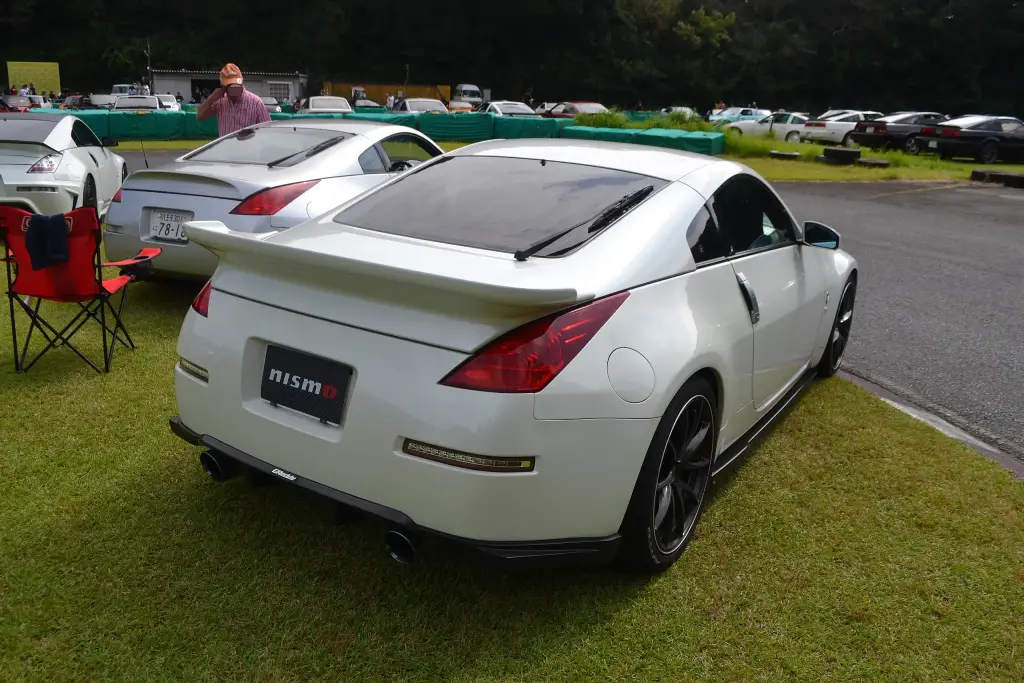
In 2004 Nismo made its own version of the 350Z. The standard exhaust gave way to a sports system with two outlets, and the aerodynamics were revised with a body kit developed together with Polyphony Digital, the studio behind the Gran Turismo games; the side skirts were shaped to guide air onto the tyres. A taller matt-black rear wing replaced the standard item, and buyers could order an air intake on the left of the front bumper and two extractor vents at the rear. The wheels were 19-inch Nismo alloys, and the sports seats, trimmed in Alcantara, used a foam developed to absorb the loads passed from the car to the driver.
R-Tune and later cars
A stronger version, the R-Tune, used the same 3.5-litre VQ35 with 305 hp and a six-speed manual, an S-Tune stainless exhaust and S-Tune suspension, Nismo R-Tune brakes and a further revised body kit. In 2005 came a 35th-anniversary edition of the 240Z with 18-inch wheels 1.6 kg lighter, in black and yellow only. For model year 2007 the engine was replaced by the VQ35HR with 313 hp and 363 Nm, cutting 0–100 km/h to 5.6 seconds and raising the limited top speed to 251 km/h. The 370Z replaced the car in 2009.
Design and features
- Polyphony Digital body kit: side skirts shaped to channel air onto the tyres, plus a taller black rear wing.
- Twin-outlet exhaust: a sports system in place of the standard one.
- Alcantara seats: built by Nismo with a load-absorbing foam.
- 19-inch wheels: Nismo alloys replacing the standard rims.
- R-Tune: 305 hp, S-Tune suspension and exhaust, Nismo R-Tune brakes.
Nismo 380RS versions
- Nismo 350Z (2004): the first Nismo-tuned Z33, with body kit, wheels and seats.
- R-Tune: 305 hp with S-Tune chassis parts and Nismo brakes.
- 35th Anniversary (2005): lighter 18-inch wheels, black or yellow.
- VQ35HR (2007): 313 hp and a 5.6-second sprint to 100 km/h.
The bigger car from the same department is the Nismo GT-R. More cars are in the Nismo collection.
Sources
- Nissan 350Z, Italian Wikipedia: Nismo version, R-Tune, anniversary edition
- Nissan 350Z, English Wikipedia: model history and background
- Nissan 350Z, German Wikipedia: engine figures, gearbox, weight distribution