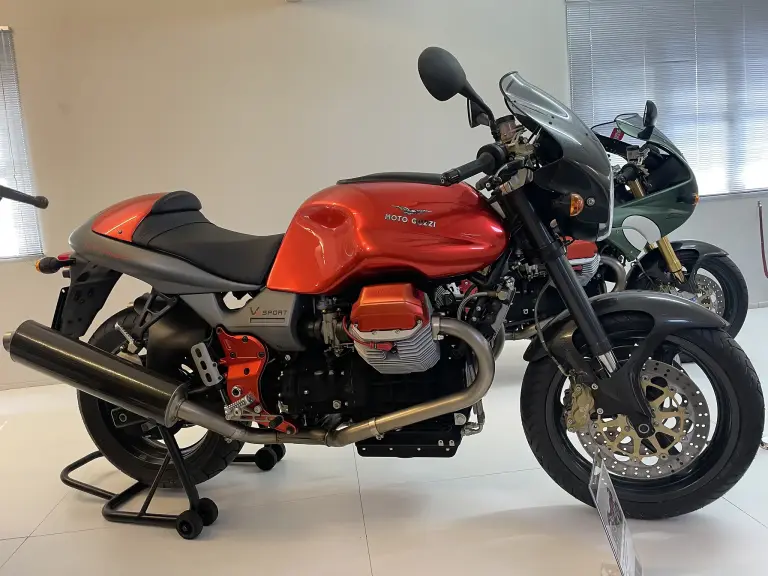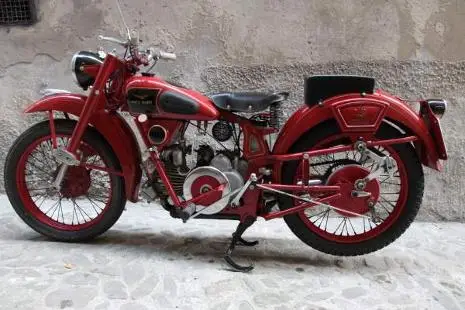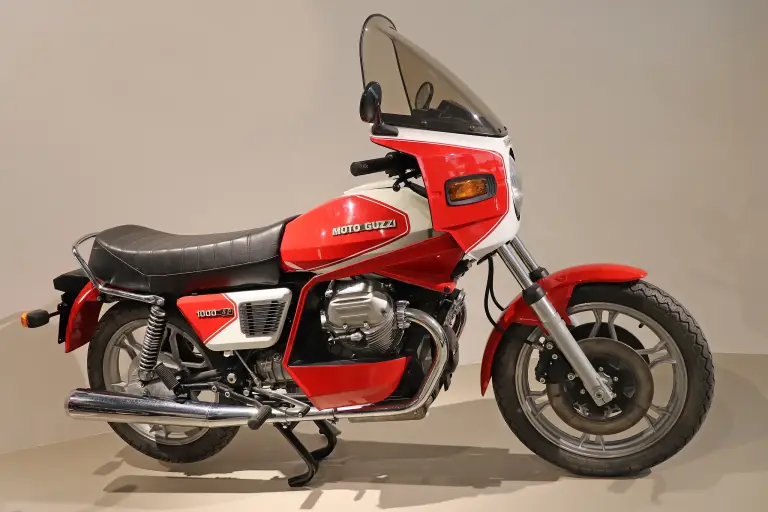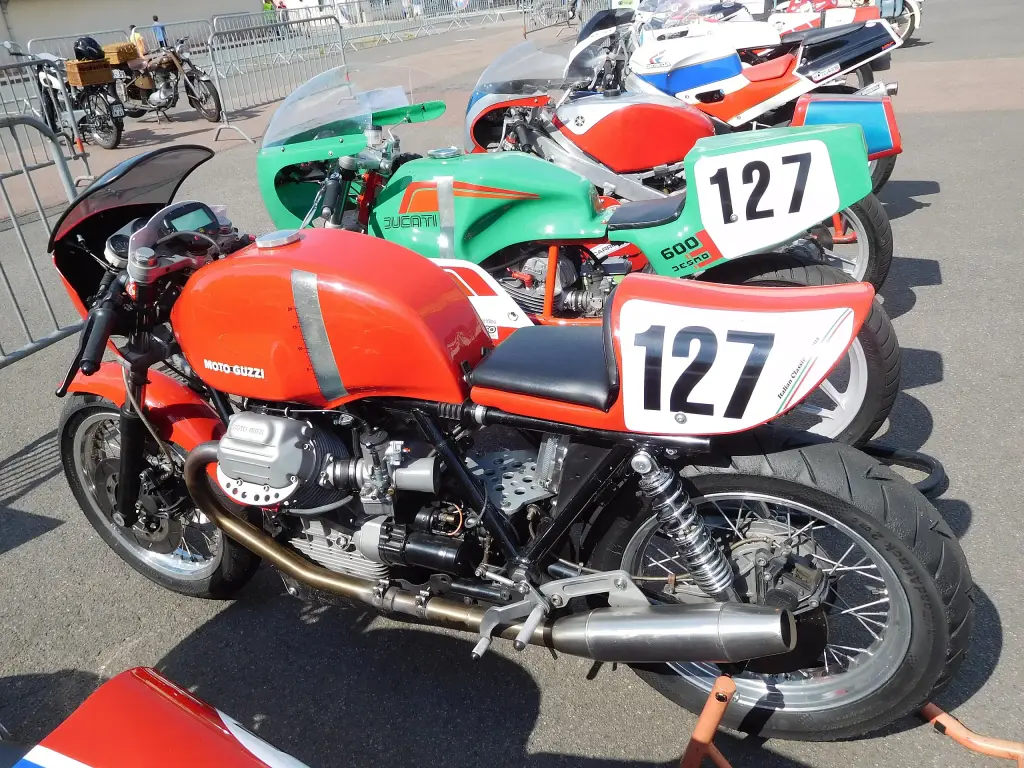
The Moto Guzzi Le Mans is a sports motorcycle first manufactured in 1976 by the Italian company Moto Guzzi. It is named after the 24-hour motorcycle endurance race at Le Mans in France, and the Le Mans designation was first used for an 850 prototype based on the V7, displayed at the Premio Varrone in late 1972.
Moto Guzzi Le Mans at a glance
| Maker | Moto Guzzi, Mandello del Lario |
|---|---|
| Production | from 1976, later models into the early 1990s |
| Named after | the 24 Hours of Le Mans |
| Shown | Milan motorcycle show, November 1975 |
| Engine | 843.6 cc air-cooled 90° V-twin, two valves per cylinder, pushrods |
| Power | 71 hp, 73 hp claimed at 7,700 rpm |
| Top speed | about 209–210 km/h |
| Gearbox | five speeds, dry multi-plate clutch |
| Final drive | shaft, crown and pinion bevel box |
| Frame | Lino Tonti frame from the V7 Sport |
| Carburettors | Dell’Orto 36 mm, 40 mm in the competition kit |
History of the Moto Guzzi Le Mans
In 1972 Moto Guzzi developed a prototype with the demountable frame of the V7 Sport and the same engine with some changes. Capacity was taken to 843.6 cc, with a bore and stroke of 83 by 78 mm, and two Dell’Orto PHM 40 mm carburettors with accelerator pumps and velocity stacks were used. The prototype had 82 hp at 7,500 rpm, and the same machine tested the linked braking system developed by Brembo, in which the pedal worked the rear disc and the left front disc while the handlebar lever worked the right front disc on its own.
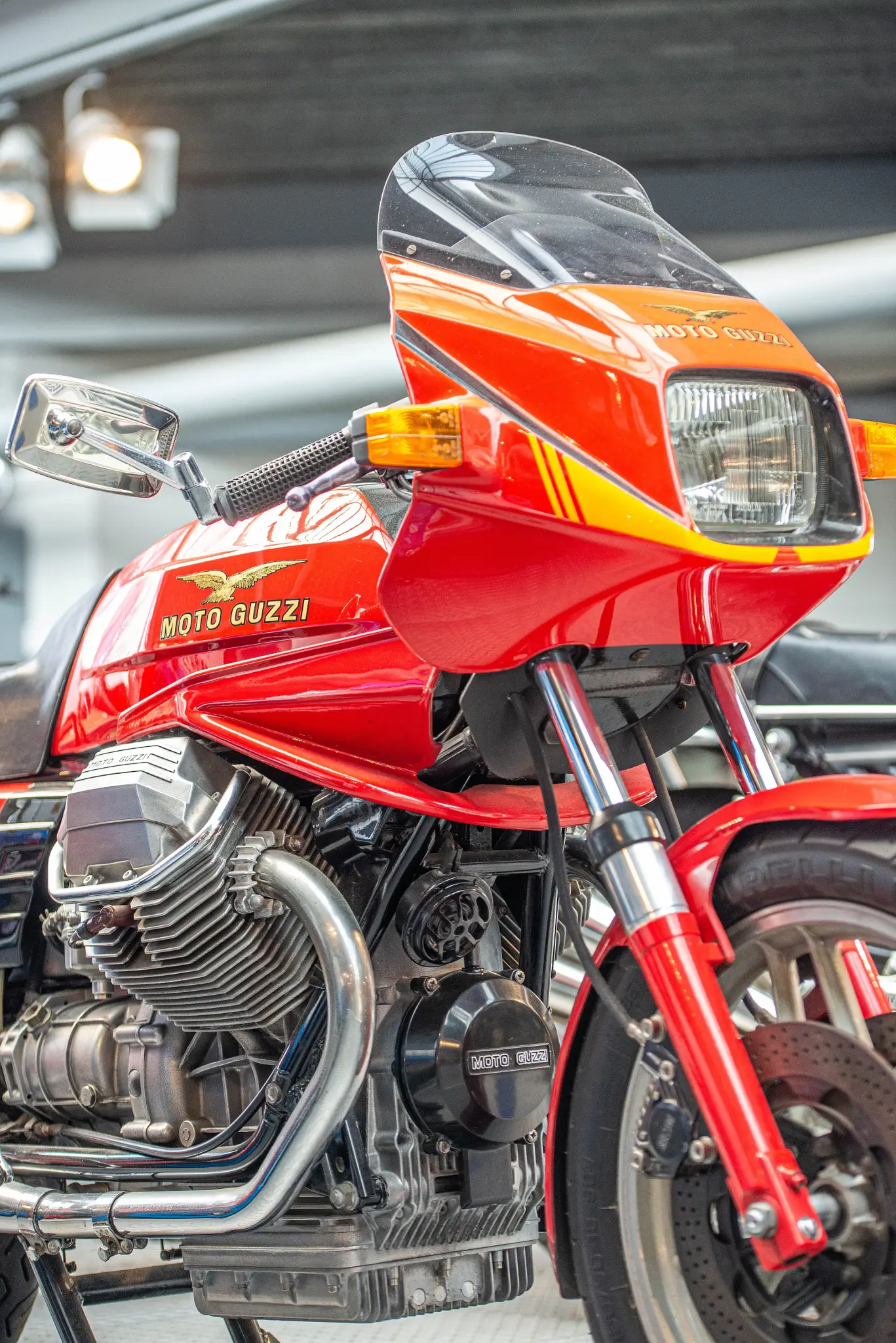
The 850 Le Mans, often called the Le Mans I, was the production machine derived from that prototype. The frame designed by Lino Tonti was kept, but power was reduced to 71 hp, enough for a top speed of 210 km/h. It was presented with the 750 S3 at the Milan show in November 1975 as a road base for production-derived racing, and was at first intended as a limited run of a few hundred examples, but it was an immediate success with more than 500 orders taken at the show, and full production began in early 1976. Compared with its roadster sister the T3, the Le Mans had higher compression, larger valves, Dell’Orto 36 mm instead of 30 mm carburettors, a steering damper and alloy wheels with bimetallic front discs.
The original 850 Le Mans was a café racer with clip-on handlebars and a bikini nose fairing, and later models were developed more as sports tourers with a three-quarter fairing. The model had two production series with slight changes applied progressively. The first, of about 2,000 examples, lasted until September 1976 and is recognised by the round CEV 9350 tail light and a one-and-a-half seat that broke almost at once and was replaced under warranty with a two-seat item. The second series had the CEV 211 tail light introduced in the De Tomaso period, a modified rear mudguard to take the rectangular light and a two-seat saddle in a single moulded foam piece. Most 850 Le Mans were red and black, some were metallic blue and a few were white.
Le Mans II
The second Le Mans was similar to the first, but the small bikini fairing became a large fairing with built-in indicators, tested in the Moto Guzzi wind tunnel that had been used for racing fairings since the 1950s and made of four elements, with a rectangular headlight in the centre. The new sports-tourer bodywork compromised top speed, so the main jet was enlarged and the cylinder bores were coated with the patented Nigusil nickel-silicon process to improve wear resistance. The front brake calipers moved behind the fork legs and the Brembo linked system already used on the prototype was adopted, along with a revised instrument panel with four instruments and eight warning lights derived from the 1000 SP and new handlebar switchgear, including a hazard light control.
Le Mans III and later
For the Le Mans III the tank grew to 25 litres from 22, the fairing and screen were reduced and the instruments cut to three, with a large white Veglia rev counter in the middle. The cylinder heads were redesigned, the cooling fins squared, the pushrods moved to the side in view of future capacity increases, and carburettors and exhausts were revised for more power and torque. The frame was modified to take an oil vapour recovery system, which made Guzzi the first Italian manufacturer to meet the anti-pollution limits. The basic design stayed the same throughout, with the longitudinally mounted V-twin, the five-speed gearbox bolted behind it and shaft drive to the rear wheel, and the final versions appeared in the early 1990s.
Design and features
- Tonti frame: the straight-tube, highly triangulated chassis designed for the V7 Sport, praised for its handling.
- Longitudinal V-twin: air-cooled 90° engine with pushrods and two valves, giving 71 hp.
- Café-racer origins: the original 850 Le Mans had clip-ons and a bikini fairing.
- Linked Brembo brakes: tested on the 1972 prototype and adopted on the Le Mans II.
- Competition kit: open exhaust with 40 mm headers, PHM 40 carburettors and a B10 camshaft, for a claimed 240 km/h.
Moto Guzzi Le Mans versions
- 850 Le Mans (1976–1978): two series, the first with a round tail light and the second with a rectangular one.
- 850 Le Mans II (1978–1981): large fairing with indicators, Nigusil bores and linked brakes.
- 850 Le Mans III (1981–1985): 25-litre tank, smaller fairing, squared fins and revised heads.
- Later Le Mans models: developed into the early 1990s, including the Le Mans 1000 and the Le Mans IV seen in our video.
- Competition kit: open exhaust, larger carburettors and a racing camshaft offered by the factory.
The Le Mans grew out of the V7 and its engine and frame led to the 1000 SP and the racing Daytona. More machines are in the Moto Guzzi collection.
Video: kraftrad.tv Folge 2 – Moto Guzzi LeMans IV
Video by kraftrad.tv on YouTube.
Sources
- Moto Guzzi Le Mans, English Wikipedia: design, 850 Le Mans, series A and B, Le Mans II
- Moto Guzzi Le Mans, Italian Wikipedia: prototype, production series, Le Mans II and III