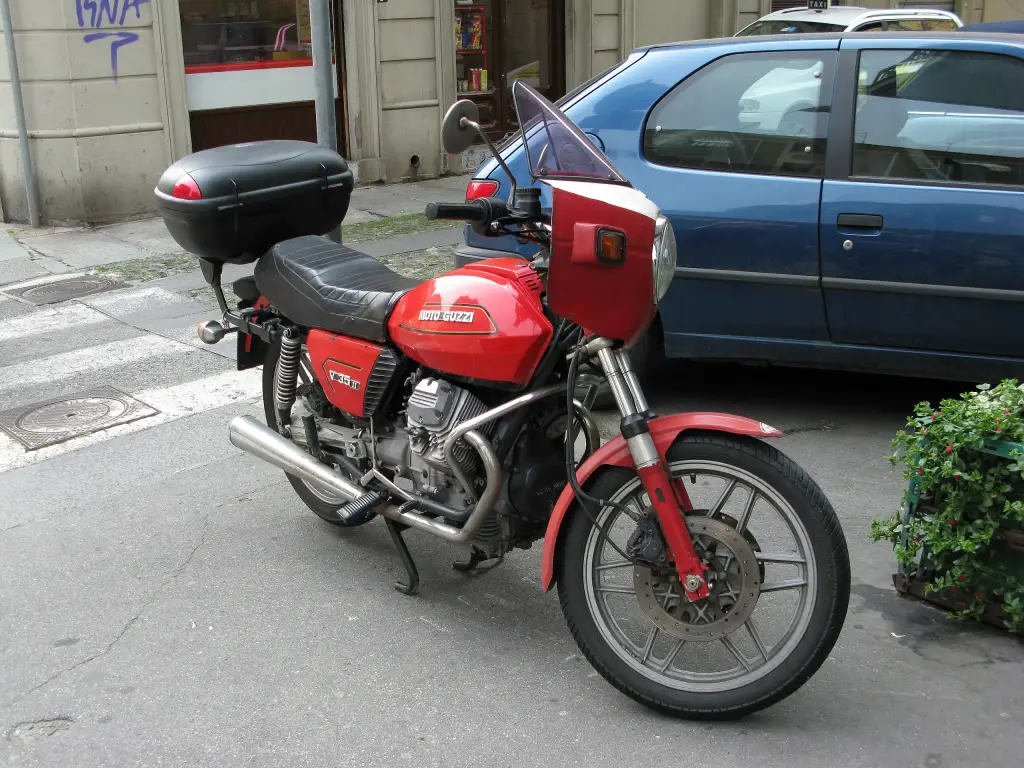
The Moto Guzzi V35 is a motorcycle produced in Italy by Moto Guzzi from 1978 to 1992. It was created in the De Tomaso years, when Italian motorcycling was in crisis and Japanese bikes were gaining ground, by shrinking the V50 into a machine that escaped the taxes of the period and suited new riders.
Moto Guzzi V35 at a glance
| Maker | Moto Guzzi, Mandello del Lario |
|---|---|
| Production | 1978–1992 |
| Engine | 346 cc 90° V-twin, designed by Lino Tonti |
| Frame | built so that several versions could be derived from it |
| Brakes | Brembo |
| Shocks | Sebac, later Paioli |
| Series | V35, V35 II and V35 III |
| Sport version | V35 Imola (1979–1983) and Imola II (1984–1987) |
| Custom versions | V35 C (1983–1988) and Florida (1987–1992) |
| Police version | V35 P.A. (1994–1997) |
The English Wikipedia has no article on the V35; this page is based on the Italian article and is therefore based on one source.
History of the Moto Guzzi V35
At the time the group was led by the Italian-Argentine industrialist Alejandro de Tomaso. In the crisis of Italian motorcycling and the growing success of Japanese bikes, the Moto Guzzi V50 was a machine of quantity rather than quality, yet it sold well, and since its 500 cc capacity was penalised by the remnants of the austerity-era taxes, it was decided to derive a detaxed version from it, also suitable for new riders. Besides the proven design of the Guzzi 90° V-twin of Lino Tonti, this time newly engineered, the frame was built so that several versions could be derived from it, which aroused interest among young riders and others.
The version known as the V35 was a normal road bike with the standard qualities of the period for city riding; it was also called a tourer, as it did not mind long journeys. It was produced in three series, the last two known as V35 II and V35 III, with capacity unchanged at 346 cc. Being a machine of quantity it was very widespread among new riders and among those who would not abandon Italian motorcycle makers or the brand, and it was the bike for people starting to ride or wanting to get about without spending too much and without unnecessary frills. It had Brembo brakes and Sebac shock absorbers, later Paioli. The II was practically built on the V65 frame, while the III was almost completely redesigned with the new shape of the V75 rather than the typical roadster form of the V50 and V65. The three series were made from 1977 to 1985.
Imola, C and Florida
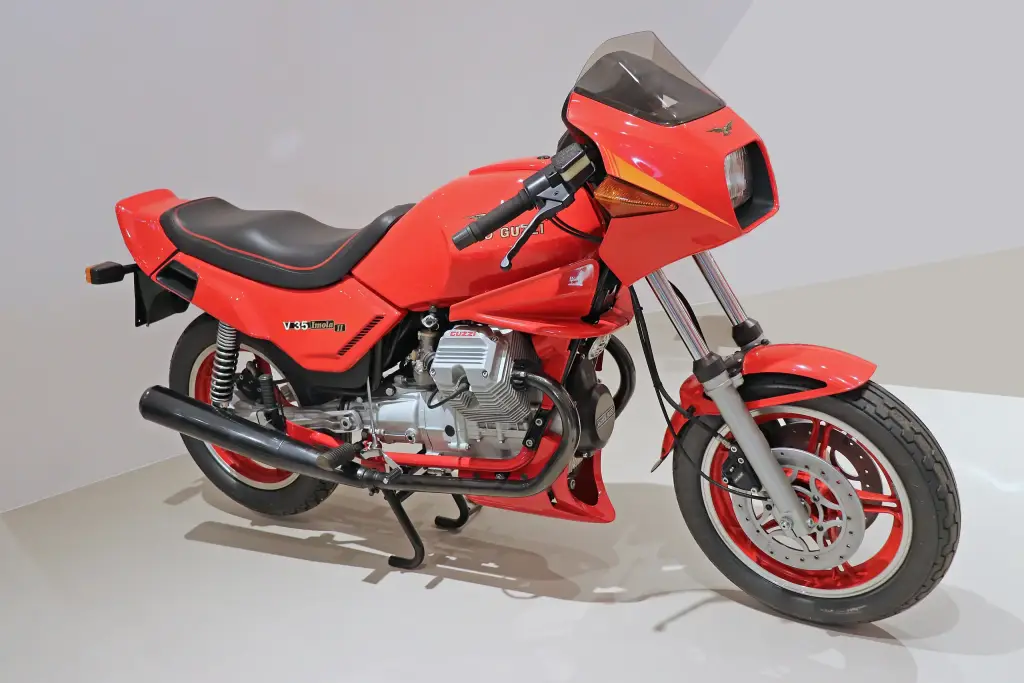
The V35 was not exempt from derivations in the sports field either. The Imola version recalled a famous racetrack, like the 850 Le Mans before it: it was a sporting bike, not excessive, with lines reminiscent of the 850 Le Mans II on the normal V35 frame, and the Imola II took the lines of the 850 Le Mans III. With the arrival of the V65, the factory started from the same frame of the new V35 and V65 series and added tank, belly pan and half fairing aimed at better aerodynamics and lower weight; mechanically the engine changed greatly in the heads and valve gear, the heads now no longer flat and with four valves per cylinder that proved rather delicate, which brought a certain increase in power. The Imola was made from 1979 to 1987, and the V40 Capri was an export version for Japan derived from the Imola II with a capacity of 386.9 cc.
The custom version, the V35 C, had a low seat and long footboards like every respectable custom, a tapered tank similar to the California’s instead of the square one fitted as standard, and was produced from 1983 to 1988; it was an agile and comfortable 350. The Guzzi answer to the Italian custom theme was the Florida, whose footboards were not very far forward but whose seat was designed for the typical riding position, with a tank much more tapered than the Custom’s. It was the smaller sister of the V65 Florida and the cheaper version in equipment, since the 650 had panniers and a screen as standard while on the 350 they were available only at extra cost; it was made from 1987 to 1992 with this name. From 1992 to 1994 the Nevada name was added to the V35, and the second best-selling custom in Italy from 1992 was known simply as the Guzzi Nevada, produced until 2016 with the 750 engine.
The model list also includes the V35 GT of 1987–1990, the V35 NTX of 1987–1991 and the V35 P.A. of 1994–1997 for the public services.
Design and features
- Small-block V-twin: a 346 cc 90° engine designed by Lino Tonti, still the basis of the family.
- For new riders: a detaxed machine aimed at beginners in a period of austerity taxes.
- One frame, many bikes: the chassis was designed from the start to carry different bodywork.
- Imola sportsters: the Imola and Imola II brought Le Mans styling to the small block.
- Custom line: the C and Florida customs led directly to the Nevada.
Moto Guzzi V35 versions
- V35 (1977–1979): the original roadster, in three series up to the V35 II and III.
- V35 II (1980–1985) and V35 III (1985): the II on the V65 frame, the III with the V75 shape.
- V35 Imola (1979–1983) and Imola II (1984–1987): the sporting versions.
- V35 C (1983–1988): the custom version with a tapered tank and low seat.
- V35 Florida (1987–1992): the cheaper sister of the V65 Florida, ancestor of the Nevada.
- V35 GT, NTX and P.A.: touring, off-road and public-service versions of the 1980s and 1990s.
The V35 was the small-block contemporary of the V65 and the 254, and its Florida version led to the Nevada. More machines are in the Moto Guzzi collection.
Video: Moto Guzzi V35 Imola
Video by afroblue1000 on YouTube.
Sources
- Moto Guzzi V35, Italian Wikipedia: origin, series, versions, Imola, C and Florida, model list