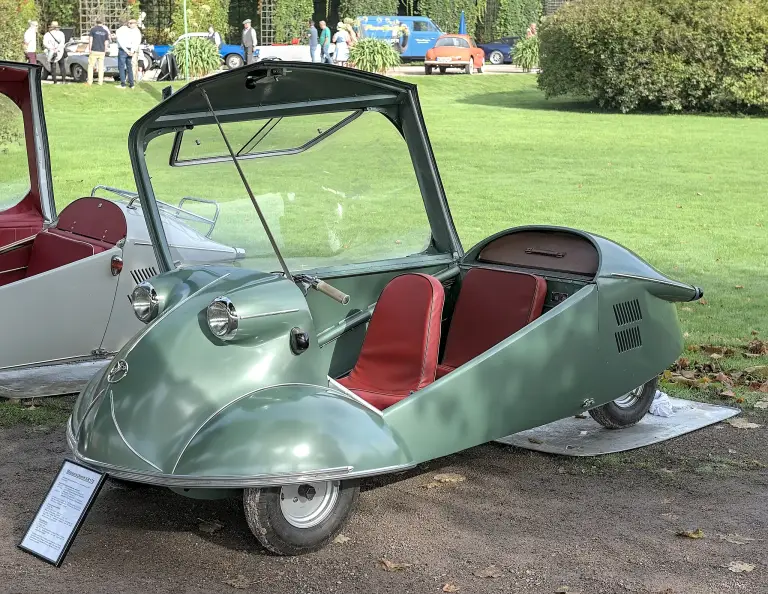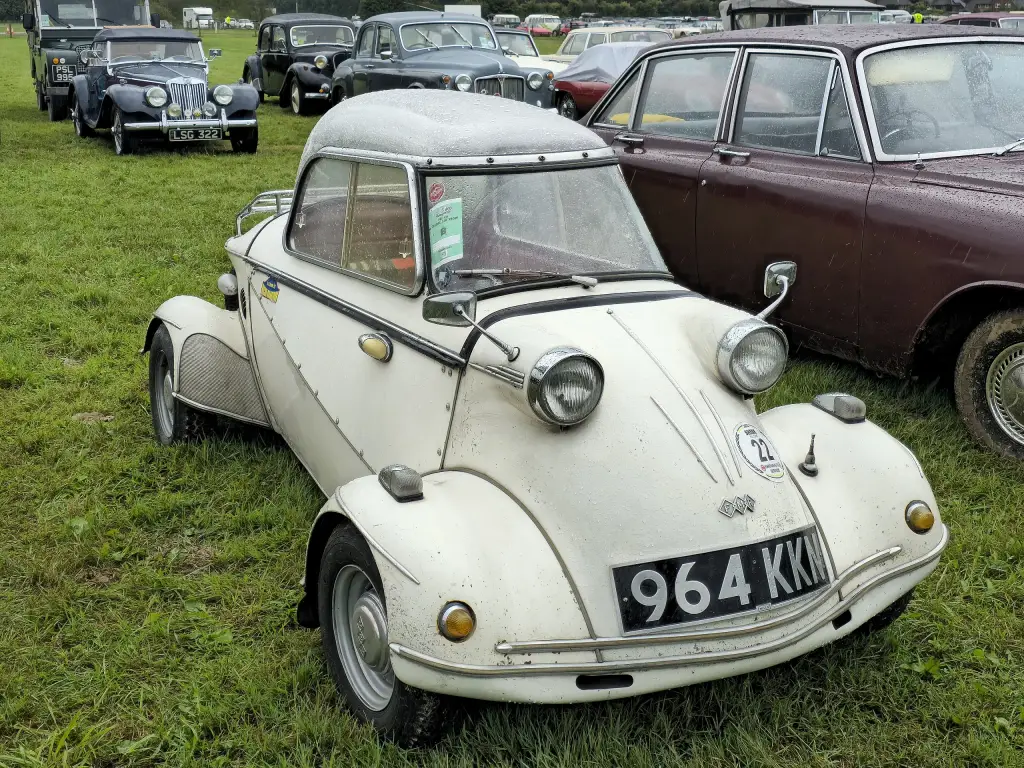
The Messerschmitt KR200, or Kabinenroller — “cabin scooter” — is a three-wheeled bubble car designed by the aircraft engineer Fritz Fend and produced in the factory of the West German aircraft manufacturer Messerschmitt from 1955 until 1964. It replaced the KR175 and became the best-known of the Kabinenroller models, with 30,286 built.
Messerschmitt KR200 at a glance
| Maker | Messerschmitt, later FMR, Regensburg |
|---|---|
| Production | 1955–1964 |
| Designer | Fritz Fend |
| Engine | Fichtel & Sachs air-cooled single-cylinder two-stroke |
| Power | 10 PS (7.4 kW) |
| Layout | three wheels, mid engine, rear-wheel drive |
| Seating | two, in tandem |
| Suspension | hydraulic shock absorbers at all three wheels |
| Tyres | 4.00×8 |
| Top speed | over 90 km/h; about 105 km/h claimed |
| Fuel consumption | 3.2 l/100 km claimed |
| Price | around DM 2,500 |
| Built | 30,286 |
based on one source: the English Wikipedia article on the KR200.
History of the Messerschmitt KR200
Replacing the KR175
Messerschmitt, temporarily barred from aircraft manufacture after the war, had turned to other products, and in 1952 Fend approached the company with the idea of building small vehicles based on his Flitzer invalid carriage. The first to reach production at Regensburg was the KR175; although the Messerschmitt name and insignia were used, a separate company, Regensburger Stahl- und Metallbau GmbH, made and marketed the cars. The KR200 replaced the KR175 in 1955. It used the same basic frame but was otherwise an almost total redesign: the bodywork gained wheel cutouts in the front fenders, the canopy was improved, the rear suspension and engine mounting were reworked, hydraulic shock absorbers went on all three wheels and the tyres grew to 4.00×8.
A success, then a change of owner
Retailing for around DM 2,500, the KR200 was an instant success, with almost 12,000 built in its first year — the highest annual production of any Kabinenroller model. Its maximum speed of more than 90 km/h on a claimed 10 PS, one more than the 175 cc engine of the KR175, reflected low weight and low aerodynamic drag; the KR200 was nevertheless 23 kg heavier than the car it replaced. An Export package added two-tone paint, painted hubcaps, a fully trimmed interior, a heater, a clock and a sunshade for the canopy. In 1956, about a year after West Germany joined NATO, Messerschmitt was allowed to build aircraft again and lost interest in the microcars; it sold the Regensburg works to Fend, who with the brake and hub supplier Valentin Knott formed Fahrzeug- und Maschinenbau GmbH Regensburg (FMR) to carry on production.
Roadster, Kabrio and the end
FMR launched the KR201 Roadster in 1957; it stayed in production until 1964 in very small numbers, with a frameless windscreen, an optional folding cloth roof and removable side curtains of transparent plastic. In February 1958 came the KR200 Kabrio Limousine, with a cloth convertible top and fixed side window frames, and a Sport model followed with a cut-down Plexiglas screen, no roof and fixed side panels, so that the driver climbed in and out over the top; it is the rarest KR200 apart from the Super. Production was heavily reduced in 1962 and stopped in 1964 as demand for basic transport fell away in booming West Germany and in export markets such as Britain, where the Mini was taking over.
Twenty-four hours at Hockenheim
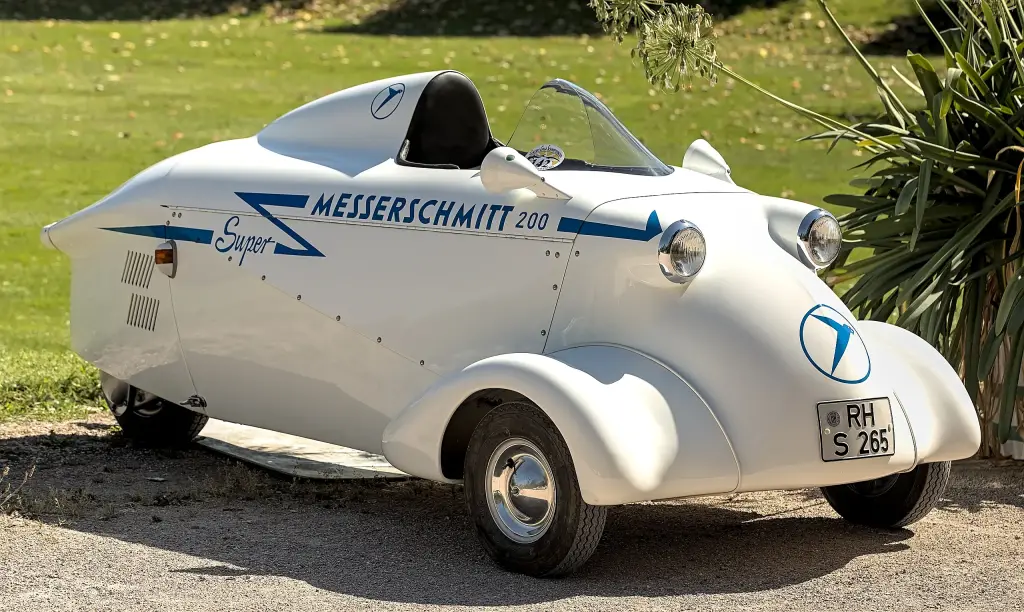
In 1955 Messerschmitt prepared a KR200 to break the 24-hour speed record for three-wheeled vehicles under 250 cc. The record car had a single-seat low-drag body and a highly modified engine, but standard suspension, steering and brakes, with duplicated throttle, brake and clutch cables. It ran for 24 hours at the Hockenheimring on 29–30 August 1955 and broke 22 international records in its class, including the 24-hour mark at 103 km/h.
Design and features
- Bubble canopy: the narrow body, transparent acrylic canopy and low stance were the most obvious features of the Kabinenroller.
- Tandem seating: two seats one behind the other kept the body narrow and allowed it to taper like an aircraft fuselage; it also made a left-hand-drive export version unnecessary.
- Good handling: centralised mass along the longitudinal axis, a low centre of gravity, low weight and wheels at the extremes of the car gave the KR200 sound handling.
- Export package: two-tone paint, painted hubcaps, trimmed interior, heater, clock and canopy sunshade.
- Service Car: a factory conversion for the motor trade with a detachable tow bar and clamp and a revised front suspension; about 12 were built and only one is known to survive.
Messerschmitt KR200 versions
- KR200 (1955–1964): the standard dome-canopy car.
- Export: the option package for foreign markets.
- KR201 Roadster (1957–1964): frameless windscreen, folding cloth roof and plastic side curtains.
- Kabrio Limousine (from February 1958): cloth convertible top with fixed side window frames.
- Sport: cut-down Plexiglas screen, no roof, fixed side panels.
- Service Car: tow-bar conversion for garages, about 12 made.
The KR200 replaced the Messerschmitt KR175 and shared its basic frame. More cars are in the Messerschmitt collection.
Video: 1955 Messerschmitt KR 200 Barn Find & First Drive since 1960
Video on YouTube.
Sources
- Messerschmitt KR200, English Wikipedia: history, FMR, variants, record run, features